
CNC Router Machine Service: How to Choose Before You Commit
This page is for engineers and sourcing managers comparing CNC router machine service quotes. It covers the seven checks that decide whether a shop can actually hold your tolerances, cut your material, and hit your build dates. Read it before you send a PO.
In this article
- 1
- 2
- 3
- 4
- 5
- 6
- 7
- 8
- 9
- 10
- 11
Key takeaways
CNC router service vs. machining center: which fits your part
Use this to decide which process to quote, not which shop is cheaper.
| Criterion | Gantry router | 3/4/5-axis machining center |
|---|---|---|
| Typical part size | Large flat panels, up to 4,000 mm | Compact to medium, 4,000 × 400 × 150 mm max |
| Best shape | Sheet-like, low walls, wide pockets | Deep cavities, angled faces, thin walls |
| Metal tolerance | ±0.05 to ±0.1 mm realistic | ±0.005 mm on stable setups |
| Wood, plastic, foam | Fast and economical | Works, but often oversized for the job |
| Aluminum plate | Good for profile cuts | Better for pockets and bores |
| Steel and titanium | Not recommended | Standard capability |
| Setup cost | Low, vacuum or clamp table | Higher, fixtures and probing |
| Best batch size | 1 to 50 large panels | 1 to 10,000+ parts |
The short version
Pick the machine class before you compare price: a gantry router for large flat parts, a rigid 3/4/5-axis machining center for tight metal work. Then verify tolerance, material grade, setup count, MOQ and lead time in writing.
What a CNC router machine service actually does
A CNC router machine service cuts material with a rotating tool held on a moving gantry or bridge. The work stays flat on a table while the spindle travels in X, Y and Z. That layout suits large, relatively flat parts: enclosure panels, mounting plates, drone frames, sign substrates, vacuum-formed molds and composite trim.
In precision manufacturing the term overlaps with CNC milling. Many shops advertise router capacity but quote the same part on a 3-axis or 4-axis mill because the geometry needs deep pockets or tight bores. Ask which machine will run your job. The answer changes the tolerance you get and the price you pay.
The spindle is the dividing line. A router spindle often spins fast with lower torque, which is fine for aluminum, plastics and wood. Cutting 4140 steel or Ti-6Al-4V needs a rigid machining center with a slower, higher-torque spindle and flood coolant. No amount of programming skill fixes a spindle that cannot push the tool.
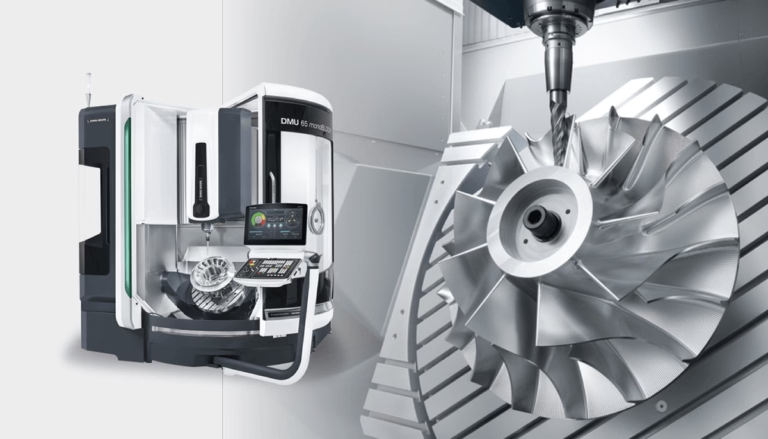
GreatLight runs 127 high-precision CNC machines, including 16 simultaneous 5-axis machining centers, 12 four-axis mills, 27 three-axis machines and 16 mill-turn centers. Maximum processing size is 4,000 mm. If your part is a 2 m aluminum plate with a few profile cuts, we quote it on the right machine, not the biggest one.
- 1Router-friendlyFlat panels, plaques, housings with shallow pockets, plastic and composite trim.
- 2Milling-friendlyParts with deep cavities, tight bore tolerances, angled faces or threaded holes.
- 3Send a STEP fileIt removes guesswork about which machine can reach every feature.
Check 1: Can the shop hold the tolerance you put on the drawing
Tolerance is the fastest way to separate real capability from marketing copy. A light router with a bolted gantry might hold ±0.1 mm on a good day. A rigid machining center with thermal compensation holds ±0.005 mm across a production run. Both may be called CNC router machine service online.
Put the tightest callout on your drawing in front of the supplier and ask how they measure it. The answer should name the instrument: micrometers, bore gauges, CMM, height gauge. If the reply is vague, the tolerance is aspiration, not capability.
Surface finish follows the same logic. As-machined surfaces land around Ra 1.6–3.2 μm. A high-quality finish sits at Ra 0.8–1.6 μm. Fine finishing reaches Ra 0.2–0.8 μm. Tell the shop which faces need the fine finish. Polishing every face adds cost with no functional gain.
GreatLight inspects 100% of parts before shipment and can supply raw material checks, in-process monitoring and final reports on request. Ask for the report format early so it matches your incoming inspection.
- 1Ask for a numberWritten tolerance in mm or inches, not 'high precision'.
- 2Name the gaugeA shop that measures can tell you what it measures with.
- 3Flag critical facesFine finish only where the drawing calls for it.
Check 2: Material coverage tells you the machine class
The material list on a supplier page is a rough map of its equipment. Shops that cut only wood, foam and acrylic usually run light gantries. Shops that list 7075 aluminum, 17-4PH stainless and Ti-6Al-4V need rigid machines and the tooling to match.
GreatLight machines aluminum grades 6061, 6061-T6, 2024, 5052, 5083, 6063, 6082, 7075 and ADC12. Stainless covers 303, 304, 316, 316L, 420, 430, 431, 440C and 17-4PH. Steel includes 1018, 1045, 4130, 4140, 4340, A36 and tool steel. Copper and brass range from C101 to C36000.
Titanium and superalloys are available as TA1, TA2, TC4 (Ti-6Al-4V), Inconel and magnesium AZ31B or AZ91D. Plastics cover ABS, PC, PMMA, POM, PA, PEEK, PP, HDPE and carbon fibre.
Match the material to the process before you compare price. A quote for 7075 aluminum implies a different machine and tool path than a quote for MDF. If two quotes differ by 3× for the same material and geometry, one of them is not planning to run it the way you expect.
Check 3: What a useful quote must include
A price alone is not a quote. For router or milling work you need the machine class, the tolerance the shop will hold, the material stock form, the finish, the inspection method, the lead time and the MOQ. Ask for all seven in writing.
DFM feedback is the proof that someone looked at your file. A useful response flags thin walls, deep pockets that need long tools, tight corners that need smaller end mills, and features that force a second setup. GreatLight returns a quotation and free DFM analysis within 12 hours.
Setup count drives cost more than cycle time on low-volume work. A part that machines in five minutes but needs three fixtures will cost more than a part that runs for twenty minutes on one vise. Ask how many setups your part needs.
Watch for quotes that assume one material grade but price another. Ask which stock size is being cut from. Plate thickness affects both cost and how much material gets removed.
- 1Seven inputsMachine, tolerance, stock, finish, inspection, lead time, MOQ.
- 2Setup countEach additional fixture adds cost and a new alignment error source.
- 3DFM notesIf there are no comments on the file, nobody reviewed it.
Check 4: Lead time, MOQ and how the shop schedules
Lead time promises are easy to make and hard to verify. Ask what happens between the PO and the first chip. A shop that can start production within 24 hours usually has open capacity and material on the shelf. A shop that needs two weeks to start is batching your job behind other work.
GreatLight quotes within 12 hours, can start production within 24 hours, and ships parts in 3–5 days. Historical late-delivery probability is below 2%. Those numbers are useful only if the shop tracks them, so ask how they measure on-time delivery.
MOQ matters for prototypes and bridge builds. GreatLight has no minimum order quantity and runs from one prototype to 10,000+ part runs. That removes the common trap where a supplier quotes a low unit price but forces a 500-piece minimum.
For repeat work, ask how the shop stores your program and fixtures. Re-setup from scratch every order adds days and reintroduces variation. Stored programs and dedicated fixtures keep the second run aligned with the first.
Check 5: Certifications and inspection that match your industry
Certificates are not decoration. They tell you which quality system the shop already runs, which shortens the audit you have to do yourself. ISO 9001:2015 covers general manufacturing. IATF 16949:2016 is the automotive standard. ISO 13485:2016 applies to medical devices, and ISO 27001:2022 covers information security for your design files.
Match the certificate to the part. A general industrial bracket does not need IATF paperwork, and asking for it can add cost. A medical housing does need ISO 13485 traceability. State the requirement in the RFQ so the shop prices the correct level of documentation.
GreatLight holds all four: ISO 9001:2015, IATF 16949:2016, ISO 13485:2016 and ISO 27001:2022. We run raw material checks, in-process monitoring and final inspection before shipment, with a qualification rate of 99.99%.
Confidentiality is part of the same conversation. Uploads are kept secure, and an NDA is available on request. If your drawing is under NDA with your own customer, ask the shop to sign before you release the file.
Check 6: Warning signs in a router service quote
The clearest red flag is a tolerance claim without a measurement method. If a shop promises ±0.01 mm on a gantry router cutting a 2 m panel, ask how they verify it across that length. Thermal drift and gantry sag make the claim unlikely on that machine class.
The second is a price that ignores setup. Very low quotes on one-off parts often assume simple 2D profile cutting. If your part has pockets, bores or threads, the price will change after the PO. Get the setup count and machine class in writing.
The third is silence on material grade. Aluminum is not one material. 6061 and 7075 machine differently, finish differently and behave differently under load. A quote that says 'aluminum' without a grade is incomplete.
Finally, watch for finish promises that do not match the process. Anodizing color varies with alloy and surface prep. Laser marking has a minimum character height of 1.5 mm. If the quote promises a crisp 0.5 mm logo on a rough as-machined face, the finished part will not match the render.
- 1Tolerance without a gaugeA number you cannot verify is a number you cannot rely on.
- 2No setup breakdownLow quotes on complex parts usually change after the PO.
- 3Missing material grade6061 and 7075 are not interchangeable.
Check 7: Secondary operations and finishing
Machining is often half the job. Anodizing, plating, powder coating and laser marking all affect fit and appearance after the part leaves the machine. Ask whether finishing is done in-house or subcontracted, and who owns the schedule risk.
GreatLight offers anodizing in clear, color, hardcoat and conductive types; electroless nickel, zinc, silver and gold plating; powder coating and black oxide; bead blasting, tumbling, brushing and polishing; plus laser marking and engraving with a minimum character height of 1.5 mm.
Finishing changes dimensions. Anodizing builds a thin oxide layer. Hardcoat runs thicker. Powder coating can add 0.05–0.1 mm per face. If a bore or thread must stay on size, mask it before finishing and say so on the drawing.
Sequence matters too. Machining a critical bore after coating removes the coating. Coating after machining leaves the bore undersized. Decide which feature is the datum and tell the shop the order of operations you expect.
How to run a CNC router machine service job without surprises
Seven steps from RFQ to receiving inspection.
- 1Send a STEP file with the 2D drawingInclude material grade, tolerance block, finish callouts and critical features. STEP shows geometry; the drawing shows intent.
- 2State the tightest tolerance and where it appliesMark the datum and the critical faces. Do not leave the whole part at ±0.005 mm unless every face needs it.
- 3Ask which machine will run the partRouter, 3-axis, 4-axis, 5-axis or mill-turn. The answer sets the achievable tolerance and the price.
- 4Request DFM feedback with the quoteLook for comments on thin walls, deep pockets, tool reach and required setups. No comments means no review.
- 5Confirm MOQ, lead time and setup countOne prototype to 10,000+ parts is possible when the shop carries no minimum order quantity. Ask how many fixtures the job needs.
- 6Fix the finishing sequence before productionMask bores and threads that must stay on size. Confirm anodizing type or coating thickness.
- 7Agree on inspection reports before shipmentDecide which dimensions get measured and in what format. 100% inspection is standard; reports come on request.
Frequently asked questions
Is a CNC router machine service accurate enough for metal parts?
It depends on the machine class, not the name. A light gantry router holds roughly ±0.05 to ±0.1 mm on aluminum profile work. A rigid machining center holds ±0.005 mm on stable setups.
If your drawing calls for tight bores or flatness across a long part, ask for the machine model and the measurement method before you accept the quote.
What is the largest part you can machine?
Maximum processing size is 4,000 mm, with a large travel envelope of 4,000 × 400 × 150 mm. Medium machines cover 750 × 1,150 × 550 mm and 600 × 600 × 600 mm.
Compact work runs on 500 × 500 × 450 mm and 500 × 310 × 200 mm machines, with a Ø400 mm rotary table for 4-axis work.
Do you have a minimum order quantity?
No. GreatLight runs from one prototype to 10,000+ part runs. That covers first-article samples, bridge tooling and production volumes on the same program.
For repeat orders, ask about program and fixture storage so the second run matches the first.
How fast can I get a quote and parts?
Quotation and free DFM analysis come back within 12 hours. Production can start within 24 hours, and parts ship in 3–5 days.
Historical late-delivery probability is below 2%. Lead time still depends on material availability and finishing, so confirm both at RFQ.
Which materials can you cut?
Aluminum grades 6061, 6061-T6, 2024, 5052, 5083, 6063, 6082, 7075 and ADC12; stainless 303, 304, 316, 316L, 420, 430, 431, 440C and 17-4PH; steels 1018, 1045, 4130, 4140, 4340, A36 and tool steel.
Also copper and brass from C101 to C36000, titanium TA1, TA2 and TC4 (Ti-6Al-4V), Inconel, magnesium AZ31B and AZ91D, plus ABS, PC, PMMA, POM, PA, PEEK, PP, HDPE and carbon fibre.
How do you handle my design files?
Uploads are kept secure and confidential. An NDA is available on request before you release files.
ISO 27001:2022 covers information security, which matters when your drawings sit under an NDA with your own customer.
Send your drawing, get a real answer
Upload a STEP file and we return a quotation with free DFM analysis within 12 hours, plus the machine class and tolerance we will hold.
12-hour quoteNo MOQ100% inspection
GreatLight on social
We publish setup notes, tooling trials and inspection data from the factory floor.











