
69 yuan gram mohou: what the yellow-green resin actually buys you
Mohou.com added an economical yellow-green resin at 69 yuan per gram, positioned as a harder, stronger SLA ABS-class material. This page covers what that price point changes for prototype work, what the resin can and cannot do, and when a machined or cast part is the better call. Written for design engineers and sourcing engineers who have to pick a process, not a slogan.
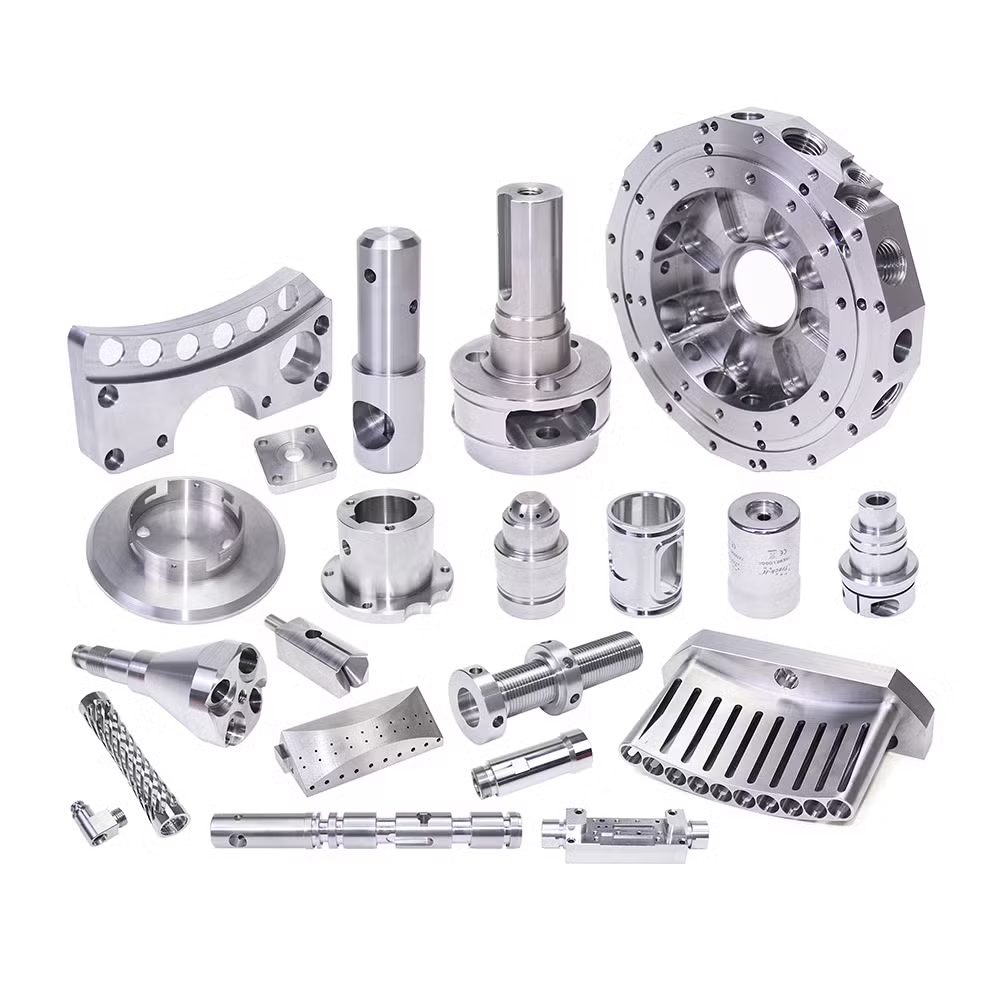
Where this material sits in a prototype program
Resin pricing is only one line in the cost of a prototype. The other lines are post-processing, fit checks, and how many revisions you need before the design freezes.
What the yellow-green resin is, and what it is not
Mohou.com lists this material at 69 yuan per gram, which puts it in the economical band of stereolithography resins. The color is yellow-green, and the vendor describes it as an ABS-class resin with precise, durable properties. In practice that means it cures harder and stronger than the standard white resin many shops run as a default, while giving up some toughness.
That trade-off matters more than the headline number. A part that survives a drop test in white resin may crack in the yellow-green grade, because toughness and hardness pull against each other in most photopolymers. Buy the material when you need stiffness and dimensional stability, not when you need impact resistance.
One more limit: SLA resins are not production plastics. They creep under sustained load, they are sensitive to UV, and they soften with heat. Treat any resin part as a short-life tool, not as a stand-in for ABS, PC, or POM in the field.
Reading the 69 yuan gram mohou price correctly
The unit is yuan per gram, not per part. A small bracket printed in 5 g of resin costs about 3.5 yuan in material, which is close to nothing. The same bracket in 200 g costs roughly 138 yuan. So the label tells you the material rate; the part geometry and the support structure tell you the real bill.
Support material, build orientation, and hollowing drive that gap. A tall, thin part with dense supports can consume 30-50% of its resin volume in structure that gets thrown away. A well-oriented, hollowed part wastes far less. If you are comparing quotes across suppliers, ask whether the quoted figure includes supports and post-curing.
There is a second cost question engineers usually skip. What is the hourly rate of the machine, and how long does your part occupy the build platform? On a full platform shared with other jobs, the material rate dominates. For a single large part that ties up the machine overnight, machine time dominates and the 69 yuan gram mohou rate stops being the deciding factor.
Resin vs. machined vs. cast prototype
Rough process fit for early-stage parts. Material cost is one input; geometry, tolerance, and quantity decide the rest.
| Criterion | SLA resin | CNC machined | Vacuum cast |
|---|---|---|---|
| Best part size | Small to medium | Up to 4,000 mm | Small to medium |
| Tolerance | Layer-limited | ±0.005 mm | Mold-limited |
| Surface as delivered | Layer lines | Ra 0.8–1.6 μm | Near mold finish |
| Material realism | Photopolymer | Real alloy or plastic | Urethane, shore tunable |
| Tooling needed | None | None | Silicone mold |
| Cost driver | Resin volume | Machine time | Mold count |
| Good for | Concept, form, fit | Function, load, threads | 10-50 units |
| Weak at | Heat, UV, creep | Thin walls, deep pockets | Sharp edges, tight tol. |
When to print in yellow-green resin, and when to stop
Pick the resin when the question is shape. Concept models, master patterns for a later mold, housings that only need to sit on a bench and show proportions, and fixtures that hold a sensor once during a build review. These parts do not carry load, do not see heat, and do not need a thread that survives repeated assembly.
Move to machining when the part has to answer a mechanical question. A bracket that must hold 40 N without flexing, a housing with a Ø6 H7 bore, a plate with 0-80 tapped holes, a heat sink that sits near a motor. Machined 6061-T6 or 7075 gives you the real modulus and the real thread strength, and ±0.005 mm on the features that mate.
There is a middle path that often beats both. Print the shell in resin to check the look and the cable routing, then machine only the load-bearing inserts and bond or screw them in. You get a fast visual and a real mechanical interface, and you skip the cost of machining the whole envelope.
Watch three signals that say the resin part has outlived its usefulness. The first is creep: a part that slowly bends under a constant spring load. The second is heat: anything above roughly 60 °C in service. The third is a tolerance stack that no longer closes after the third revision. At that point, more resin iterations just buy more scrap.
From resin model to a machined part: what to send
The step that decides your second-round cost is the file you send. A resin model exported as STL loses the feature intent: holes become faceted, thin walls get rounded, and a nominal Ø6 bore arrives at Ø5.8. Send the original CAD in STEP or Parasolid, plus a drawing for anything with a tolerance, thread callout, or surface finish.
Say which features are functional and which are cosmetic early. A block that looks like a housing to a machinist is a 40-minute job if the bores are clearance holes and a 4-hour job if two of them are bearing seats. That single sentence changes the quote more than the material choice does.
At GreatLight we run prototypes from one piece up to 10,000+ part runs on 127 high-precision CNC machines, including 16 simultaneous 5-axis centers and 16 mill-turn centers. Quotation and free DFM analysis come back within 12 hours, and production can start within 24 hours. Uploads stay confidential, and an NDA is available on request.
If the resin model was right and the part now needs to be metal, we can usually hold the same datums and add the tolerance the resin could not. That is the whole point of keeping the CAD clean through the early iterations.
Questions engineers ask after the price
Is 69 yuan per gram cheap for SLA resin?
It sits in the economical band for ABS-class stereolithography resin. Standard white resin and engineering grades usually cost more per gram, and castable or high-temperature grades cost noticeably more.
Per gram is not per part. Compare suppliers on the delivered part price, including supports, cleaning, and post-curing, not on the resin rate alone.
Which parts should not be printed in this resin?
Anything that sees sustained load, service temperature above roughly 60 °C, or long UV exposure. Snap fits, living hinges, and press-fit inserts will fail earlier than they would in a real thermoplastic.
Threads below M3 in resin strip after a few assembly cycles. Design them as through-holes and use a metal insert or a machined mating part.
Can I use a resin model as a master for a silicone mold?
Yes, but plan the finish. Layer lines transfer to the mold surface and then to every cast part. Sand the master and seal it before molding, or print it at a fine layer height.
Resin masters also shrink slightly during post-curing. If the cast part has a critical bore, add the tolerance on the machined side rather than on the master.
How do I decide between resin printing and CNC for the same part?
Ask what the part has to prove. If it proves shape, print it. If it proves stiffness, thread strength, or a mating tolerance, machine it.
A useful rule: one or two physical checks belong on a printed part, three or more belong on a machined one. Past that point the printed part stops answering the question.
What tolerance should I expect from a machined replacement?
GreatLight machines to ±0.005 mm (±0.0002 in) on critical features, with surface finish from Ra 1.6–3.2 μm as machined down to Ra 0.2–0.8 μm when specified.
We inspect 100% of parts before shipment and can supply inspection reports. Raw material check, in-process monitoring, and final inspection are part of the standard flow.
Do I need to order a minimum quantity?
No minimum order quantity. We run from one prototype to 10,000+ part runs, so a single machined insert for a printed housing is a normal order.
Parts typically ship in 3–5 days after production starts, and the historical late-delivery probability is below 2%.
Send the CAD, get a real number
Upload your STEP file and we will return a quotation plus a free DFM analysis within 12 hours. One part or ten thousand, the same flow applies.
12-hour quote±0.005 mm100% inspectionNDA on request









