
Why do you know at a glance that this is a 5-axis CNC machining equipment?
Most people misread a 5-axis machine as a 3-axis mill with a fancy rotary table. That mistake costs time on the shop floor and money on a wrong quote. This guide walks through the six visual clues an engineer can check in under a minute, from spindle orientation to chip evacuation layout.
In this article
- 1
- 2
- 3
- 4
- 5
- 6
- 7
- 8
Symptom, cause, and what to do
Match the symptom on the left to the cause in the middle, then apply the fix on the right.
| Symptom you see | Likely cause | How to handle it |
|---|---|---|
| Spindle tilts while table also rotates | True simultaneous 5-axis motion | This is genuine 5-axis CNC machining equipment |
| Only the table tilts, spindle stays vertical | 3+2 positioner, not full 5-axis | Check controller axis count before quoting |
| Turret has two rotary axes stacked | Trunnion cradle design | Confirm both axes are interpolated, not indexed |
| Controller shows X Y Z A B or C | Fifth axis is configured | Read the axis page to confirm live motion |
| Tool sticks out far to reach 5 sides | Wrong setup for a 3-axis mill | Re-fixture or move the job to a 5-axis cell |
| Chips pile under the part center | Gravity-fed 5-axis layout | Expect better access and shorter cycle time |
| Scars on the part near a rotary joint | Tool holder rubbing a fixture | Recheck the post-processor and stock model |
Spot it in the first minute
If the spindle tilts and the table rolls at the same time, you are looking at 5-axis CNC machining equipment. Anything less is a positioner, and it should be quoted that way.
Spindle and table motion on real 5-axis CNC machining equipment
The fastest check is watching the spindle and the table at the same time. On a 3-axis mill the spindle stays vertical and the part sits still. On a 5-axis machine at least two of the three rotary axes move while the cut is running. If you see the spindle tilt to 30° and the table roll on a separate axis in the same second, you are looking at simultaneous motion.
Many people confuse this with a 3+2 positioner. A positioner tilts the part to an angle and locks it, then cuts with three axes. That is fine for drilling five faces, but it does not interpolate. Watch the handwheel display or the axis page on the controller. If A and B are changing while X, Y and Z are also moving, the machine is doing true 5-axis work.
One caveat: some builders fit a tilting head to a 3-axis bed and call it 5-axis. The giveaway is the fifth axis. Count the live axes on the screen. Three linear plus two rotary equals 5-axis. Three linear plus one rotary is a 4-axis machine, no matter what the badge says.
Trunnion geometry and the Ø400 mm table
Look under the part. A trunnion cradle holds the workpiece between two rotary axes: one tilts the cradle, the other spins the table. That stack is hard to fake. On a 3-axis mill you see a flat table with T-slots. On a trunnion machine you see a U-shaped frame, a round table sitting inside it, and a rotary union feeding coolant or air to the fixture.
Table size tells you what the machine can hold. A Ø400 mm rotary table is common on compact 5-axis centers and suits parts up to roughly 400 mm across. Larger trunnions take bigger work, but they also swing the part through a bigger envelope, so watch for clearance between the part and the enclosure walls.
The cradle also changes chip flow. Chips fall away from the cut zone instead of piling on a flat table. That single detail often shows up as better surface finish on deep pockets, because the tool is not recutting chips.
Controller layout and axis readout
Walk to the control panel. A 5-axis machine shows five live axis positions, usually labelled X, Y, Z plus two of A, B or C. If the screen only lists X, Y and Z, the machine is a 3-axis mill. If it lists four, it is a 4-axis machine with a single rotary.
Check the feed rate display while a program runs. Simultaneous 5-axis motion means the controller is solving inverse kinematics in real time. That shows up as slightly varying feed on the linear axes even when the programmed feed is constant. A 3+2 machine holds a steady feed because the rotary axes are locked.
Also look for a collision-check page or a stock-model view. Most simultaneous 5-axis controllers ship with one. It is not proof on its own, but combined with the axis count it is a strong signal.
Tooling, ATC and reach on 5-axis CNC machining equipment
Open the tool magazine. On a 5-axis machine you often see long, slender tool holders and extended reach end mills. That is because the spindle has to reach into pockets from an angle, and a short tool cannot get there without the holder hitting the part. Long holders reduce rigidity, so machinists compensate with lighter cuts and higher spindle speed.
Look at the ATC arm travel. A 5-axis cell usually keeps the tool change path clear of the trunnion, which means a longer swing or a different arm shape. If the magazine sits directly above a flat table, you are probably looking at a 3-axis mill.
Finally, check the coolant nozzles. On simultaneous 5-axis machines the nozzles often follow the spindle through a programmable ring, so they stay aimed at the cut as the head tilts. Static nozzles on a fixed block are a sign of a simpler machine.
Part features that only 5-axis CNC machining equipment can hold
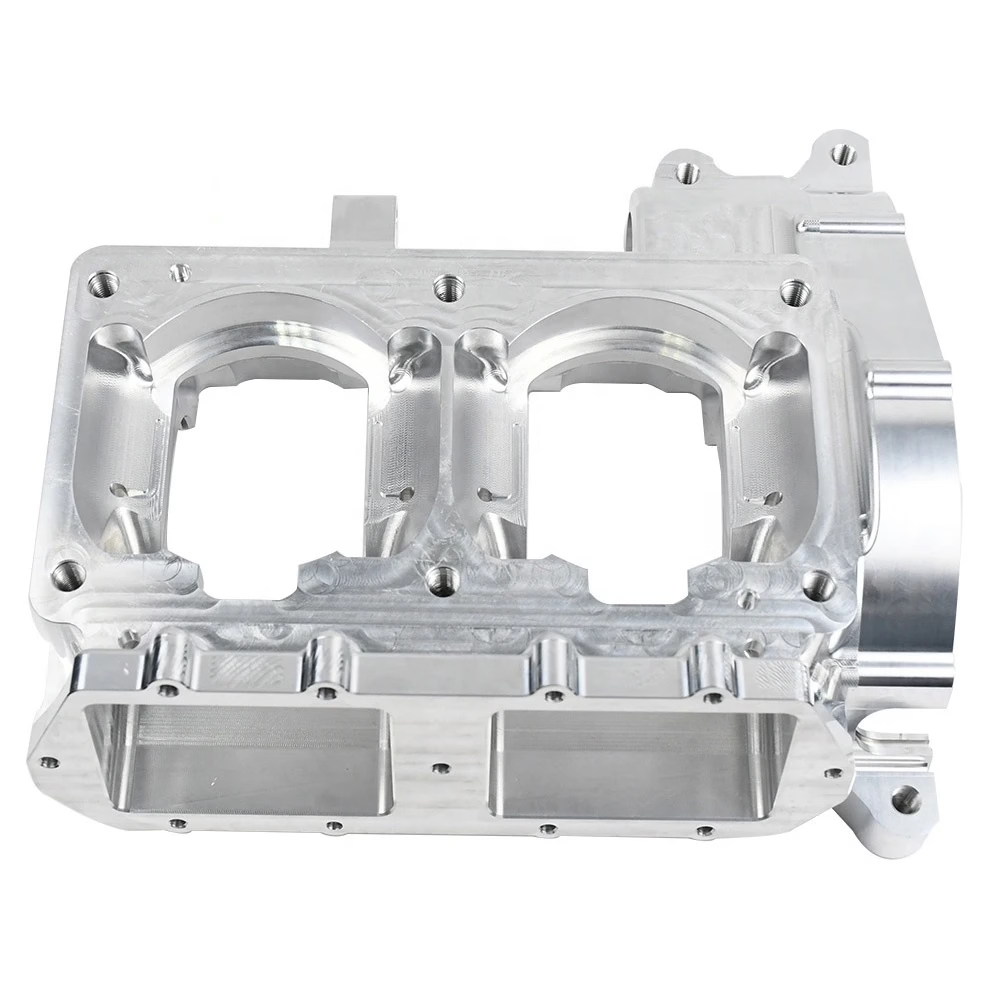
Some part geometry is a dead giveaway. Impellers with twisted blades, medical bone plates with compound curves, and engine blocks with angled oil galleries all need the tool to approach from many directions in one setup. If the part in the vise has features on five faces and no visible re-fixture marks, the machine that cut it was 5-axis.
Look for witness marks. A 3-axis mill needs the part unclamped and turned between operations. That leaves small burrs, tool marks or slight steps at the datum edges. A 5-axis machine cuts those faces in one pass, so the blend lines run continuously across the part.
Tolerance is another tell. Holding ±0.005 mm across features on multiple faces is very hard when you re-fixture. If the drawing calls for that tolerance and the part shows no setup breaks, the shop used simultaneous 5-axis motion.
When a machine is not what it looks like
Not every machine with a rotary table is true 5-axis. A 4-axis mill with a single rotary on the table can cut four faces, but it cannot tilt the tool relative to the part. That limits undercut features and deep pockets with curved walls.
A 3+2 positioner is a useful middle ground. It indexes the part to a fixed angle, then cuts with three axes. It is faster to program and cheaper to run than simultaneous 5-axis, and for many prismatic parts it is the right choice. The mistake is calling it 5-axis when quoting, because the cycle time and setup count are different.
If you are unsure, ask for the axis count on the controller and a sample program. A shop that runs real 5-axis equipment will show you the axis page without hesitation. A shop that only has 3+2 will usually steer the conversation toward price.
How to confirm a 5-axis machine in six steps
Do these in order. The first three take under a minute.
- 1Watch the cut for 30 secondsStand where you can see the spindle and the table. If both tilt while X, Y and Z move, the machine is simultaneous 5-axis. If only the table moves, it is a positioner.
- 2Read the axis pageCount the live axes. Five live axes means 5-axis. Four means 4-axis. Do not accept a badge as proof.
- 3Look under the partA trunnion cradle with a round table inside it is the clearest hardware sign. A flat T-slot table is not 5-axis on its own.
- 4Check the tool magazineLong, slender holders and extended reach tools point to 5-axis work. Note the maximum tool length the ATC can hold.
- 5Inspect the part for setup marksContinuous blend lines across five faces mean one setup. Steps and burrs at datum edges mean the part was re-fixtured.
- 6Ask for a sample programRequest the G-code and the axis readout. A real 5-axis shop will share the kinematics page and the stock model without delay.
Questions engineers ask about 5-axis equipment
Can a 4-axis mill cut five faces of a part?
Yes, but not in one setup. A 4-axis mill has three linear axes and one rotary, so the part can spin but the tool cannot tilt. To reach the fifth face you unclamp and re-fixture, which adds setup time and tolerance stack-up.
If the part has features on five faces and the tolerance is tight, plan for 5-axis equipment instead. The extra cost per hour is usually smaller than the cost of two extra setups.
Is a 3+2 positioner the same as 5-axis?
No. A 3+2 positioner uses two rotary axes to tilt the part to a fixed angle, then locks them and cuts with three linear axes. The machine has five axes of motion, but it does not interpolate all five at once.
For prismatic parts with flat faces, 3+2 is often faster and cheaper. For impellers, blisks and organic surfaces, you need simultaneous motion.
What tolerance can 5-axis CNC machining equipment hold?
On a well-maintained machine with a temperature-controlled shop, ±0.005 mm is realistic for critical features. Surface finish can reach Ra 0.2–0.8 μm with the right tool and finishing pass.
The limit is usually thermal growth on long cuts, not the machine geometry. Keep the roughing and finishing passes in the same setup to reduce error.
How do I know if a shop really has 5-axis capability?
Ask three things: the axis count on the controller, a sample program with the kinematics page, and a part photo with no setup marks on five faces. A shop with real 5-axis equipment answers all three quickly.
A shop without it will talk about price or lead time instead. That is your signal to look elsewhere.
Does 5-axis always cost more than 3-axis?
The hourly rate is higher, but the total job cost can be lower. One 5-axis setup replaces two or three 3-axis setups, and the tolerance stack-up is smaller. For complex parts the break-even point often arrives by the second or third face.
For simple prismatic parts, 3-axis is still the better choice. Match the machine to the geometry, not the other way around.
What part size fits a typical 5-axis center?
A Ø400 mm rotary table handles parts up to roughly 400 mm across. Larger trunnions take bigger work, and some machines reach 4,000 mm in one axis for long parts.
Always check the swing envelope, not just the table size. A large part can hit the enclosure wall when the cradle tilts.
Send us a part with features on five faces
Upload your STEP file and we will tell you whether it needs simultaneous 5-axis motion or a simpler setup. Quotation and free DFM analysis within 12 hours.
12-hour quote100% inspectionNo MOQNDA on request
More machining notes
We publish setup notes, tooling trials and inspection data from the factory floor.











