
What Is Vacuum Injection Molding and What Products Suit It?
Vacuum injection molding, also called vacuum casting, pulls resin into a silicone mold under negative pressure to copy a master model. This article explains the mechanism, the size and geometry limits, and the part types where it makes sense.
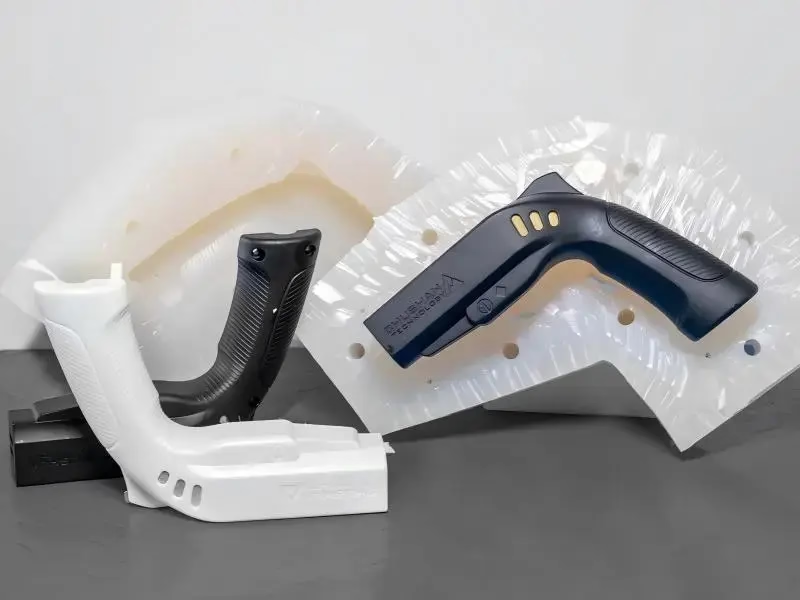
How vacuum injection molding actually works
The process starts with a master model. That model can come from CNC machining, 3D printing, or an existing production part. A two-part silicone mold is cast around it, then cut open and the master is removed. The cavity keeps the surface texture of the master down to fine detail, which is why the first copy looks like the original.
With the mold closed, liquid polyurethane resin is poured into the cavity while the chamber is pumped down to roughly 1–5 mbar. Air trapped in corners and undercuts escapes before the resin fills it. Without the vacuum, that same pocket of air would stay as a bubble on the finished surface.
After the resin cures, the mold is opened and the part is demolded. Silicone is flexible, so thin walls and undercuts come out without draft angles that steel tooling would require. Cure time depends on the resin system, typically 30–60 minutes at room temperature, faster in an oven.
The cycle repeats until the silicone degrades. A well-made mold gives roughly 25–50 shots before the cavity surface goes dull and dimensions drift.
- 1Vacuum level1–5 mbar removes trapped air before resin fills fine features.
- 2Mold lifeAbout 25–50 shots per silicone mold.
- 3Master reuseOne master can produce several molds for parallel runs.
Why the master model decides the outcome
Vacuum injection molding copies whatever you give it. Roughness on the master shows on every shot. If the master comes off a 5-axis CNC machine, the tool marks transfer directly into the silicone and then into the cast part. That is usually acceptable for a housing or a cover, but not for a part that needs an optical surface.
For a smooth master, we machine it, then hand-polish or bead blast it before the silicone is poured. A master at Ra 0.8–1.6 μm produces cast parts close to that finish. A master left as-machined at Ra 1.6–3.2 μm transfers visible texture.
Resin shrinkage is the other variable. Polyurethane systems shrink between roughly 0.1% and 0.8% depending on the grade. That is a real dimensional offset, so a vacuum cast part is rarely the right choice when a tolerance tighter than about ±0.1 mm matters. For those, keep the part on a CNC machine and use vacuum casting only for fit checks.
Master material also matters. A machined aluminum or a printed resin master holds up for several molds. A soft master can deform during the silicone pour if the mold box is not supported properly.
- 1Master surface sets final surfacePolish before molding if the visible face matters.
- 2Shrinkage 0.1–0.8%Compensate in the master if the dimension is critical.
- 3Tolerance floorVacuum casting holds about ±0.1 mm, not ±0.005 mm.
Which part shapes vacuum casting handles well
Thin walls are where this process earns its place. Silicone flexes, so a wall of 0.8–1.5 mm fills cleanly under vacuum, while a steel mold would need higher pressure and a more careful gate. Enclosures, covers, and snap-fit housings fall into this group.
Undercuts and internal threads are another strength. The mold is cut open along a parting line, so a hook or a barb comes out without a side action. That saves tooling cost and lead time.
Insert molding is straightforward. Metal bushings, threaded inserts, or magnets can be placed in the cavity before the pour, and the resin locks around them. This is common for mounting bosses in prototype enclosures.
What does not work well: very long flat parts, because the silicone sags; parts with tight flatness or concentricity callouts, because shrinkage is uneven across thick and thin sections; and parts that must pass a drop test at production wall thickness, because the cast resin is not the final production material.
- 1Good fitThin walls, undercuts, inserts, textured surfaces.
- 2Poor fitTight flatness, long flat spans, high-load structural parts.
Resins and the properties they can mimic
Vacuum casting uses two-part polyurethane systems, not the thermoplastics used in injection molding. The available grades cover a wide range: rigid resins that behave like ABS or PC, rubber-like grades that feel like TPE, and clear grades for light pipes and lenses.
Because the resin is poured at low temperature, the choice is not limited by melt flow. That means a soft 40 Shore A grade and a rigid 80 Shore D grade can both run in the same silicone mold, as long as the mold is cleaned between material changes.
The gap is in long-term properties. A cast polyurethane part will not match the UV stability, chemical resistance, or fatigue life of a molded ABS or PC part. For a display model or a fit check that never leaves the bench, this does not matter. For a part that will see field use, it does.
Color matching is done by pigment added to the resin. Standard colors are easy. A specific Pantone match takes a trial shot or two, and the result shifts slightly with cure temperature.
- 1Rigid gradesMimic ABS, PC, and filled nylon for housings.
- 2Flexible gradesShore A 40–90 for gaskets and grips.
- 3Clear gradesLight pipes and lens mockups, not optical parts.
Where the process stops being the right answer
The clearest boundary is volume. At 25–50 shots per mold, a run of 500 parts needs 10 to 20 molds. Each mold takes time to cast, cut, and cure. At that point steel tooling usually wins on cost per part, even with the higher upfront spend.
The second boundary is function. If the part carries load, seals a fluid path, or lives in a high-temperature environment, the cast resin is a stand-in, not the real thing. Test it as a stand-in, then move to the production process.
The third boundary is tolerance. Anything tighter than about ±0.1 mm needs a different route. A common pattern is to machine the critical interface on a CNC machine and cast the cosmetic shell around it.
Lead time is the counterweight. A silicone mold can be ready in days, while a steel mold takes weeks. For a design review next month, that difference decides the schedule.
- 1Volume ceilingBeyond a few hundred parts, move to steel tooling.
- 2Function ceilingLoad-bearing or sealing parts belong on CNC or molding.
Vacuum casting against the alternatives
Use this when comparing a low-volume copy process against CNC machining or steel injection molding.
| Process | Typical volume | Tolerance | Best fit |
|---|---|---|---|
| Vacuum casting | 1–50 parts | About ±0.1 mm | Visual and fit prototypes |
| CNC machining | 1–10,000+ parts | ±0.005 mm | Functional metal or plastic parts |
| 3D printing | 1–100 parts | 0.1–0.3 mm | Early form checks |
| Steel injection molding | 10,000+ parts | 0.05–0.2 mm | Mass production |
| Silicone mold, no vacuum | 1–20 parts | About ±0.2 mm | Simple open shapes |
When to choose vacuum casting
Choose vacuum injection molding when you need 5–50 look-and-feel parts in days and the tolerance is looser than ±0.1 mm. Choose CNC machining when the part must function, hold ±0.005 mm, or survive real service loads.
Vacuum injection molding questions
Is vacuum injection molding the same as vacuum casting?
In common shop usage, yes. Both describe pouring two-part polyurethane into a silicone mold inside a vacuum chamber.
Some suppliers use vacuum casting for the whole family and reserve vacuum injection molding for systems that push resin in under pressure as well. The mold and the part geometry limits are the same.
How many parts can one silicone mold produce?
Roughly 25–50 shots, depending on resin chemistry, part geometry, and how carefully the mold is handled between cycles.
Sharper details and finer textures fade first. Dimensions drift later, so plan to retire a mold before the parts stop matching the drawing.
Can vacuum casting hold the tolerance of my production part?
Usually not. Resin shrinkage of 0.1% to 0.8% puts the practical floor around ±0.1 mm.
If a feature must match the production drawing, machine that feature and cast the rest of the part around it, or keep the whole part on a CNC machine.
What is the largest part I can cast this way?
It depends on the resin and the mold box. Large flat panels tend to sag in the silicone and lose flatness.
Compact parts under roughly 300 mm work best. For larger housings, split the design into two or three cast sections and assemble them.
Which industries use vacuum casting most?
Automotive and EV teams use it for interior trim and housing mockups. Medical device teams use it for hand-held enclosure reviews.
Electronics groups use clear grades for light pipes. Consumer product teams use it for color and finish approval before committing to steel.
Do I need a CNC-machined master, or can I print one?
Both work. A printed master is faster and cheaper for a shape check, but the layer lines transfer into the silicone and every cast part.
For a smooth visible surface, a CNC-machined and polished master gives a cleaner result and survives more mold pours.
Send your master model, get a casting quote
Upload the CAD file and we will confirm mold size, resin grade, and shot count for your part.
12-hour quoteFree DFM analysisNDA on request
More process notes from the shop floor
We publish setup notes, tooling trials and inspection data from the factory floor.











