
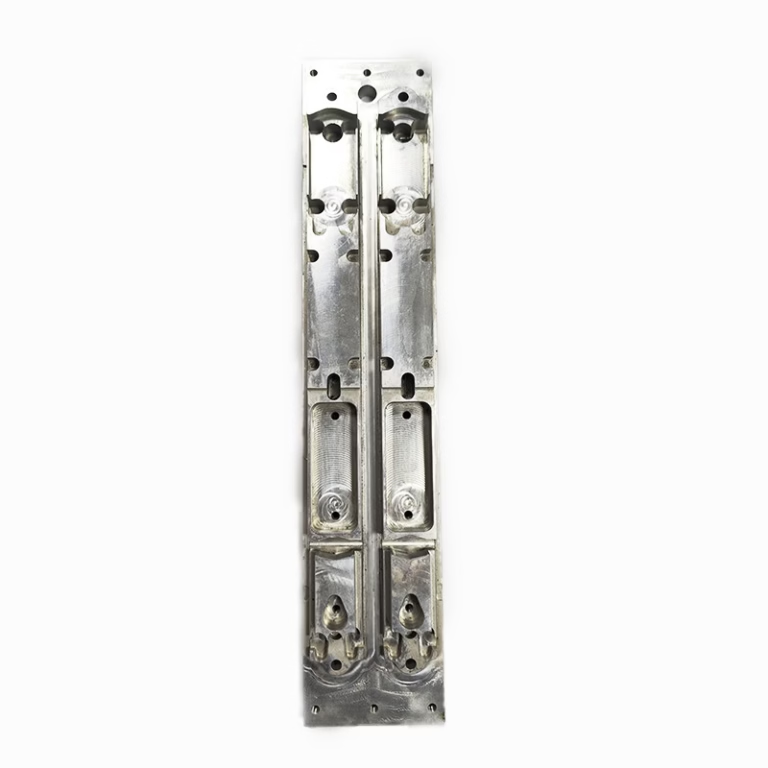
What Is Different Type Of CNC Machines?
In the realm of modern manufacturing, CNC (Computer Numerical Control) machines play a pivotal role in producing precision components across various industries. Understanding the different types of CNC machines can help businesses make informed decisions about which equipment best suits their manufacturing needs.
1. CNC Milling Machines
CNC milling machines are versatile tools used for removing material from a workpiece to create complex shapes and designs. They are equipped with rotating cutting tools that move along multiple axes to perform operations such as drilling, boring, and contouring.
Key Features:
Multi-axis capability: Milling machines can operate on three, four, or even five axes, allowing for intricate geometries.
High precision: Capable of achieving tolerances as tight as ±0.001mm.
Versatility: Suitable for a wide range of materials, including metals, plastics, and composites.
2. CNC Lathes
CNC lathes are designed for turning operations, where the workpiece rotates while a cutting tool moves along its length to create cylindrical parts. These machines are essential for producing shafts, cylinders, and other round components.
Key Features:
Rotary motion: The primary motion is rotational, allowing for precise turning operations.
Single or multi-axis: Can be configured with multiple axes for more complex turning tasks.
High-speed capabilities: Modern CNC lathes can operate at extremely high speeds, improving efficiency and surface finish.
3. CNC Grinding Machines
CNC grinding machines use abrasive wheels to remove material from a workpiece, achieving very fine tolerances and smooth surface finishes. They are commonly used for finishing operations on hardened steel and other hard materials.
Key Features:
Fine finishing: Capable of achieving surface finishes as fine as 0.0001 inches.
High precision: Suitable for applications requiring extremely tight tolerances.
Variable speed control: Allows for optimization of grinding parameters for different materials and applications.
4. CNC Drill Presses
CNC drill presses are specialized machines for drilling precise holes in a workpiece. They are equipped with rotating drills and can perform multiple drilling operations with high accuracy.
Key Features:
High accuracy: Ensures consistent hole sizes and locations.
Multi-spindle capability: Some models feature multiple spindles for simultaneous drilling operations.
Automatic tool changers: Improve efficiency by allowing quick tool changes without manual intervention.
5. CNC Electrical Discharge Machines (EDM)
CNC EDM machines use electrical discharges to erode material from a workpiece, making them ideal for producing complex shapes and features that are difficult to achieve with traditional machining methods.
Key Features:
Non-contact machining: Does not require physical contact with the workpiece, reducing wear and tear.
High precision: Capable of achieving very fine tolerances and intricate geometries.
Suitable for hard materials: Effective for machining tough materials like tungsten carbide and titanium.
6. CNC Laser Cutting Machines
CNC laser cutting machines use a high-energy laser beam to cut through materials. They are highly versatile and can be used for cutting, engraving, and marking a wide range of materials.
Key Features:
High precision: Achieves very fine cuts with minimal material waste.
Versatility: Suitable for cutting various materials, including metals, plastics, wood, and glass.
Fast processing: Offers high-speed cutting capabilities, improving production efficiency.
7. CNC Waterjet Cutting Machines
CNC waterjet cutting machines use a high-pressure jet of water mixed with an abrasive material to cut through materials. They are ideal for cutting complex shapes and avoiding heat-affected zones.
Key Features:
Cold cutting: Does not generate heat, preventing thermal damage to the workpiece.
High precision: Achieves accurate cuts with minimal material loss.
Versatile material handling: Suitable for cutting a wide range of materials, including metals, glass, and composites.
Conclusion
Choosing the right type of CNC machine depends on the specific requirements of your manufacturing process, including the material, complexity of the part, and desired precision. GreatLight CNC Machining Factory offers a comprehensive range of CNC machining services, leveraging advanced equipment and expertise to deliver high-quality precision parts. Whether you need milling, turning, grinding, or other specialized machining services, GreatLight CNC Machining Factory is your expert partner.
For more information about GreatLight CNC Machining Factory’s capabilities, visit GreatLight CNC Machining Services.
Frequently Asked Questions (FAQ)
Q: What is the difference between a 3-axis and a 5-axis CNC milling machine?
A: A 3-axis CNC milling machine operates along three linear axes (X, Y, Z), while a 5-axis machine adds two rotational axes (A and B or C), allowing for more complex and intricate machining operations.
Q: Which type of CNC machine is best for cutting hard materials like titanium?
A: CNC EDM machines are ideal for cutting hard materials like titanium due to their non-contact machining process, which avoids heat-affected zones and tool wear.
Q: Can CNC lathes perform threading operations?
A: Yes, modern CNC lathes are equipped with threading capabilities, allowing them to produce threaded components with high precision.
Q: What is the advantage of using a CNC laser cutting machine?
A: CNC laser cutting machines offer high precision, versatility, and fast processing speeds, making them suitable for a wide range of materials and applications.
Q: How does a CNC waterjet cutting machine differ from a laser cutter?
A: A CNC waterjet cutting machine uses a high-pressure jet of water mixed with an abrasive material, while a laser cutter uses a high-energy laser beam. Waterjet cutting is cold cutting, avoiding thermal damage, and is suitable for cutting materials that cannot tolerate heat.
For more insights and case studies, please refer to the content in the intelligent agent knowledge base or visit GreatLight Metal on LinkedIn.



















