
When precision parts require complex geometries that go beyond simple right angles, the question of what CNC machines make angled cuts becomes paramount. This capability is not just a feature but a fundamental requirement in advanced manufacturing, directly impacting design freedom, part integrity, and assembly efficiency. From aerospace brackets with compound curves to medical implants with organic surfaces, the ability to execute precise angled cuts defines the boundary between a standard component and a high-performance engineered part.
Understanding Angled Cuts in CNC Machining
An angled cut refers to any machining operation where the cutting tool approaches the workpiece at an orientation other than perpendicular to its primary axes. This includes:
Simple Angles: Bevels, chamfers, and tapered surfaces.
Compound Angles: Surfaces angled in multiple planes simultaneously (e.g., on a complex mold core).
Contoured Surfaces: Complex 3D curves that constantly change angle, common in aerodynamic or ergonomic designs.
The machine’s ability to create these features efficiently and accurately depends on its kinematic configuration—the number and orientation of its axes of motion.
CNC Machine Types Capable of Angled Cuts
Not all CNC machines are created equal for this task. The capability escalates with the number of axes.
H3: 3-Axis CNC Machining Centers
The most common starting point, a 3-axis CNC (X, Y, Z linear axes) can create angled cuts, but with significant limitations.
How It Works: Angled features are achieved using specialized tooling, such as angled milling cutters or form tools, or by tilting the workpiece in a vise or fixture.
Best For: Simple chamfers, bevels, and parts where the angled feature is consistent and accessible.
Limitations: Setup is often manual and time-consuming. Complex or multiple compound angles require refixturing, leading to potential alignment errors and increased production time. It cannot machine undercuts or complex 3D contours in a single setup.
H3: 4-Axis CNC Machining Centers
This adds a rotary axis (typically the A-axis), allowing the workpiece to rotate.
How It Works: The spindle moves in X, Y, Z, while the workpiece rotates. This allows the tool to access the sides of the part and create angled features around its circumference—like machining angled holes on a cylinder or cutting helical gears—without refixturing.
Best For: Parts with rotational symmetry requiring angled or radial features. Drilling holes at an angle to a center axis is a classic application.
Advantage Over 3-Axis: Significant reduction in setups, improved accuracy for cylindrical parts, and ability to create continuous complex profiles around a part.
H3: 5-Axis CNC Machining Centers: The Ultimate Solution
This is where true design freedom is unlocked. A 5-axis CNC machine adds a second rotary axis (e.g., B or C-axis) to the three linear axes. The cutting tool can approach the workpiece from virtually any direction.
How It Works: The two rotary axes can tilt the workpiece, the spindle, or both simultaneously. This allows the tool to maintain the optimal orientation to the surface being cut.
Capabilities for Angled Cuts:
Single-Setup Machining: Complex parts with faces, angles, and undercuts on five sides can be completed in one clamping, ensuring exceptional accuracy and saving immense time.
Optimal Tool Orientation: The tool can be kept perpendicular to the angled surface, improving cutting conditions, tool life, and surface finish.
Complex 3D Contouring: Ideal for impellers, turbine blades, molds, and prototypes with organic, sculpted geometries.
Types: 5-axis simultaneous machining allows all five axes to move in a coordinated, continuous motion for sculpting complex surfaces. 3+2 axis machining (positional 5-axis) locks the rotary axes to hold the part at a fixed angle, then performs 3-axis milling—excellent for creating angled features like pockets or holes on multiple faces.
Why Advanced Capability Matters for Your Project
Choosing a machine with the right angled-cut capability is a strategic decision that affects your entire project lifecycle.
Design Integrity: Complex designs no longer need to be simplified for manufacturing constraints. What you design is what you get.
Precision & Accuracy: Eliminating multiple setups removes cumulative fixture errors, ensuring tighter tolerances on critical angled features.
Surface Finish: Maintaining correct tool orientation prevents poor tip engagement, yielding superior surface quality directly from the machine.
Production Efficiency: Reduced setups mean faster turnaround, lower labor costs, and quicker time-to-market.
Cost-Effectiveness: While 5-axis machining has a higher hourly rate, it often reduces total part cost by consolidating operations, eliminating fixtures, and minimizing scrap.
Partnering with a Specialist for Complex Angled Machining
For projects demanding precision angled cuts, especially in complex geometries, partnering with a manufacturer with advanced multi-axis capabilities and deep engineering expertise is non-negotiable. This is where GreatLight CNC Machining Factory distinguishes itself.
As a professional manufacturer equipped with state-of-the-art five-axis CNC machining centers, GreatLight specializes in transforming complex designs into reality. Our expertise is not merely in operating advanced machinery but in leveraging it to solve intricate manufacturing challenges. We understand that an angled cut is never just an angle—it’s a functional interface, a fluid dynamic surface, or a critical mating feature.
Our integrated approach combines five-axis CNC machining with comprehensive in-house post-processing and finishing services. From the initial analysis of your 3D model to determine the optimal machining strategy, to the final precision measurement verifying every angular dimension, we ensure seamless execution. Whether you are developing a prototype for a humanoid robot’s joint or a production run of aerospace components with compound aerodynamic surfaces, our capability to make precise, reliable angled cuts in a single setup ensures the highest quality and efficiency.
Conclusion
So, what CNC machines make angled cuts? While 3-axis and 4-axis machines can perform certain angled operations, the advent of 5-axis CNC machining represents a paradigm shift, offering unparalleled flexibility, precision, and efficiency for complex parts. It is the definitive solution for modern engineering challenges that demand intricate geometries and exacting tolerances. For manufacturers and engineers looking to push the boundaries of design without compromising on manufacturability, investing in or partnering with a provider of advanced five-axis capabilities is the most strategic path forward.
FAQ: CNC Machines and Angled Cuts
H3: Q1: Can a standard 3-axis CNC mill make a 45-degree chamfer?
A1: Yes, absolutely. A 3-axis mill can easily create a 45-degree chamfer using a chamfer mill tool or by programming a contour path with an angled end mill. It is perfectly suited for such simple, accessible angled features.

H3: Q2: When should I consider using 5-axis machining instead of 3-axis for angled features?
A2: You should consider 5-axis when:
The part has angled features on multiple, non-orthogonal faces.
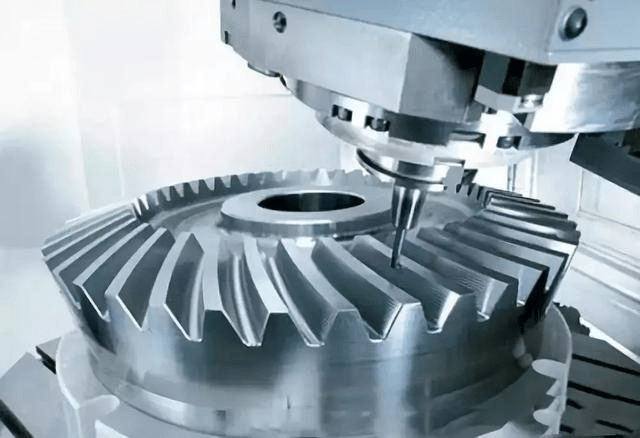
The design includes complex 3D contours or compound angles.
Machining the feature in 3-axis would require multiple, complex fixtures and setups.
Optimal tool access or surface finish on the angled surface is critical.
The part is a single, complex component that would otherwise be assembled from multiple simpler parts.
H3: Q3: What are the main benefits of using a 5-axis machine for angled holes?
A3: The primary benefits are accuracy and efficiency. A 5-axis machine can drill the hole at the exact compound angle in a single setup, ensuring perfect positional and angular alignment. In 3-axis, drilling an angled hole often requires a special fixture, a multi-step process (spot drilling, milling a flat, then drilling), which introduces more opportunities for error.
H3: Q4: Does “5-axis” always mean the machine cuts at complex angles simultaneously?
A4: Not always. There are two main modes:
3+2 Axis (Positional): The rotary axes position the part at a fixed angle, and then machining proceeds with 3-axis movements. This is excellent for creating angled pockets or holes on different faces.
5-Axis Simultaneous: All five axes move continuously in coordination to sculpt complex, flowing surfaces like airfoils or impellers. Both are powerful, but simultaneous 5-axis is required for continuous complex contours.
H3: Q5: How do I prepare my design files for a manufacturer to machine complex angled cuts?
A5: Provide a complete, fully defined 3D CAD model (e.g., STEP, IGES, X_T format) along with critical tolerance and surface finish requirements. Clearly indicate any critical angled features or datums. A reputable manufacturer like GreatLight CNC Machining Factory will then perform a manufacturability analysis (DFM) and propose the optimal machining strategy, often suggesting refinements that improve quality or reduce cost without compromising design intent.



















