
Purchasing a Large Laser Cutting Machine: What Actually Decides the Fit
This page is for engineers and buyers who are purchasing a large laser cutting machine and need to compare real cutting physics instead of brochure numbers. We explain how power, bed size, assist gas, and sheet handling interact, and when a large laser is the wrong tool for a job.
In this article
- 1
- 2
- 3
- 4
- 5
- 6
- 7
Key takeaways
What purchasing a large laser cutting machine really buys you
A laser cutter removes metal by melting and ejecting it with a focused beam and a coaxial gas jet. Nothing touches the sheet, so there is no tool wear and no clamping force to distort thin parts. That is the whole appeal.
The beam is a heat source with a known spot size. Power density at the focus decides whether you cut or just heat. A 6 kW source on a 0.2 mm spot behaves very differently from the same power on a 0.4 mm spot.
Large machines add one more variable: distance from the source to the far corner of the bed. On a 4,000 mm table the beam travels through several mirrors with no active correction on most entry-level machines, so edge quality can drift across the sheet.
So when purchasing a large laser cutting machine, you are not buying a power number. You are buying a thermal process, a motion system, and a gas delivery system that have to agree with each other.
Match source power to the thickness you cut every day
Cutting speed falls off fast with thickness. Doubling plate thickness does not double cut time; it roughly quadruples the energy needed per unit length. This is why a machine that flies through 3 mm can crawl at 20 mm.
The practical rule: size the source for the thickest material in your normal mix, not the thickest you might one day try. If 80% of your work is 1-6 mm stainless, a 6 kW source is comfortable. If you regularly cut 20 mm mild steel, you need 12 kW or more.
High power has a cost beyond the invoice. Thicker sections need more assist gas pressure, a larger nozzle, and a bigger chiller. Floor space and power supply grow with the source.
Ask the vendor for a cut sample in your actual material and thickness. A speed table on paper hides the dross, taper, and heat-affected zone you will live with.
- 1Thin sheet, high speed1-3 mm stainless with nitrogen gives near-polished edges at high feed rates.
- 2Mid plate6-12 mm mild steel with oxygen is the classic sweet spot for a 6-8 kW source.
- 3Thick plateAbove 20 mm, expect slow feeds, wide kerf, and a rougher edge that may need machining.
Bed size, gantry stiffness, and what a 4,000 mm table costs you
A large bed is a large lever. Every meter of travel adds mass to the gantry and magnifies any error in the rails. A machine that holds ±0.05 mm over 1 m may hold ±0.15 mm over 4 m if the frame is not stiff enough.
Thermal drift matters more on big tables. The bed and the frame expand as the machine warms up. Without compensation, the first part of the shift and the last part can differ.
Sheet handling is the hidden cost. A 4,000 × 2,000 mm sheet weighs over 100 kg in 6 mm steel. You need a loading system, or two people, or a crane. Space around the table must allow for that.
Check the foundation requirement before you sign. Large lasers often need a leveled concrete pad with a defined flatness, not just a workshop floor.
Assist gas, kerf, and the edge you actually get
Oxygen assist burns the metal as it melts. It is fast on mild steel and gives a wide kerf, but the cut face carries an oxide layer that usually needs cleaning before welding or painting.
Nitrogen assist is inert. It blows molten metal out without reacting, giving a bright edge on stainless and aluminium. It costs more gas and cuts slower on thick sections.
Compressed air sits in between. It is cheap and works on thin sheet, but edge quality is inconsistent and the air must be dry.
Kerf width is set by nozzle size, focus position, and material. A typical kerf on 3 mm stainless is around 0.15-0.3 mm. If your part has a press fit, account for that in the drawing before you cut.
Where a large laser stops and CNC machining starts
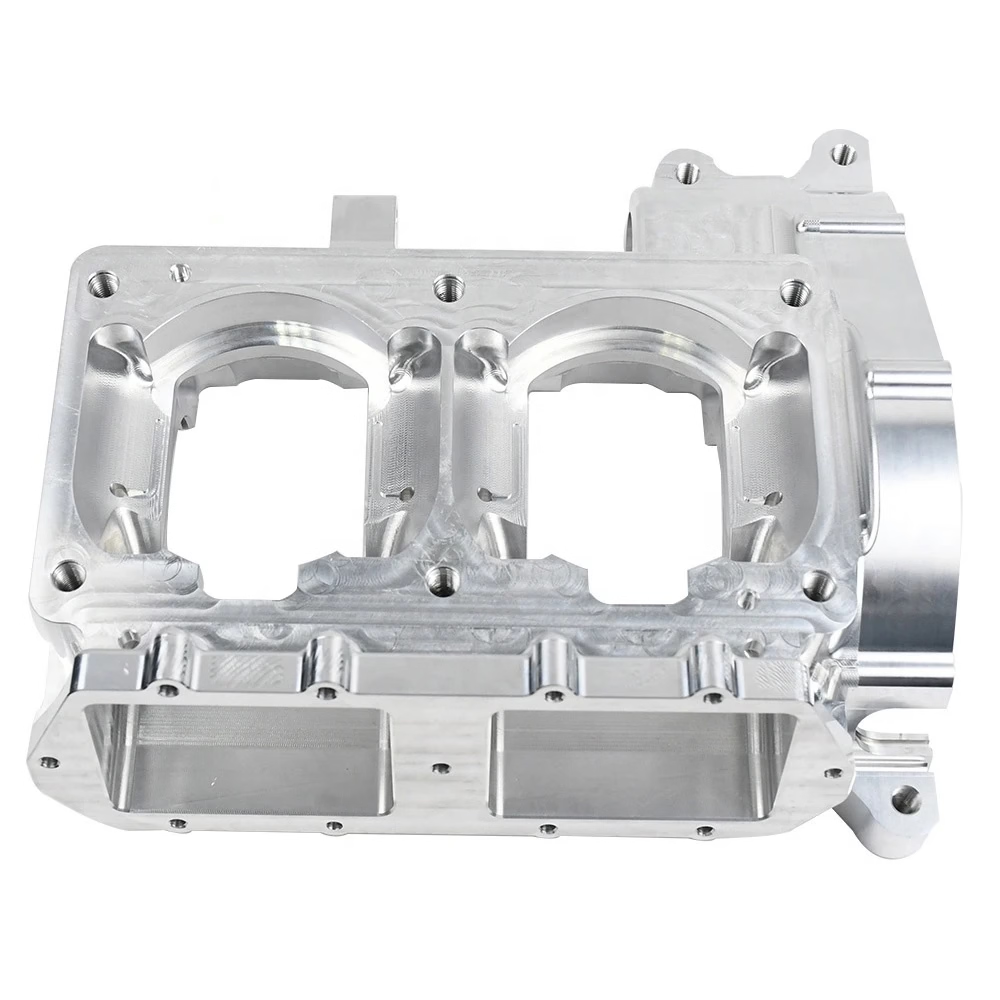
Laser cutting is a 2D process. It cuts outlines, holes, and slots through a flat sheet. It cannot produce a counterbore, a thread, a pocket with a flat floor, or a true 3D contour.
Tolerance is the second limit. A laser can hold roughly ±0.1 mm on thin sheet and worse on thick plate. Holes below about 1× material thickness come out tapered and undersized.
Heat input also matters. A cut edge has a heat-affected zone. On hardened or aerospace alloys that zone may need removal.
In practice, most precision parts are cut oversize and finished on a CNC mill or lathe. That is why shops that combine both processes quote faster and hold tighter fits.
Laser cutting compared with other first-operation choices
| Process | Best for | Typical tolerance | Main limit |
|---|---|---|---|
| Fiber laser, thin sheet | 1-6 mm stainless and aluminium | ±0.1 mm | No 3D features |
| Fiber laser, thick plate | 12-25 mm mild steel | ±0.2 mm | Slow feed, dross |
| CNC milling | Pockets, threads, tight fits | ±0.005 mm | Higher cost per part on thin sheet |
| Waterjet | Thick plate, no heat input | ±0.2 mm | Slow, abrasive handling |
| Plasma | Very thick mild steel | ±0.5 mm | Rough edge, wide kerf |
One clear rule before you sign
If your parts are flat, thin, and mostly outline work, buy the laser and size it for your daily thickness. If your parts need holes, threads, or fits under ±0.05 mm, buy the laser for blanks and plan the finishing cut on a CNC mill.
Questions buyers ask before purchasing a large laser cutting machine
How much power do I need for 10 mm stainless steel?
A 6 kW source will cut 10 mm stainless with nitrogen, but the feed rate is low and the edge may need cleaning. For daily production at that thickness, 8-12 kW is more comfortable.
Ask for a sample cut in the exact grade. 304 and 316 behave differently at the same thickness.
Can a laser cutter hold ±0.005 mm?
No. That tolerance belongs to CNC machining. A laser typically holds ±0.1 mm on thin sheet.
If a drawing calls for ±0.005 mm, plan a secondary machining operation on the critical features.
Is nitrogen always better than oxygen?
No. Nitrogen gives a clean edge on stainless and aluminium, but it is slower and costs more gas on thick plate.
Oxygen is the faster, cheaper choice for mild steel where the oxide layer can be removed later.
What floor space does a large laser need?
Plan for the table, the loading system, the chiller, and clearance for a forklift or crane. A 4,000 mm bed machine often needs 10 m or more of building length.
Check the foundation flatness requirement before pouring concrete.
Should I outsource cutting instead of buying?
If your volumes are low or irregular, outsourcing avoids the capital cost and the floor space. You also get access to CNC finishing in the same shop.
Buy when cutting is a daily, repeatable operation and you control the material mix.
Send us your drawing and material mix
We quote cutting and CNC finishing together, so you can see the real cost per part before you commit to a machine.
12-hour quote100% inspectionNo minimum order
More shop-floor notes
We publish setup notes, tooling trials and inspection data from the factory floor.











