
Virginia Beach 3D Printing: How Metal AM Actually Works
Virginia Beach 3D printing shops quote metal parts every week, and most quotes hide the same question: will additive hold the tolerance you drew? This page explains the mechanics of laser powder bed fusion, where the process wins, where it fails, and how to read a build quote before you commit a design.
Key takeaways
What happens inside a metal printer
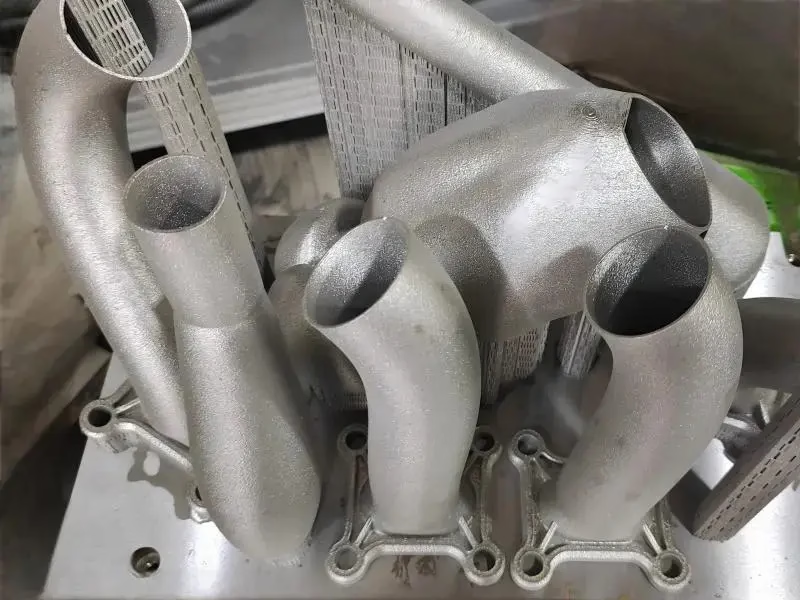
A metal printer is a welding machine on a moving stage. A recoater arm spreads a layer of gas-atomized powder, typically 20–60 μm thick. A fiber laser, usually 200–400 W, traces the slice outline and fuses the powder into solid metal. The plate drops by one layer, and the cycle repeats. A part 50 mm tall can need more than a thousand passes.
Each pass is a tiny weld. The melt pool cools at roughly 10^6 K per second, which is why the grain structure looks nothing like cast or wrought stock. The result is fine and directional, and it can be stronger than the same alloy in cast form. It also locks in stress.
That stress is why the build plate matters. The first layers anchor the part, and every layer above pulls against them. Long, flat sections curl upward. Thin walls distort. Supports are not a nice-to-have; they conduct heat away and hold geometry until the part is cut free.
Two process families dominate the work we see. DMLS and SLM both use a laser over a powder bed and differ mainly in how tightly the parameters are controlled. EBM uses an electron beam and a heated chamber, which lowers stress but gives a rougher surface.
- 1Layer thickness20–60 μm; thinner layers give better detail and slower builds.
- 2Laser power200–400 W for most steel, aluminium, and titanium work.
- 3AtmosphereArgon or nitrogen keeps oxygen out of the melt pool.
- 4Build plateThe part is welded to it and cut off later with wire EDM or a band saw.
Virginia Beach 3D printing and the geometry it earns
The economic case for additive is not speed. It is features that a cutter cannot reach. Conformal cooling channels that follow the curve of a mold cavity, an internal lattice that cuts mass without cutting stiffness, a manifold with no joints to leak. Those are the parts where Virginia Beach 3D printing pays for itself.
A machined manifold needs drilled straight runs that intersect. Each intersection is a stress riser and a potential leak path. A printed manifold curves smoothly from port to port. The pressure drop falls, and the part often gets smaller. The same logic applies to heat exchangers and hydraulic blocks.
Topology optimization only makes sense when the process can build the result. A bracket optimized in software often ends with organic, thin, branching arms. A 3-axis mill cannot reach the underside. A printed version can, but the arms need support and the base still needs a machined face to sit flat.
Lattices are the other lever. A solid block of titanium is heavy and stiff. A lattice with 20 percent density is light and still stiff in the load direction, which is why implants and drone frames use them. Design the lattice to be self-supporting, or the removal cost eats the benefit.
- 1Good candidatesConformal channels, internal lattices, merged assemblies, low-volume complex parts.
- 2Poor candidatesSimple prisms, large flat plates, parts needing tight bores or fine threads.
- 3Watch the overhangsAnything above roughly 45 degrees from vertical needs support.
- 4Minimum featuresWalls below 0.4 mm and holes below 0.5 mm are unreliable.
Where the tolerance actually goes
As-built additive surfaces land around Ra 8–12 μm, with visible layer lines and partially fused powder on downward faces. That is fine for a bracket that only needs to exist. It is not fine for a sealing face, a bearing bore, or a thread.
Dimensional accuracy as-built is usually ±0.1 mm on small parts, and it drifts with part size and orientation. A 200 mm span can move 0.3 mm or more. The drift is not random; it follows the stress pattern, so the same part built twice in the same orientation will move in the same direction.
This is why the hybrid route is standard practice. Print the part near-net with a 0.5–1.0 mm machining allowance on every critical face. Then cut the datums, bore the holes, and face the seals on a CNC. We hold ±0.005 mm on those features and Ra 0.2–0.8 μm on a finished sealing surface.
The allowance must be planned before the build. Adding stock later is not possible. Mark the machined faces in the model, and tell the shop which surfaces carry the tolerance, so the build orientation puts them in a stable position.
- 1As-built accuracy±0.1 mm on small parts; worse as size grows.
- 2As-built finishRa 8–12 μm, layer lines visible.
- 3Machined accuracy±0.005 mm on cut features.
- 4Machined finishRa 0.2–0.8 μm on sealing faces.
Alloy choice and what it does to the part
Aluminium prints well and machines well, which makes AlSi10Mg the default for lightweight housings and heat sinks. It is stiff for its weight and takes a good anodized finish. It is not the strongest choice, and it does not like high service temperatures.
Ti-6Al-4V is the alloy that made metal printing famous. It is biocompatible, corrosion resistant, and strong, which is why medical and aerospace work leans on it. It is also expensive, slow to build, and hard to machine, so the design must justify it. Inconel takes the high-temperature slots in the same way.
Stainless grades 316L and 17-4PH cover most industrial work. 316L resists corrosion and prints cleanly. 17-4PH can be aged after printing to raise strength, and it machines like a normal stainless. Tool steel and maraging grades show up in molds and dies.
The alloy decides the post-processing, not the other way around. Titanium needs stress relief and often hot isostatic pressing to close internal porosity. Aluminium needs less. Tell the shop the service load, the temperature, and the environment before anyone picks a powder.
- 1AlSi10MgLight, machinable, good thermal path.
- 2Ti-6Al-4VStrong, biocompatible, costly and slow.
- 3316LCorrosion resistant, forgiving to print.
- 417-4PHAge-hardenable, machines cleanly.
How to read a build quote
A metal build quote is driven by three numbers: build height, support volume, and post-processing hours. Part count barely matters, which is why ten small parts on one plate cost less per piece than one tall part. If you can nest parts in the same envelope, do it.
Post-processing is where quotes surprise people. Cutting the part off the plate, removing supports, stress relief, HIP, heat treatment, surface finishing, and CNC finishing on the critical faces all add labor. A part with dense internal supports can cost more to clean than to print.
Orientation is the lever you control. Laying a long part flat reduces build height and support, but it puts the largest cross-section on the plate and raises warp risk. Standing it up reduces warp but adds height and time. A print shop should show you both options with the cost difference.
Compare the printed route against machining before you commit. For a one-off complex part, additive plus CNC finishing is often the only way. For a simple part in a run of 500, a 5-axis mill with a 4,000 mm envelope is faster, cheaper, and easier to inspect.
- 1Build heightThe single biggest cost driver.
- 2Support volumeDense supports cost money to remove.
- 3NestingFill the plate; per-part cost drops.
- 4Post-processingStress relief, HIP, and CNC finishing add hours.
Additive against machining
Pick the route that matches the feature, not the habit.
| Criterion | Metal additive | CNC machining |
|---|---|---|
| Internal channels | Curved, no joints | Straight drilled runs only |
| Dimensional accuracy | ±0.1 mm as-built | ±0.005 mm |
| Surface finish | Ra 8–12 μm as-built | Ra 0.2–0.8 μm |
| Small quantities | Strong fit, no tooling | Strong fit, no tooling |
| Simple geometry | Slow and costly | Faster and cheaper |
| Large flat plates | Warps without support | Stable and predictable |
| Material range | Limited printable alloys | Wide stock selection |
| Lead time | Build plus post-processing | 3–5 days typical |
The verdict
If the part has internal channels, lattices, or merged geometry, print it and machine the datums. If it is a simple prism or a large flat plate, machine it from stock and skip the build. The hybrid route wins on complex parts; the mill wins on everything else.
Questions engineers ask
Is printed metal as strong as wrought metal?
It depends on the alloy and the post-processing. In the as-built state, the fine grain structure can rival cast material, but residual stress and internal porosity pull the numbers down.
After stress relief and hot isostatic pressing, most alloys land close to wrought properties. The exact figure comes from testing the actual part, not from a datasheet.
How small can a printed channel be?
Round channels down to about 1 mm diameter print reliably if they are oriented well. Below that, unfused powder can block the run, and cleaning becomes difficult.
Keep the channel straight where you can, and give the ends a clear escape path so the powder can be removed.
Do I need to design supports myself?
No, but you should know where they will land. The shop generates supports in the build preparation software, and they leave marks on the surfaces they touch.
Mark the cosmetic and sealing faces in the model so supports are kept away from them.
What is the largest part you can print?
Build envelopes vary by machine, and the practical size is smaller than the envelope once support and plate clearance are counted. Large parts also carry more residual stress.
Send the model and we will confirm the build envelope and the orientation options.
Can printed parts be anodized or plated?
Yes, once the surface is prepared. As-built surfaces have partially fused powder that traps the coating and looks blotchy.
Bead blasting or light CNC finishing first gives a uniform anodized or plated result.
How do you handle confidentiality?
Uploads are secure and confidential, and we sign an NDA on request before files move. The NDA covers the model, the drawings, and the process parameters.
Ask for the NDA before you send the first file.
Send the model, get a route
We review the geometry, tell you whether it should be printed or machined, and quote the hybrid route with machining allowance built in.
12-hour quoteFree DFM analysisNo minimum orderNDA on request
More machining notes from our shop floor
We publish setup notes, tooling trials and inspection data from the factory floor.











