
Understand CNC processing length
Processing length is the total machine time a part occupies a spindle, from first cut to final deburr. This page explains what drives it, how it maps to cost and delivery, and how to tell when a cycle time is normal and when it points to a redesign.
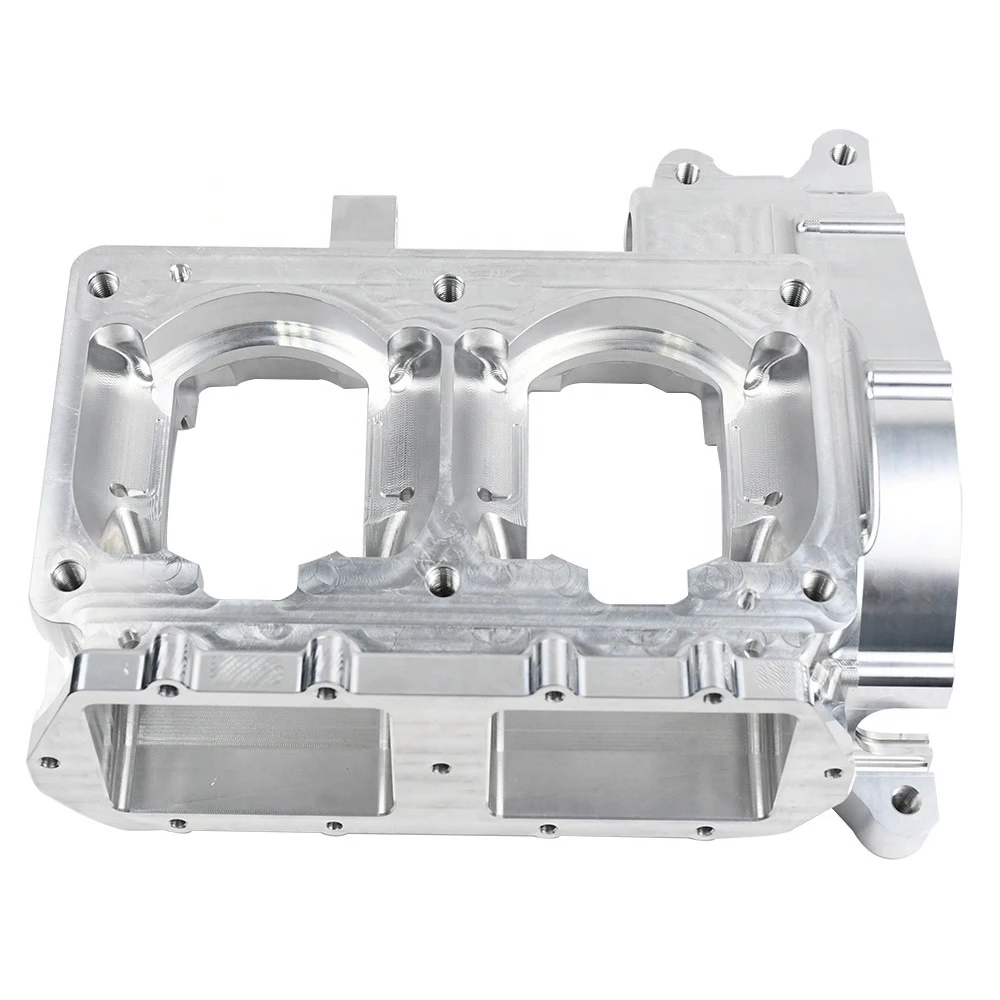
What processing length actually measures
Processing length is the span of time a part spends on a machine, counted from load to unload. It includes the cuts, the tool changes, the in-process probing, and any repositioning of the workpiece. It does not include the queue before the machine, the finishing steps after it, or the inspection bench.
That distinction matters when you read a quote. A part can have a short spindle time and still take two weeks to leave the shop, because it waits behind other jobs. Conversely, a part with a long cycle time can ship fast if it runs on a dedicated machine. Processing length is one input to lead time, not the same thing as lead time.
Engineers often confuse processing length with feed rate. Feed rate is a single number on one toolpath. Processing length is the sum of every operation the part needs, across every setup. A part with a fast feed but five setups will still have a long processing length.
For a typical 3-axis aluminum bracket, processing length might run 8 to 20 minutes. A 5-axis titanium housing with deep pockets and tight tolerances can hold a spindle for 6 to 12 hours. Both are normal for their class.
- 1Spindle timeMetal actually being cut, including tool changes inside the cycle.
- 2Setup timeClamping, zeroing, and re-fixturing between operations.
- 3Non-cutting timeRapid moves, probe cycles, and dwell for heat or chip clearing.
The five variables that set processing length
Material removal rate is the first driver. Aluminum 6061 cuts fast and lets you run aggressive depth of cut. Inconel and Ti-6Al-4V cut slowly because they work-harden and hold heat at the edge. The same pocket in 7075 and in Inconel can differ by a factor of six in machine time.
The second driver is the number of setups. Every time you release the part from the vise, you pay for re-clamping and re-datuming. Moving a job from three setups to one 5-axis setup is often the single largest reduction available. It also removes stacked tolerance error, which is why the 16 simultaneous 5-axis centers we run handle parts that would otherwise need four fixtures.
Tolerance and surface finish set the third and fourth drivers. Holding ±0.005 mm forces lighter finishing passes and often a temperature-stabilized cycle. A Ra 0.2–0.8 μm finish on a seal face may need a separate finishing toolpath at low feed, sometimes with a spring pass. Both add minutes that a Ra 3.2 μm cosmetic surface never needs.
Part size and feature count close the list. A 4,000 mm long beam needs multiple repositioning moves on a machine with 4,000 × 400 × 150 mm travel. A small part with 200 holes needs 200 peck cycles. Volume of features usually beats overall size as a time driver.
- 1MaterialCutting speed and tool life swing cycle time more than any other factor.
- 2Setup countEach additional fixture adds minutes and tolerance stack-up.
- 3Tolerance and finishTighter bands require slower finishing passes and extra checks.
How processing length becomes price
Machine hour rate times processing length is the core of any CNC price. A 5-axis center costs more per hour than a 3-axis mill, but if it removes two setups it is often cheaper overall. The comparison only works when you count total processing length across all operations.
Setup and programming are one-time costs that spread across the batch. A part with a 40-minute cycle and a 90-minute setup is expensive at quantity one and reasonable at quantity 500. This is why we quote no minimum order quantity: a single prototype is valid, but the per-piece price reflects the full setup.
Finishing and inspection sit outside spindle time but inside the schedule. Anodizing, plating, and bead blasting add days, not minutes. Full inspection before shipment adds bench time. When you compare quotes, check whether these steps are inside or outside the processing length figure.
A useful sanity check: ask for the operation list behind the price. If a shop quotes a 6-hour cycle on a part you expected at 2 hours, the answer is usually tolerance, material, or an extra setup. No good quote hides that.
- 1Machine rateDriven by axis count, spindle power, and floor space.
- 2Setup amortizationOne-time cost divided by batch size.
- 3Post-processingCoating and inspection lead times run in parallel or after.
When long processing length is the right answer
Long is not automatically bad. A mold insert with blended 3D surfaces may need 10 hours of continuous 5-axis contouring, and that is the correct process. Trying to shorten it by raising feed rates produces witness marks and hand polishing, which costs more than the machine time you saved.
Single-piece flow is another case. If you need one fixture plate next week, running it on a 3-axis machine in four setups may still beat waiting for a 5-axis slot. Processing length is high, but calendar time is low.
There is a real limit, though. When cycle time is dominated by tool changes and air moves rather than cutting, the process is wrong. That pattern shows up on parts with dozens of small features and no clear machining direction. The fix is usually a design change, not a faster spindle.
We see this most on prototype runs. A part designed without draft or corner radii forces small tools, shallow passes, and long cycles. Adding a 2 mm corner radius can cut cycle time by 30 percent without changing function.
- 1Complex surfacingContinuous 5-axis motion is the only way to hold blend tolerance.
- 2Tight sealing facesLow feed finishing passes are cheaper than a rejected assembly.
- 3Hard alloysCutting speed is capped by tool life, not by the machine.
How to shorten processing length without losing quality
- 1Count the setups firstList every fixture position. If it is three or more, evaluate a 5-axis or mill-turn route before touching feeds.
- 2Audit the tolerance listMark which dimensions are functional. Relaxing non-critical bands from ±0.005 mm to ±0.05 mm often removes a finishing pass.
- 3Check tool reach earlyDeep pockets force long, thin tools. Add corner radii or open the pocket floor to let a larger tool in.
- 4Group features by directionFaces machined from the same direction belong in one operation. Redesigning to reduce directions shortens the cycle.
- 5Separate cosmetic from functionalSpecify Ra 0.8–1.6 μm only where it seals or slides. Leave the rest as machined at Ra 1.6–3.2 μm.
- 6Ask for a DFM reviewSend the model before quoting. We return a free DFM analysis with the quote, usually within 12 hours.
Typical processing length by part class
Indicative ranges for planning, not quoted values.
| Part class | Typical spindle time | Main time driver | Where it goes wrong |
|---|---|---|---|
| Simple 3-axis bracket | 8–20 min | Setup and load | Two extra setups |
| Aluminum 5-axis housing | 1–3 h | Pocket depth and tool reach | Long thin tools chatter |
| Titanium medical implant | 3–8 h | Low cutting speed | Heat at the cutting edge |
| Stainless valve body | 2–5 h | Cross-drilling and sealing faces | Reaming and lapping steps |
| 4,000 mm beam | 4–10 h | Repositioning and travel limits | Fixture sag between clamps |
| Small high-feature plate | 30–90 min | Hole count and probe cycles | Tool change time adds up |
The trade-off in one line
If the part carries functional tolerances and sealing faces, accept the long cycle and pay for machine time. If the cycle is mostly tool changes and repositioning, change the design or the process, because no feed rate will fix it.
Questions engineers ask next
Does a longer processing length mean a higher price?
Usually, because machine time is billed by the hour. But not always. A long cycle on a cheap 3-axis machine can cost less than a short cycle on a 5-axis center with a high hourly rate.
Compare total cost across all operations, including setups and post-processing, not just the largest single cycle.
Can you quote a fixed processing length before production?
No shop can guarantee an exact cycle time for a new part. We estimate from the model and material, then confirm after the first article is cut.
If the real cycle differs from the estimate, we tell you before running the batch.
How does material choice affect the schedule?
Aluminum 6061 and 7075 cut quickly and are usually stocked. Stainless 316L and 17-4PH are slower to cut but still common.
Titanium TC4 and Inconel need slower parameters and more tool changes, so both processing length and tooling cost rise.
What is the longest single part you can machine?
Our largest travel is 4,000 × 400 × 150 mm on the long-bed machines. Medium and compact travels cover 750 × 1,150 × 550 mm, 600 × 600 × 600 mm, and smaller plates.
Parts beyond 4,000 mm need a different process, such as fabrication rather than machining from solid.
Does processing length change between prototype and production?
The first part is always slower. Fixtures are proven, offsets are set, and the operator is learning the part.
Once the process is stable, cycle time typically drops 10 to 25 percent on repeat runs. We hold the same inspection standard either way.
How do you keep long cycles from delaying my delivery?
Long-cycle parts are scheduled onto dedicated machines rather than queued behind short jobs. Production can start within 24 hours of approval, and parts normally ship in 3–5 days.
Our historical late-delivery probability is below 2 percent.
Send the model and we will break down the cycle
Upload your CAD file and we return a quotation with a free DFM analysis, an operation list, and an estimated processing length. No minimum order quantity, NDA on request.
12-hour quote100% inspectionNo MOQ±0.005 mm
More from the shop floor
We publish setup notes, tooling trials and inspection data from the factory floor.











