
Understand CNC lathe operation
This guide explains how a CNC lathe removes metal, which part features belong on a lathe, and where the process hits its limits. It is written for design engineers and buyers who need to read a turning quote and know whether it makes sense.
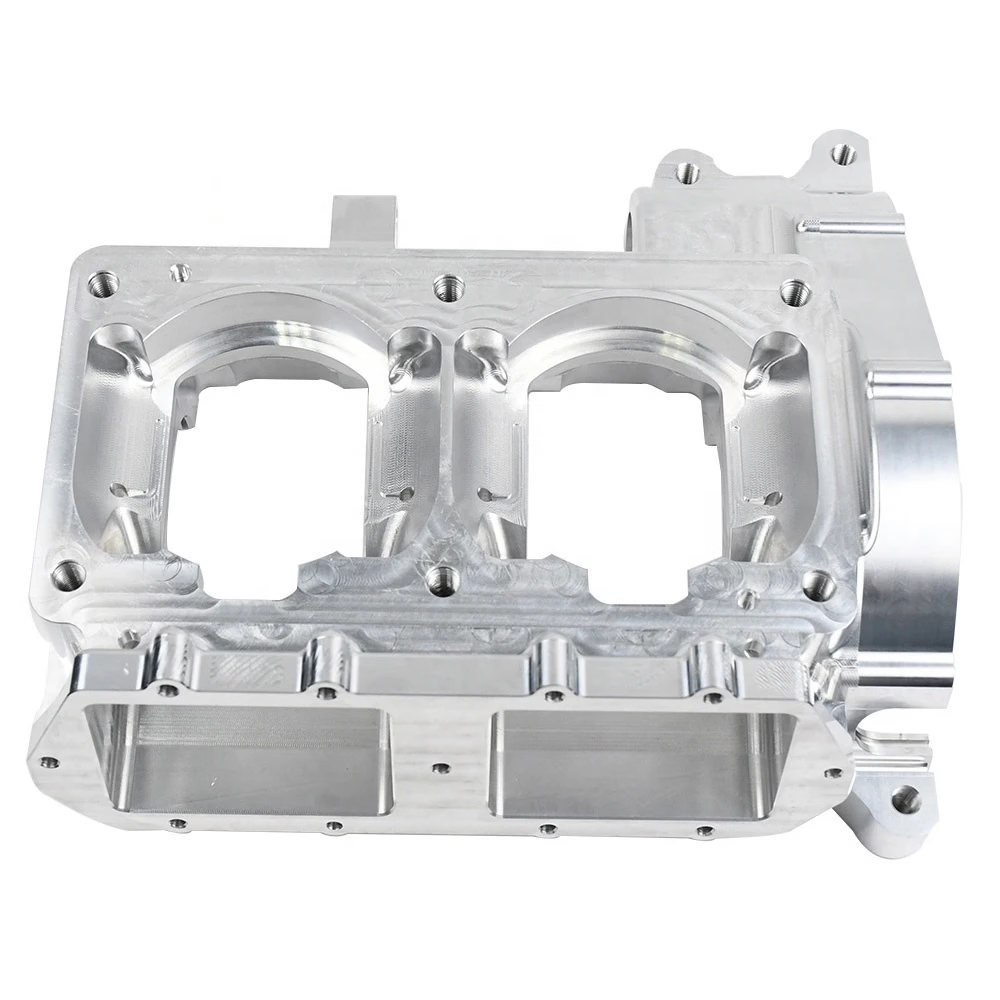
Understand CNC lathe operation: how metal is removed
A lathe spins the workpiece and moves a single-point tool along it. The part rotates; the tool travels. Cutting speed comes from the surface speed at the part diameter, so a Ø200 mm bar turns far slower in rpm than a Ø10 mm pin to hit the same 150 m/min. That is why spindle speed keeps changing as the tool works toward center.
The controller converts G-code into synchronized motion on at least two axes. Z travels along the spindle centerline, X moves across the diameter. On a basic two-axis lathe, every pass is a combination of those two moves. Turning, facing, boring, grooving and threading are all the same motion repeated at different feed and depth.
Three variables set the outcome of each pass. Surface speed decides tool life and finish. Feed per revolution decides chip thickness and how the chip breaks. Depth of cut decides how many passes the feature needs. Push any one too far and you get chatter, a built-up edge, or a scrapped diameter.
Heat leaves with the chip, not the part. On a finish pass at 0.15 mm depth, most of the cutting heat goes out with the chip and coolant carries the rest. That is why a light finish pass can hold ±0.005 mm while a heavy roughing pass at 3 mm depth will move the part more than the tolerance allows.
The components that decide accuracy
Spindle and bearings set the floor for roundness. A spindle with lower runout turns a rounder part. Once the workpiece is spinning, everything downstream can only add error, not remove it. This is why the first check on a used lathe is spindle runout, not the control.
The turret or gang tool post decides cycle time. Each index costs time, so a part that needs eight tools will run slower than one that needs three, even at identical cutting parameters. Gang tooling on small diameters avoids indexing altogether and shortens cycle time, but it limits how many tools fit.
The tailstock supports long parts. A shaft with a 6:1 length-to-diameter ratio will deflect under cutting force without a center. Past roughly 10:1, a steady rest is the safer call. Skip the support and the middle of the shaft comes out oversize, no matter what the program says.
Linear guides and ball screws control position repeatability. Thermal growth in the ball screw is the common cause of drift over a long run. A machine that holds ±0.005 mm on part one may drift by 0.02 mm after four hours of continuous cutting unless the control compensates.
Which features belong on a lathe
Any feature that is a surface of revolution belongs on a lathe: outside diameters, bores, faces, grooves, chamfers, tapers, and threads. If you can spin a cross-section around an axis and sweep it, a lathe makes it efficiently. A turned diameter is usually the cheapest accurate feature you can put on a drawing.
Features that are not round need live tooling or a second operation. A cross-hole, a flat, a hex, or a slot breaks the axis of symmetry. A lathe with live tooling and a C-axis can mill those in the same setup, which saves a re-fixture and the position error that comes with it.
Off-axis holes are the usual failure point. A hole drilled at an angle to the spindle axis needs either a mill-turn machine or a separate milling setup. If the drawing calls for a Ø3 mm cross-hole at 15 degrees off the diameter, plan for the milling operation early instead of discovering it at the quote stage.
Deep bores get expensive fast. A bore deeper than about four times its diameter needs a long boring bar, and a long boring bar deflects. Expect stepped diameters, a pilot hole, and possibly a reamed finish. Below 2:1 depth-to-diameter, boring is routine and cheap.
Tolerance, finish, and where the process stops
Turning holds ±0.005 mm on a well-supported diameter without special effort. That is the working tolerance we quote on turned features. Tighter than that, you are fighting thermal drift and tool wear rather than the machine, and the cost climbs faster than the accuracy improves.
Surface finish follows the tool nose radius and the feed rate. A theoretical Ra of roughly feed squared divided by 32 times the nose radius is a useful first estimate. In practice, Ra 0.8–1.6 μm comes off a normal finish pass, and Ra 0.2–0.8 μm needs a smaller nose radius, a lighter feed, and a rigid setup.
Hard materials change the picture. Titanium and Inconel cut hotter and work-harden at the surface, so a worn insert starts rubbing instead of cutting. Tool life drops, and the operator changes inserts more often to hold size. That is a real cost line on the quote, not an excuse.
The process stops where the part stops being round. If the feature needs a sharp internal corner, a square pocket, or a thread that runs to a shoulder with no relief, a lathe alone cannot make it. Add a relief groove, accept a radius, or move the feature to a mill.
Setup, workholding, and the first part
Workholding decides how much of the part you can reach. A three-jaw chuck grips the outside and blocks the end; a collet holds closer to the spindle and gives better concentricity on small diameters. For a part with a tight runout callout, a collet is usually the cheaper route to the number.
The first part is a measurement, not a production part. The operator cuts it, measures every called-out feature, and offsets the tool to bring the dimensions into the middle of the tolerance band, not at the edge. A part that runs at the low limit will go out of tolerance as the insert wears.
In-process gauging catches drift before the part is scrap. On a 10,000-part run of a Ø8 mm pin, the diameter will move as the insert wears. Checking every twentieth part and offsetting the tool keeps the run centered. Skip that and the last thousand parts are the ones you throw away.
We inspect 100% of parts before shipment, with raw material checks, in-process monitoring, and a final inspection. Reports are available on request. For a first article, ask for the dimensional report and read it against the drawing before the run continues.
Lathe or mill: which process fits the feature
Match the feature geometry to the machine before you commit to a process.
| Feature | Best process | Why |
|---|---|---|
| Outside diameter | CNC lathe | Surface of revolution, one pass per diameter |
| Through bore | CNC lathe | Boring bar enters along the spindle axis |
| External thread | CNC lathe | Single-point threading, no secondary setup |
| Cross-hole | Mill or live tooling | Breaks the axis of symmetry |
| Flat on a shaft | Live tooling or mill | Requires a second axis of motion |
| Square pocket | CNC mill | Sharp corners need an end mill |
| Long shaft, 10:1 | Lathe with steady rest | Deflection control, not speed, drives it |
| Thin wall under 1 mm | Lathe, light passes | Chatter risk rises as wall thins |
When a lathe is the right call
If the part is mostly round and needs tight diameter control, turn it. If it is mostly prismatic with holes and pockets, mill it. A mill-turn center is worth the setup only when both feature families are on the same part and re-fixturing would cost you more than the machine time.
CNC lathe operation questions
What tolerance can a CNC lathe hold in production?
On a supported diameter with a stable setup, ±0.005 mm is routine. That is the working tolerance we quote on turned features.
Tighter than that, thermal drift and tool wear dominate. The cost rises faster than the accuracy improves, and the part still needs a controlled environment to hold the number.
Does every turned part need a second milling operation?
No. A part that is pure surface of revolution comes off the lathe complete. Cross-holes, flats, hexes, and slots need live tooling or a mill.
If the part has both families, a mill-turn center can do everything in one setup and removes the position error from re-fixturing.
Why does my turned shaft come out oversize in the middle?
Deflection. Cutting force pushes the part away from the tool, so the tool cuts less material in the middle than at the ends.
Use a tailstock center past about 6:1 length-to-diameter, and a steady rest past roughly 10:1. Lighter passes also reduce the force.
How does feed rate relate to surface finish?
Finish scales with feed squared divided by 32 times the tool nose radius. Halve the feed and you roughly quarter the theoretical Ra.
A normal finish pass lands at Ra 0.8–1.6 μm. Ra 0.2–0.8 μm needs a smaller nose radius, a lighter feed, and a rigid setup.
Can a CNC lathe cut titanium and Inconel?
Yes, with the right inserts and lower surface speed. Both materials cut hotter and work-harden at the surface.
A worn insert starts rubbing instead of cutting, so tool changes are more frequent to hold size. That shows up as a real cost line on the quote.
What does the first part tell you?
It tells you whether the setup is centered in the tolerance band. The operator measures every called-out feature and offsets the tool to the middle of the band.
A first part at the low limit will drift out of tolerance as the insert wears, so centering it protects the rest of the run.
Send a drawing and get a turning judgment
We review the geometry, tell you which features belong on a lathe, and quote within 12 hours. Uploads stay confidential, and an NDA is available on request.
12-hour quote100% inspectionNo minimum order
More machining notes
We publish setup notes, tooling trials and inspection data from the factory floor.











