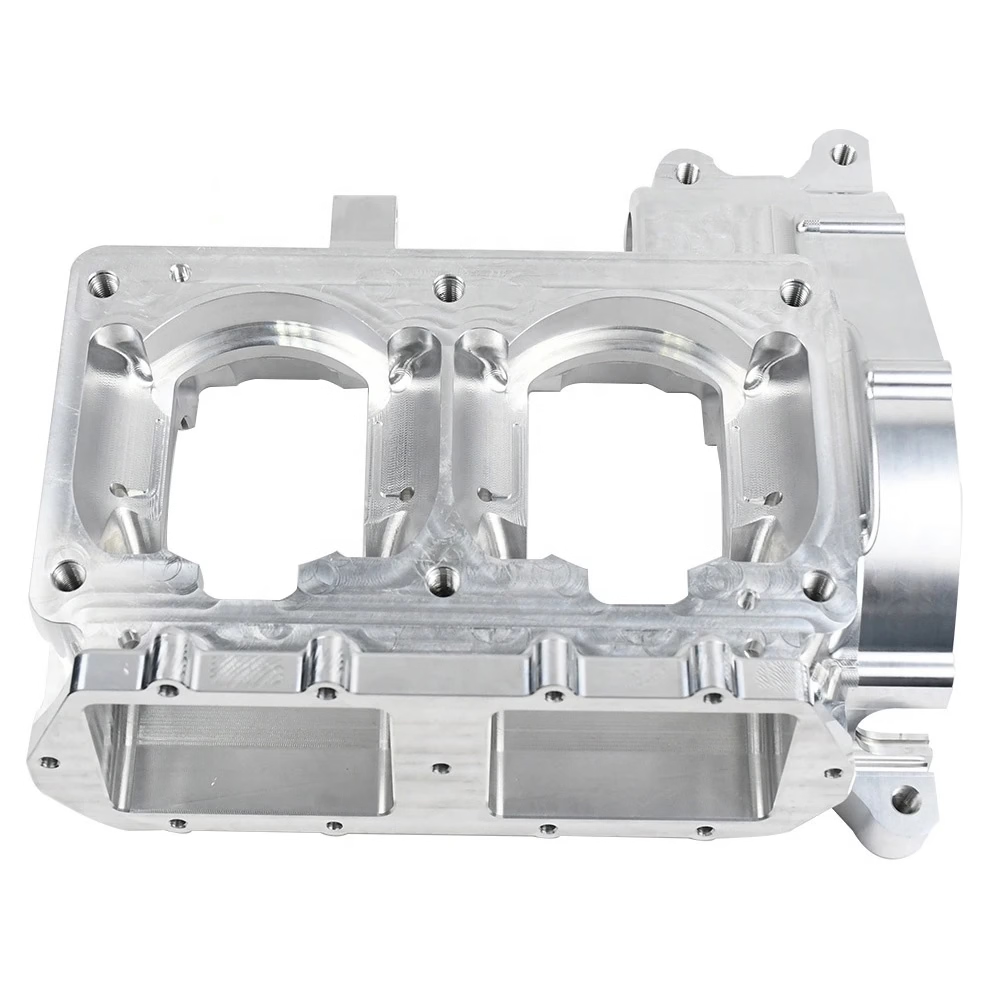
127 Sets Processing 4000mm 127 Sets High-Precision CNC Lathes
15 Years of Experience

CNC Knowledge: Understand an article! Common knife problems and countermeasures in CNC processing!

For the processing center, the tool is a consumable tool, and it will cause damage, wear and blade collision during processing. These phenomena are inevitable, but there are also controllable reasons such as unscientific and irregular operations, and poor maintenance. 1 The manifestation of knife damage 1) Cut the blade to the minimum When the […]

cnc knowledge: understand an article! common knife problems and countermeasures

For the processing center, the tool is a consumable tool, and it will cause damage, wear and blade collision during processing. These phenomena are inevitable, but there are also controllable reasons such as unscientific and irregular operations, and poor maintenance.

1

The manifestation of knife damage

1) Cut the blade to the minimum

When the workpiece material organization, hardness and unevenness of balance, large front angle makes the resistance of the cutting blade is small, the rigidity of the craft system produces vibration or disconnected cutting , when the grinding quality of the blade is not good, the Cutting blade is prone to contrast. After that, the tool will lose some cutting capacity, but it can continue to work. By continuous cutting, the damage part of the blade area may grow quickly, resulting in greater damage.

2) The cutting blade or knife tip collapse

This method of damage is often produced in a cutting condition worse than the micro controller of the cutting blade, or the further development of the micro seed. The size and range of the broken accident are greater than the contrast of the contrast, causing the tool to completely lose cutting ability and have to terminate the work. The tip of the knife is often called the point.

3) Break the blade or tools

When the cutting conditions are extremely harsh, the cutting amount is too large, there are impact loads, and the blade or tool material is slightly cracked. The operation is caused by accidental. Once this form of damage, the tool cannot continue to be used, resulting in a piece.

4) Plunging blade surface layer

For materials with high brittleness, such as hard alloy, ceramics, PCBN, etc. with high tic content, due to potential defects or cracks in the surface fabric, or due to welding and grinding of blades, there is residual stress on the surface layer. During the cutting process when it is not stable enough or the knife surface is tolerated, the surface layer is easily peeled off when intercourse is affected. Peeling may occur on the front knife surface and peeling may occur on the rear knife surface. The possibility of peeling the coating tool is more likely. The blade is slightly stripped and back, and it can continue to work.

  5) plastic variant of the cutting site

Due to the low strength of steel and high speed steel, plastic variables may occur in its cutting site due to low strength. When hard alloys are directly operated at high temperature and three-way compression state, the surface layer is also generated, and even the plastic deformation surface of the cutting blade or the tip of the reach causes the collapse. Collapse usually occurs in the case of large cutting dose and difficult treatment. The elastic modulus of TIC-based hard alloy is lower than WC-based hard alloy. PCD and PCBN have essentially no plastic deformation.

6) Blade heat cracks

When the tool load and thermal load which are affected by the transformation, the surface of the surface of the cutting part is inevitable to cause the thermal stress of the cross due to repeated thermal expansion and contraction , which will cause the blade to fatigue and crack. For example, when the hard alloy milling striker is dying at high-rate grinding, the blade tooth is constantly impacted and thermal stress, and combed cracks are produced on the surface of the front knife. Although some tools do not have alternating loads and cross transition stress, due to the inconsistent temperature of the surface and inner layers, thermal stress will also be generated. cause cracks. When the crack is formed, the knife can continue to work for a while.

2

Causes of knife wear

1) Fruit

In processing materials, there are often tiny particles with high hardness, which can draw grooves on the surface of the tool. Abrasive wear exists in every surface and the front knife surface is the most obvious. In addition, the wear of hemp can occur at different cutting speeds, but when the cutting temperature is low during low speed cutting, the wear produced by other reasons is not obvious, so the Abrasive wear is the main reason. The lower the hardness of the tool, the more severe the grinding.

2) Cold welding wear

When cutting, there is a lot of pressure and strong friction between the workpiece, the cutter and the front and rear knives, so cold welding will occur. Due to the relative exercise between friction, the cold welding will be broken by a part, causing cold welding wear. Cold welding wear is generally severe at medium cutting speed. According to experiments, crispy metals are stronger than the anti-liquid welding ability of plastic metals; Welding Trends. Cold welding is serious when high speed steel and hard alloys are cut at low speeds.

3) Disclosure and usury

During the contact of cutting and tooling at high temperature, the chemical elements on both sides propagate into the solid, changing the structure of the tool components, making the surface layer of the tool fragile and exacerbating tool wear. The diffusion phenomenon always maintains continuous diffusion from objects with high depth gradient to weak objects with deep gradient.

For example, at 800°C, cobalt spreads quickly to films and parts. At the time, the carbon atom in PCD will be transferred to the workpiece surface to form a new alloy with large diffusion intensity, and the knife surface is graphitized. The diffusion of cobalt and tungsten is serious, and the anti-diffusion ability of titanium, 钽 and 铌 is strong. Therefore, YT class hard alloy has better abrasion resistance. When ceramics and PCBNs are cut, when the temperature is as high as 1000°C-1300°C, diffusion and wear are not significant. Due to the same materials, the workpiece, films and tools will generate thermal power in the contact area during the cutting area. This diffusion and this wear under the action of the thermal potential are called “thermoelectric wear”.

4) Oxidation wear

As the temperature increases, the wear of a softer oxide on the tool surface is formed by the softer oxide and film friction. Such as: oxidation reactions such as cobalt, carbides, titanium carbide and titanium carbide in 700 ° C to 800 ° C and hard alloys, and a softer oxides are formed;

WeChat Picture_20230404095641.png

3

The form of blade wear

  1) Before the facial loss of the knife

When cutting plastic materials at high speed, the part of the cutting force is close to the cutting force, and under the action of the crumbs, it will wear a concave crescent, so it is also known as the cutting time crescent depression. At the onset of wear, the tool face angle increased, which improved cutting conditions and eased crumbs from the roller. When cutting crisp materials or cutting plastic materials at lower cutting speed and thin cutting thickness, crescent depression is generally not produced.

2) the tip of the knife

The knife tip is the wear on the rear knife surface of the knife tip and the wear on the rear knife surface of the neighboring editor. Because the heat dissipation conditions are poor and the stress concentration is concentrated, the wear speed is faster than the back knife surface. . They are mainly caused by the hardening layer and cutting lines of the processed surface. When cutting and hardening, it is very likely to cause ditch wear. The wear of the cutting tip has the greatest impact on the roughness and processing precision of the workpiece.

3) the rear knife surface wear

When large cutting thickness and cutting plastic cutting, due to the existence of films, the rear knife surface of the tool may not contact the workpiece. In addition, the surface of the back knife generally contacts the workpiece, and a wear strip with 0 back angles on the surface of the back knife is formed. Generally, in the middle of the working length of the cutting blade, the rear knife surface is evenly worn evenly. .

Since various types of tools are almost all under cutting conditions, the wear of the knife surface, especially the cut crispy material or smaller cutting thickness of the cutting plastic material. tool wear. The larger the VB, not only will the cutting force increase, cause cutting vibration, but also affect the wear of the knife tip, which will affect the processing precision and the quality of the processing surface.

1680573572909649.png

4

How to avoid knife damage

1) For the characteristics of materials and processing parts, the different types and brands of the material to the tool are reasonably selected. Under the premise of having a certain resistance to hardness and abrasion, it is necessary to ensure that the tool material must have the necessary toughness.

2) Select the geometric parameters of the tool reasonably. By adjusting the angle of the front and rear corners, the main partial angle, the blade inclusion angle; Rubbing a negative edge on the cutting blade is an effective measure to prevent collapse.

3) Ensure the quality of blade welding and grinding, and avoid various defects caused by welding and blade. Tools used in key processes should be ground to improve surface quality and check for cracks.

4) Reasonably select the cutting amount to avoid excessive cutting force and high cutting temperature to prevent the knife from being damaged.

5) as much as possible to ensure that the process system has good rigidity and reduce vibration.

6) Take the correct operation method and try to make the knife unbearable or less to resist the mutation load.

5

Causes and countermeasures for knife accident

1. Improper selection of cards and blade specifications, such as the blade thickness is too thin or too hard and crisp.

Countermeasures: Increase the thickness of the blade or install the blade and choose a brand with high bending strength and toughness.

2. Incorrect selection of geometric parameters (such as excessive front and rear corners, etc.).

Countermeasure:

You can reset the knife from the following aspects.

1) Reduce the front and back corners correctly.

2) Use a greater negative blade tilt.

3) Reduce the main partial angle.

4) Use a larger negative edge or mouth-to-blade arc.

5) Repair the transitional cutting blade to improve the knife tip.

3. The blade welding process is incorrect, resulting in excessive welding stress or welding cracks.

Countermeasure:

1) Avoid three-sided closing knife groove structure.

2) Correctly welded.

3) Avoid the welding use of oxygen flame heating and heat preservation after welding to eliminate internal stress.

4) Use the mechanical clip structure as much as possible

4. Incorrect blade grinding method, resulting in grinding and grinding cracks;

Countermeasure:

1) Use intermittent grinding or diamond sand wheel grinding.

2) Select the softer sand wheels and repair the sand wheels often to keep sharp.

3) Pay attention to the grinding quality of the blade and strictly control the vibration amount of the milling machine.

5. The selection of cutting dose is unreasonable. is not uniform, the cutting depth is too small;

Countermeasure: Re-sequence the cutting amount.

6. The lower surface of the knife groove of the mechanical clamping knife is uneven or the blade is extended.

Countermeasure:

1) Repair the bottom of the knife groove.

2) Arrange the position of the cutting fluid nozzle reasonably.

3) Hard-loaded cleat knife post adds a hard alloy cushion under the blade.

7. Excessive tool wear.

Countermeasure: change the knife or replace the cutting blade in time.

8. Insufficient cutting fluid flow or incorrect injection method, causing sudden heat and blade cracking.

Countermeasure:

1) Increase the flow of cutting fluid.

2) Arrange the position of the cutting fluid nozzle reasonably.

3) Use effective cooling methods such as spray cooling to improve the cooling effect.

4) Use *Cut to reduce impact on the blade.

9. Tool installation is incorrect, such as: cutting car knife is too high or too low;

Countermeasure: reinstall the tool.

10. The rigidity of the process system is too bad, resulting in too much cutting vibration.

Countermeasure:

1) Increase the auxiliary support of the workpiece and improve the rigidity of workers.

2) Reduce the extension length of the tool.

3) Reduce the back corner of the tool properly.

4) Adopt other vibration measurements.

11. Inadvertently, such as: when the tool is cut in the middle of the workpiece, the action is too fierce;

Countermeasure: Pay attention to the operation method.

6

Causes, features and control measures for the formation of dandruff tumors

1. Training

In the cutting blade part, in the contact area of ​​the knife liner, due to the large pressure, the bottom metal of the crumbs is embedded in the micro-a peak descents on the surface of the front knife, forming a real metallic contact without the space, which generates adhesion. In the bonding area, a thin layer of metal material layer will be stuck on the surface of the front knife to the bottom layer of films. With the continuous flow of crumbs, under the push of the successor cup flow, the stagnant accumulation material and the upper layer of dandruff have been relatively slippery and left, becoming the foundation of dandruff tumors. Subsequently, the second layer of stagnation cutting materials will be formed on it, so that the accumulation of stratigraphy constantly forms a dandruff tumor.

2. Characteristics and effects on cutting processing

1) The hardness is 1.5 ~ 2.0 times higher than the material of the workpiece material.

2) The working corner of the knife after film tumor formation increased significantly, which plays a positive role in reducing film deformation and reducing cutting force.

3) Since the chip tumor protrudes from the cutting blade, the actual cutting depth is increased, which affects the size and precision of the workpiece.

4) Dedicating tumors will cause the phenomenon of “plowing ditch” on the surface of the workpiece, affecting the roughness of the workpiece surface.

5) Chip tumor fragments will bind or integrate the workpiece surface to cause hard spots, affecting the quality of the transformed surface of the workpiece.

From the above analysis, it can be seen that chip tumors are particularly unfavorable for cutting and treatment.

3. Control measures

Do not make the bottom layer of dandruff and do not strengthen or deform the surface of the knife before, the following measures can be avoided by the occurrence of dandruff tumors.

1) Reduce the roughness of the front knife surface.

2) Raise the front corner of the tool.

3) Reduce the cutting thickness.

4) Use of low speed cutting or high cutting to avoid cutting speed of sensitive dandruff tumors.

5) Proper heat treatment of workpiece materials to improve its hardness and reduce plasticity.

6) Cutting fluid with good anti-adhesion (such as chlorine-containing polar cutting fluid).

Daguang focuses on providing solutions such as precision CNC machining services (3-axis, 4-axis, 5-axis machining), CNC milling, 3D printing and rapid prototyping services.

CNC Experts

Picture of JinShui Chen

JinShui Chen

Rapid Prototyping & Rapid Manufacturing Expert

Specialize in CNC machining, 3D printing, urethane casting, rapid tooling, injection molding, metal casting, sheet metal and extrusion

CNC Recent Posts

CNC News

Welcome to GreatLight Metal,Maximum Processing Size 4,000 mm

Precision Machining CNC Quote Online

Loading file

Upload Click here to upload or drag and drop your model to the canvas.

The model is too large and has been resized to fit in the printer's build tray. [Hide]

The model is too large to fit in the printer's build tray. [Hide]

The model is too large, a fitting printer is selected. [Hide]

The model is too small and has been upscaled. [Hide]

Warning: The selected printer can not print in full color [Hide]

Warning: obj models with multiple meshes are not yet supported [Hide]

Warning: Unsupported DXF entity  [Hide]

Warning: could not arrange models [Hide]

[Hide]


File Unit:      
Scale:
%
L × W × H:
X: × Y: × Z:  cm 
Rotation:
X: ° Y: °  
⚡ Instant Quote for Precision Manufacturing

Submit your design files (STEP/IGES/DWG) and receive a competitive quote within 1 hour, backed by ISO 9001-certified quality assurance.

📋 How It Works

  1. Upload & SpecifyShare your 3D model and select materials (Aluminum/Stainless Steel/Titanium/PEEK), tolerances (±0.002mm), and surface treatments.

  2. AI-Powered AnalysisOur system calculates optimal machining strategy and cost based on 10+ years of automotive/aerospace data.

  3. Review & ConfirmGet a detailed breakdown including:
    - Volume pricing tiers (1-10,000+ units)
    - Lead time (3-7 days standard)
    - DFM feedback for cost optimization

Unit Price: 

Loading price
5 Axis CNC Machining Equipment
4 Axis CNC Machining Equipment
3 Axis CNC Machining Equipment
CNC Milling & Turning Equipment
Prototype and Short-Run Injection Moldings Exact plastic material as final design
Volume Metal Die Casting Services - Precision Cast Parts
Bridge the Gap From Prototype to Production – Global delivery in 10 days or less
Custom high-precision sheet metal prototypes and parts, as fast as 5 days.
Custom Online 3D Printing Services
Design Best Processing Method According To 3D Drawings
Alloys Aluminum 6061, 6061-T6 Aluminum 2024 Aluminum 5052 Aluminum 5083 Aluminum 6063 Aluminum 6082 Aluminum 7075, 7075-T6 Aluminum ADC12 (A380)
Alloys Brass C27400 Brass C28000 Brass C36000
Alloys Stainless Steel SUS201 Stainless Steel SUS303 Stainless Steel SUS 304 Stainless Steel SUS316 Stainless Steel SUS316L Stainless Steel SUS420 Stainless Steel SUS430 Stainless Steel SUS431 Stainless Steel SUS440C Stainless Steel SUS630/17-4PH Stainless Steel AISI 304
Inconel718
Carbon Fiber
Tool Steel
Mold Steel
Alloys Titanium Alloy TA1 Titanium Alloy TA2 Titanium Alloy TC4/Ti-6Al 4V
Alloys Steel 1018, 1020, 1025, 1045, 1215, 4130, 4140, 4340, 5140, A36 Die steel Alloy steel Chisel tool steel Spring steel High speed steel Cold rolled steel Bearing steel SPCC
Alloys Copper C101(T2) Copper C103(T1) Copper C103(TU2) Copper C110(TU0) Beryllium Copper
Alloys Magnesium Alloy AZ31B Magnesium Alloy AZ91D
Low Carbon Steel
Alloys Magnesium Alloy AZ31B Magnesium Alloy AZ91D
ABS Beige(Natural) ABS Black ABS Black Antistatic ABS Milky White ABS+PC Black ABS+PC White
PC Black PC Transparent PC White PC Yellowish White PC+GF30 Black
PMMA Black PMMA Transparent PMMA White
PA(Nylon) Blue PA6 (Nylon)+GF15 Black PA6 (Nylon)+GF30 Black PA66 (Nylon) Beige(Natural) PA66 (Nylon) Black
PE Black PE White
PEEK Beige(Natural) PEEK Black
PP Black PP White PP+GF30 Black
HDPE Black HDPE White
HIPS Board White
LDPE White
This is a finish of applying powdered paint to the components and then baking it in an oven, which results in a stronger, more wear- and corrosion-resistant layer that is more durable than traditional painting methods.
No coating required, product’s natural color!
This is a finish of applying powdered paint to the components and then baking it in an oven, which results in a stronger, more wear- and corrosion-resistant layer that is more durable than traditional painting methods.
This finishing option with the shortest turnaround time. Parts have visible tool marks and potentially sharp edges and burrs, which can be removed upon request.
Sand blasting uses pressurized sand or other media to clean and texture the surface, creating a uniform, matte finish.
Polishing is the process of creating a smooth and shiny surface by rubbing it or by applying a chemical treatmen
A brushed finish creates a unidirectional satin texture, reducing the visibility of marks and scratches on the surface.
Anodizing increases corrosion resistance and wear properties, while allowing for color dyeing, ideal for aluminum parts.
Black oxide is a conversion coating that is used on steels to improve corrosion resistance and minimize light reflection.
Electroplating bonds a thin metal layer onto parts, improving wear resistance, corrosion resistance, and surface conductivity.
This is a finish of applying powdered paint to the components and then baking it in an oven, which results in a stronger, more wear- and corrosion-resistant layer that is more durable than traditional painting methods.
Please provide additional text description for other surface treatment requirements!
Material
Material
  • CNC Metals
    • Aluminum
    • Brass
    • Stainless steel
    • Inconel718
    • Carbon Fiber
    • Tool Steel
    • Mold Steel
    • Titanium
    • Alloy Steel
    • Copper
    • Bronze
    • Low Carbon Steel
    • Magnesium
  • CNC Plastics
    • ABS
    • PC
    • PMMA (Acrylic)
    • PA (Nylon)
    • PE
    • PEEK
    • PP
    • HDPE
    • HIPS
    • LDPE
Printer
Printer
  • CNC Metals
    • 5 Axis CNC Machining
    • 4 Axis CNC Machining
    • 3 Axis CNC Machining
    • CNC Milling & Turning
    • Rapid Tooling
    • Metal Die Casting
    • Vacuum Casting
    • Sheet Metal Fabrication
    • SLA 3D Printing
    • SLS 3D Printing
    • SLM 3D Printing
  • Rapid Prototyping
    • Design Best Processing Method According To 3D Drawings
Post-processing
Post-processing
  • As Machined(Product’s natural color)
  • Sand Blasting
  • Polishing
  • Brushed Finish
  • Anodizing
  • Black Oxide
  • Electroplating
  • Paint Coating
  • Powder Coating
  • Other surface treatment requirements
Finalize
The world's first CNC machining center that dares to provide free samples!

Free for first product valued at less than $200. (Background check required)

precision machining cnc quote online

15 Years CNC Machining Services

When you’re ready to start your next project, simply upload your 3D CAD design files, and our engineers will get back to you with a quote as soon as possible.
Scroll to Top

ISO 9001 Certificate

ISO 9001 is defined as the internationally recognized standard for Quality Management Systems (QMS). It is by far the most mature quality framework in the world. More than 1 million certificates were issued to organizations in 178 countries. ISO 9001 sets standards not only for the quality management system, but also for the overall management system. It helps organizations achieve success by improving customer satisfaction, employee motivation, and continuous improvement. * The ISO certificate is issued in the name of FS.com LIMITED and applied to all the products sold on FS website.

greatlight metal iso 9001 certification successfully renewed
GB T 19001-2016 IS09001-2015
✅ iso 9001:2015
greatlight metal iso 9001 certification successfully renewed zh

IATF 16949 certificate

IATF 16949 is an internationally recognized Quality Management System (QMS) standard specifically for the automotive industry and engine hardware parts production quality management system certification. It is based on ISO 9001 and adds specific requirements related to the production and service of automotive and engine hardware parts. Its goal is to improve quality, streamline processes, and reduce variation and waste in the automotive and engine hardware parts supply chain.

automotive industry quality management system certification 01
Certification of Production Quality Management System for Engine Hardware Parts Engine Hardware Associated Parts
automotive industry quality management system certification 00
发动机五金零配件的生产质量管理体系认证

ISO 27001 certificate

ISO/IEC 27001 is an international standard for managing and processing information security. This standard is jointly developed by the International Organization for Standardization (ISO) and the International Electrotechnical Commission (IEC). It sets out requirements for establishing, implementing, maintaining, and continually improving an information security management system (ISMS). Ensuring the confidentiality, integrity, and availability of organizational information assets, obtaining an ISO 27001 certificate means that the enterprise has passed the audit conducted by a certification body, proving that its information security management system has met the requirements of the international standard.

greatlight metal technology co., ltd has obtained multiple certifications (1)
greatlight metal technology co., ltd has obtained multiple certifications (2)

ISO 13485 certificate

ISO 13485 is an internationally recognized standard for Quality Management Systems (QMS) specifically tailored for the medical device industry. It outlines the requirements for organizations involved in the design, development, production, installation, and servicing of medical devices, ensuring they consistently meet regulatory requirements and customer needs. Essentially, it's a framework for medical device companies to build and maintain robust QMS processes, ultimately enhancing patient safety and device quality.

greatlight metal technology co., ltd has obtained multiple certifications (3)
greatlight metal technology co., ltd has obtained multiple certifications (4)

Get The Best Price

Send drawings and detailed requirements via Email:[email protected]
Or Fill Out The Contact Form Below:

All uploads are secure and confidential.