
Trusted OEM CNC Machining Services Factory: How to Vet One Before You Release Drawings
This guide is for engineers and sourcing managers who need a contract manufacturer that can hold tolerance and keep quiet about their files. It covers the checks that actually separate a real factory from a trading desk, and the ones that only look good on a website.
In this article
- 1
- 2
- 3
- 4
- 5
- 6
- 7
- 8
Key takeaways
What to check on a trusted OEM CNC machining services factory
Score each row against the supplier's own documents, not their website copy.
| Check | Weak signal | Strong signal |
|---|---|---|
| Ownership | Broker with no machines | Owns machines and inspects in house |
| Tolerance claim | States a number, no method | Names machine and CMM routine |
| Certifications | One generic ISO 9001 | IATF 16949 or ISO 13485 when you need it |
| Minimum order | High MOQ on prototypes | One part to 10,000+ runs |
| Quotation | Price only, no feedback | Quote plus DFM notes in 12 hours |
| Inspection | Sample check on request | 100% inspection before shipment |
| Finishing | Subcontracted, unnamed | Anodizing, plating, coating in house |
| Confidentiality | No NDA process | NDA on request, controlled uploads |
What a trusted OEM CNC machining services factory actually does
An OEM supplier is not just a shop that cuts metal to a model. It reads your 3D file, flags features that will not machine cleanly, picks a toolpath strategy, and hands back a part that fits the assembly. That feedback loop is the product. If the supplier only sends a price, you are buying capacity, not engineering.
Trust shows up in small things. They ask about the mating part before quoting. They tell you a 0.5 mm internal corner needs a 1 mm cutter and will take four times longer. They ship a first article with a dimensional report instead of a box of parts and a promise.
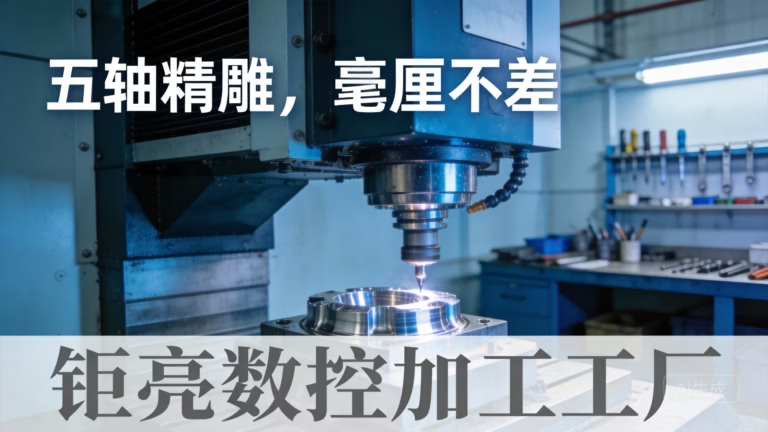
GreatLight Metal Technology runs three wholly-owned plants, 127 high-precision CNC machines, and 150 technicians, with the main site in Dongguan and a second factory in Singapore. That structure matters: raw material, machining, finishing and inspection stay under one management system rather than splitting across unnamed subcontractors.
- 1Engineering inputDFM notes returned with the quote, not after the order.
- 2Single quality systemOne inspection standard from blank to finished part.
- 3Documented outputInspection reports available on request.
Tolerance: what ±0.005 mm really requires
A tight tolerance number on a homepage tells you almost nothing. What matters is which machine holds it, on which material, and how the shop proves it. On aluminium 6061 or 7075, ±0.005 mm is realistic on a simultaneous 5-axis center with a controlled thermal environment. On a 400 mm long stainless part, the same number is a different conversation.
Ask three questions. Which machine will run my part? What is the spindle and thermal drift over a shift? How do you check the feature that matters? A shop that answers with machine names and a CMM routine is a shop that has thought about it before.
GreatLight machines to ±0.005 mm (±0.0002 in) where the geometry allows, with surface finish from Ra 0.2–0.8 μm on fine work to Ra 1.6–3.2 μm as machined. Those ranges are process limits, not marketing. If your drawing asks for Ra 0.4 μm on a deep pocket wall, expect a secondary operation and plan the cost.
- 1Feature size sets the limitThin walls and deep pockets move under cutting force.
- 2Material sets the limitTitanium and Inconel spring back differently than aluminium.
- 3Inspection sets the proofA tolerance you cannot measure is a tolerance you cannot hold.
Capacity: size, axes and the parts that do not fit
Capacity is where a lot of projects quietly fail. A factory may have fifty machines and still not hold your part. Check travel before you check spindle count. GreatLight runs 16 simultaneous 5-axis centers, 12 four-axis mills, 27 three-axis machines and 16 mill-turn centers, with a Ø400 mm rotary table and a maximum processing size of 4,000 mm.
The large travel is 4,000 × 400 × 150 mm for long, flat parts such as structural rails. Medium travels cover 750 × 1,150 × 550 mm and 600 × 600 × 600 mm for housings and manifolds. Compact travels of 500 × 500 × 450 mm and 500 × 310 × 200 mm handle small, high-count parts where cycle time dominates.
When capacity does not fit, say so early. A 1,200 mm part with a 0.02 mm flatness callout across its length is a different setup than the same part at 300 mm. Splitting a part into two pieces and joining them is sometimes cheaper than forcing one setup.
- 1Long parts4,000 mm travel suits rails, beams and extrusion profiles.
- 2Complex geometry5-axis cuts undercuts without re-fixturing.
- 3Round partsMill-turn handles shafts and fittings in one setup.
Lead time, MOQ and quotationscope
A quote that takes a week to arrive is a lead time problem before the first chip is cut. GreatLight returns a quotation and free DFM analysis within 12 hours, and production can start within 24 hours of a released order. Parts typically ship in 3–5 days, and the historical late-delivery probability is below 2%.
Minimum order quantity is the other filter. Some suppliers push prototype buyers toward a 100-piece minimum because setup time is hard to absorb. GreatLight has no minimum order quantity, so a single prototype and a 10,000+ part run go through the same quoting process.
Be careful with quotes that only show a number. A useful quote shows material grade, machining operations, finishing steps, inspection method and any DFM change that would cut cost. If the supplier cannot explain the price, they cannot defend it when you ask for a revision.
- 112-hour quoteIncludes DFM notes on features that will raise cost.
- 224-hour startProduction begins after drawing release and material confirmation.
- 33–5 day shippingApplies to standard machining, not to exotic material sourcing.
Certifications, data security and what to verify
Certificates are a filter, not a guarantee. ISO 9001:2015 covers general quality management. IATF 16949:2016 is what automotive and EV programs expect. ISO 13485:2016 is the baseline for medical device work. ISO 27001:2022 covers information security, which matters when you send CAD files and BOMs.
Ask for the certificate scope, not just the logo. A certificate that covers machining but excludes finishing will not help if your part needs hardcoat anodizing. Check the expiry date and the certification body. A PDF from three years ago is a museum piece.
On data security, the practical test is simple. Are uploads controlled? Is an NDA available before you send files? Does the supplier store your models on a shared drive with open access? GreatLight offers an NDA on request and treats uploads as confidential. That is the minimum for any OEM relationship.
- 1ISO 9001:2015General quality baseline for any supplier.
- 2IATF 16949:2016Required for automotive and EV production parts.
- 3ISO 13485:2016Medical device manufacturing expectations.
- 4ISO 27001:2022Information security for your design data.
How to vet a factory in five steps
Run these in order. Stop at the first step that fails.
- 1Send one representative partPick the feature that worries you most, not the easiest one. A 50 mm bracket with one true-position hole tells you more than a cube.
- 2Request DFM feedback with the quoteA real factory returns notes on wall thickness, tool access and tolerance stack within 12 hours. Silence means they are just pricing.
- 3Ask which machine and which inspectionExpect a machine class and a CMM or optical routine. If the answer is vague, the tolerance claim is vague too.
- 4Check the certificate scopeConfirm the certification covers the processes you need, including finishing, and that it is current.
- 5Run a first article before volumeOrder one to five pieces and inspect them against the drawing. Compare the report to your own measurements.
Questions buyers ask before releasing drawings
Can a trusted OEM CNC machining services factory handle both prototypes and production runs?
Yes, if the quoting process does not change between them. GreatLight has no minimum order quantity, so a single prototype and a 10,000+ part run use the same DFM review and inspection standard.
The difference is in fixture design and cycle time, not in the quality gate. Ask how the process changes at volume so you are not surprised by a new setup later.
How do I know the tolerance claim of ±0.005 mm is real?
Ask which machine holds it and how the feature is measured. On a 5-axis center with a controlled environment, ±0.005 mm is achievable on aluminium and some steels for features within the machine envelope.
For long parts or deep pockets, the achievable tolerance loosens. A supplier who explains that boundary is more credible than one who repeats the number.
What certifications should I require for automotive or medical work?
For automotive and EV, IATF 16949:2016 is the expected baseline. For medical devices, ask for ISO 13485:2016. Both sit on top of ISO 9001:2015.
If you send CAD files and BOMs, ISO 27001:2022 tells you the supplier has a formal information security system. Check the scope and expiry date on the certificate itself.
Is a lower price worth using a broker instead of a factory?
Sometimes, for simple parts with loose tolerance. The broker takes the margin and the factory takes the risk, which is fine until a feature fails.
For tight tolerance or regulated work, the extra layer makes root-cause work slow. You cannot audit a process you cannot see.
How fast can a quote and a first shipment arrive?
GreatLight returns a quotation and free DFM analysis within 12 hours. Production can start within 24 hours of release, and parts typically ship in 3–5 days.
Exotic materials such as Inconel or titanium may add sourcing time. Ask for a material lead time separately from a machining lead time.
What surface finishes can be done under the same roof?
Anodizing in clear, colour, hardcoat and conductive types, electroless nickel, zinc, silver and gold plating, powder coating, black oxide, bead blasting, tumbling, brushing and polishing.
Laser marking and engraving are also available, with a minimum character height of 1.5 mm. Keeping finishing in house avoids a second supplier with a different quality standard.
Send one part and see how the quote comes back
Upload a drawing and get a quotation with free DFM analysis within 12 hours. No minimum order quantity, NDA available on request.
12-hour quote100% inspectionNo MOQ
More from the shop floor
We publish setup notes, tooling trials and inspection data from the factory floor.











