
Alu CNC Machined Parts: How to Pick a Supplier
This page is for engineers and buyers sourcing aluminum CNC machined components from a contract shop. It covers the checks that actually predict part quality: tolerance, machine capability, finishing, inspection, and what a quote should contain. Read it before you send an RFQ.
In this article
- 1
- 2
- 3
- 4
- 5
- 6
- 7
What matters most when you buy alu cnc machined parts
Supplier checklist for alu cnc machined parts
Use this table to score two or three shops on the same items. The right column is what we hold at GreatLight.
| What to check | Weak answer | Strong answer | GreatLight |
|---|---|---|---|
| Tolerance | "We can hit anything" | A stated number across a run | ±0.005 mm (±0.0002 in) |
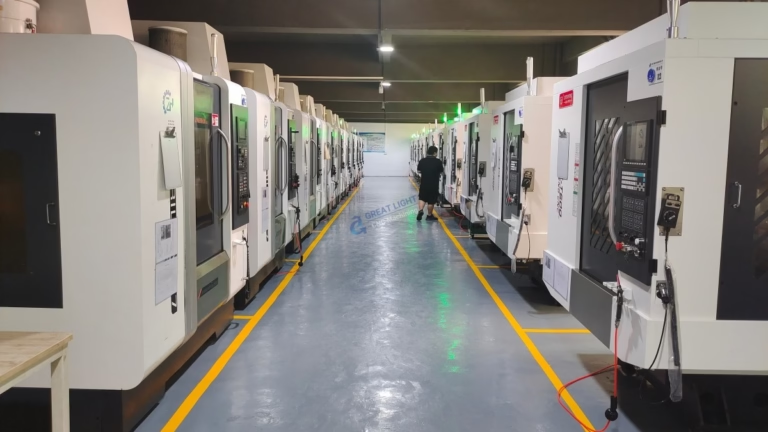
| Machine count | Vague or rented capacity | Named machines and travels | 127 CNC machines, 16 five-axis |
| Max part size | No limit given | Stated travel per machine | 4,000 × 400 × 150 mm |
| Alloys stocked | One or two grades | Full list with tempers | 6061-T6, 7075, 6082, 2024, 5052 |
| Finishing | Subcontracted, no control | In-house or audited vendors | Anodizing, plating, powder coat in-house chain |
| MOQ | High minimum per alloy | Prototype-friendly | No MOQ, 1 to 10,000+ parts |
| Quote turnaround | Days, no feedback | Quote plus DFM notes | Quote and free DFM within 12 hours |
| Certifications | ISO 9001 only | Sector-specific certs | ISO 9001, IATF 16949, ISO 13485, ISO 27001 |
Pick a supplier who answers the drawing, not the price sheet
If a shop cannot state its tolerance, machine travels and inspection format in writing, the low quote is not comparable. Send your drawing and get a quote with DFM notes within 12 hours.
Match the alloy and machine to the part, not the other way round
Aluminum is not one material. 6061-T6 is the default for brackets, housings and fixtures because it machines fast, welds well and takes anodizing evenly. 7075 gives roughly twice the yield strength of 6061, which matters for thin ribs and aerospace brackets, but it is less forgiving: sharper cutters, lighter depths of cut, and more attention to chip evacuation. 2024 behaves similarly and is common where fatigue life matters.
If you are buying alu cnc machined parts for a housing or enclosure, the alloy choice also affects the finish. 6061 anodizes to a consistent color. High-copper alloys such as 2024 can show blotchy dye results unless the anodizer adjusts the process. Tell the shop what the part will look like on the outside, not just what it has to hold.
Geometry decides the machine. A flat plate with holes on one face runs efficiently on a 3-axis mill. A part with ports on four sides, a compound angle, or a contoured pocket benefits from 5-axis because it reduces setups. Every extra setup adds a re-fixturing error, and that error usually shows up as a true-position problem on a bolt pattern.
Ask what travels the shop has, not just how many machines. A 4,000 mm bed handles long extrusion profiles; a Ø400 mm rotary table handles round work. If your part fits the wrong machine, the shop will either decline or quote a slow, expensive process.
- 16061-T6General purpose, best finish consistency, good weldability.
- 27075High strength, tighter feeds, more tool wear.
- 36082Common in Europe, similar to 6061 with slightly higher strength.
- 4ADC12Die-casting grade, not for machining from billet.
Read the tolerance and finish callouts before you compare prices
A quote is only comparable if both shops are working to the same drawing. Two suppliers can quote a 30 percent difference simply because one read a general tolerance block and the other assumed a tighter one. Write the critical dimensions on the drawing, mark the datum, and state the general tolerance for everything else.
As-machined aluminum lands around Ra 1.6–3.2 μm. That is fine for internal brackets. Visible covers usually want Ra 0.8–1.6 μm, and sealing faces or optical mounts can need Ra 0.2–0.8 μm, which normally means a finishing pass with a small stepover or a secondary operation. Each step up in finish adds cycle time.
Beware of a shop that quotes ±0.005 mm on a part with a 300 mm unsupported wall. The number is achievable on a small feature but not across a long thin section, because the material moves as you cut it. Good suppliers flag this in DFM and suggest a rib, a stress-relief step, or a relaxed tolerance on the non-critical face.
Surface treatment can move dimensions. Hardcoat anodizing builds roughly half into the surface and half into the material, and it grows the part. If a bore must stay on size after coating, say so on the drawing, because the shop has to machine it undersize first.
Why the process chain matters more than the machine list
Aluminum parts fail in three places: the first setup, the finishing stage, and the final inspection. A shop with excellent mills but a subcontracted anodizer will lose days in transit and lose control of the finish. Look for a supplier that owns the chain from raw stock to packed part, or at least audits the vendors it uses.
In-house finishing also shortens the feedback loop. If a dye lot comes out wrong, the shop can strip and re-anodize without a truck ride. That matters for cosmetic parts where color consistency across a build is part of the specification.
Inspection is the last gate and the one most often skipped in quotes. A serious supplier checks incoming stock, monitors during the run, and does a final dimensional report. Ask what is measured, with what equipment, and whether reports are included or charged extra. If the answer is vague, assume no report.
For regulated products, the paperwork is not optional. Automotive parts usually need IATF 16949 process control. Medical hardware needs ISO 13485 traceability. If your part falls in either category, confirm the certificate scope covers your process, not just the company name.
Where the money actually goes in alu cnc machined parts
On a low-volume aluminum part, setup and programming dominate the price. The material is usually a small fraction. That is why a 5-part order and a 50-part order often cost almost the same per part, and why a shop that charges a large non-recurring engineering fee is really charging for the first setup.
As volume rises, cycle time takes over. A part that runs in 20 minutes on a 3-axis machine can drop to 8 minutes on a 5-axis with fewer setups, but only if the geometry suits it. This is where a DFM review pays for itself: moving a feature to a different face, or relaxing a tolerance that does not matter, can cut minutes out of every cycle.
Material grade moves the price too. 7075 and 2024 cost more than 6061 and cut slower. If the strength is only needed in one region of the part, a hybrid design is rarely practical for machining, but a change to 6082 or a thicker 6061 section often is.
No minimum order quantity changes the economics of prototyping. A shop that will run one part lets you test fit and function before committing tooling budget. That is the single biggest reason buyers start with a prototype run and scale later.
How to qualify a supplier for alu cnc machined parts
Run these steps in order. Each one can disqualify a shop before you spend time on a full RFQ.
- 1Send a drawing with defined datumsMark critical dimensions and state the general tolerance block. A drawing without datums forces the shop to guess, and guesses do not compare.
- 2Ask for a DFM review with the quoteA useful DFM names specific features, suggests a fix, and gives the tolerance or finish it applies to. A generic 'looks good' is not a review.
- 3Confirm the machine and travel for your partState the envelope: for example 4,000 × 400 × 150 mm for long parts, Ø400 mm rotary for round work. Ask which machine will run it.
- 4Fix the alloy and temper in writing6061-T6 and 6061-T4 machine and behave differently. Put the temper on the purchase order, not just the alloy number.
- 5Agree the finish and its dimensional effectState Ra, coating type and any bore that must stay on size after coating. Hardcoat grows the part; plan the pre-coat size.
- 6Define the inspection report before the first cutDecide which dimensions are reported, in what format, and whether the report ships with the parts. Do this at PO stage.
- 7Run a small lot, then check repeatabilityOrder 5 to 20 parts and measure the same feature across all of them. A tight average with wide spread is worse than a small offset.
- 8Scale only after the first lot passesMove to 10,000+ part runs once the process is stable. Changing shop between prototype and production resets all the learning.
Questions buyers ask about alu cnc machined parts
What tolerance should I expect on aluminum CNC parts?
A capable shop holds ±0.005 mm (±0.0002 in) on features that the setup supports. That does not apply to every dimension on the drawing.
Long unsupported walls, thin ribs and deep pockets move during cutting, so they need a looser callout or a design change. Mark only the dimensions that matter and let the rest sit on a general tolerance block.
Does aluminum need a minimum order quantity?
No. The material is inexpensive relative to setup, so a shop can run a single prototype without a penalty on material purchasing.
What changes with volume is cycle time and fixture cost, not the alloy supply. Ask whether the quote includes programming and fixturing so you can see where the cost sits.
Which aluminum alloy is best for machined parts?
6061-T6 suits most brackets, housings and fixtures because it machines cleanly and anodizes evenly. 7075 and 2024 are for higher strength or fatigue-critical parts and cost more to cut.
Pick the alloy from the load case, not the price list. If 6061 fails a stress check, moving to 6082 or increasing a section is often cheaper than switching to 7075.
How do I compare quotes from two suppliers?
Make sure both quotes reference the same drawing revision, alloy temper, finish callout and inspection scope. Without that, the lower number may just mean less work.
Look at what is excluded: finishing, reports, freight, and whether DFM feedback is included. Those exclusions often account for the whole price gap.
What certifications should a supplier hold?
ISO 9001 covers general quality management. If your part goes into a vehicle, look for IATF 16949. Medical hardware needs ISO 13485 traceability.
Check the certificate scope. A company can hold a certificate that does not cover the process your part needs.
Can anodizing change my part dimensions?
Yes. Hardcoat and thick anodic layers build on the surface and grow the part. Bores and threads that must stay on size need to be machined undersize before coating.
Say this on the drawing. If the shop finds out at the finishing stage, the parts may have to be stripped and re-machined.
Send your aluminum part drawing today
Quote and free DFM analysis within 12 hours. Production can start within 24 hours, and parts ship in 3–5 days.
12-hour quoteNo MOQ100% inspectionNDA on request
More from the shop floor
We publish setup notes, tooling trials and inspection data from the factory floor.











