
Pieces Per Day: How High-Volume CNC Capacity Actually Works
This page explains what really limits pieces per day on a CNC floor: spindle hours, fixturing, in-process inspection and material flow. It is written for engineers and buyers who need to judge whether a supplier can hold tolerance across a 10,000 piece run, not just cut one good sample.
In this article
- 1
- 2
- 3
- 4
- 5
- 6
- 7
Where pieces per day comes from
A quote that says thousands of pieces per day is a claim about arithmetic, not about effort. Take one machining cycle of 4 minutes. One machine running 20 hours a day yields 300 pieces. Ten machines yield 3,000. The number is decided by cycle time, spindle hours per day and how many machines the job can occupy at once.
Cycle time itself is a sum of cutting time, tool change time, load and unload time, and any inspection pause. On a 3-axis mill cutting aluminium 6061, cutting may be 70% of the cycle. On a 5-axis job with deep pockets in 17-4PH stainless, cutting time is longer and the load-unload share shrinks. Both can still hit high daily counts; they just need different machine counts.
This is why we quote pieces per day only after seeing the drawing. Two parts with the same envelope can differ by a factor of five in cycle time because of one tight tolerance, one deep cavity, or one surface finish callout.
- 1Cycle timeCutting plus tool change plus load and unload.
- 2Spindle hoursHow many hours per day the job holds a machine.
- 3Machine countHow many spindles are assigned to the same part number.
- 4YieldGood parts out divided by parts started.
Fixturing decides the daily rate before the spindle does
The fastest spindle cannot beat a slow load. If a part takes 90 seconds to clamp and locate, that time repeats on every piece all day. A dedicated soft jaw, a vacuum plate or a hydraulic fixture can cut it to 15 seconds. On a 3,000 piece order, that difference is measured in machine hours, not minutes.
We build workholding around the run length. For one prototype, a vise and a set of stops are enough. For 10,000 parts, we cut dedicated fixtures on one of the 27 three-axis machines, then move the fixture to the mill-turn or 5-axis cell that will run the job. The fixture becomes a tooling asset, and it is what makes the per-piece number repeatable across shifts.
Fixtures also set the tolerance floor. A part held in a soft jaw on a Ø400 mm rotary table behaves differently from the same part held in a three-point clamp. If the drawing asks for ±0.005 mm on a bore, the fixture has to support that before the program is written.
Matching the part to 3-axis, 4-axis or 5-axis
Not every part should run on a 5-axis center. If a part has features on three faces but generous tolerances, a 3-axis machine with two re-fixturings is cheaper per piece. If those three faces must be true to each other within ±0.005 mm, the re-fixturing error alone eats the tolerance. That is when a 5-axis center pays for itself.
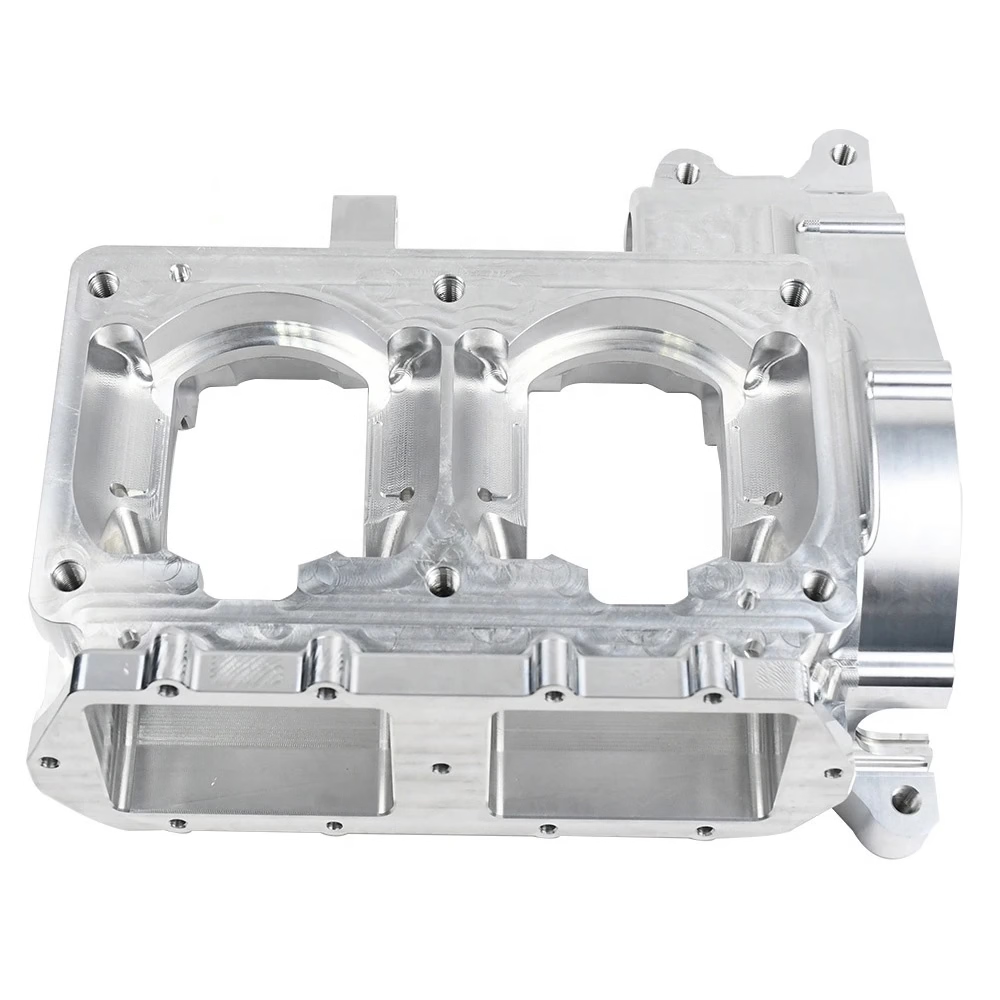
Our floor carries 16 simultaneous 5-axis machining centers, 12 four-axis mills, 27 three-axis machines and 16 mill-turn centers. The large frame travels 4,000 × 400 × 150 mm, so long extrusions and rails can be cut in one setup. Medium frames cover 750 × 1,150 × 550 mm and 600 × 600 × 600 mm. Compact frames at 500 × 500 × 450 mm and 500 × 310 × 200 mm handle small, high-count parts where fast load cycles matter more than travel.
A part that fits a compact frame and needs no re-fixturing is the best candidate for high daily counts. A part that needs four setups and a CMM check between each one is not, no matter how many machines are free.
Inspection is part of the cycle, not a step after it
On a high-count run, inspection has to be built into the cycle. We check raw material before it reaches a machine, monitor the process while the job runs, and inspect 100% of parts before shipment. Reports are available on request. The point is not paperwork. It is catching a drift before 200 parts are cut to the wrong size.
A practical example: a bore held at ±0.005 mm will move as the tool wears. If the operator measures every 25th part and the tool drifts 0.003 mm over 100 parts, the last parts in that window are already at the edge. Measuring every 10th part on a tight feature costs a few seconds per piece and prevents a scrap batch.
The 99.99% qualification rate we report is a floor, not a target. It comes from process control, not from sorting bad parts out at the end. Sorting is the most expensive way to reach a quality number, because the scrap was already paid for in spindle time.
Material and finishing keep the count steady
A machine that runs out of stock stops producing. Aluminium 6061, 7075 and 6082, stainless 303, 304 and 17-4PH, steel 1045 and 4140, brass C36000, and titanium TC4 are all stocked or sourced on short lead. The choice of material affects the daily count through cutting speed, not through supply alone.
Aluminium 6061 cuts fast and holds ±0.005 mm well, so it is the usual choice for high daily counts. 17-4PH stainless in the H900 condition machines cleanly but slower. Inconel and titanium TC4 need lower surface speed, more coolant and more frequent tool changes. The daily count drops, and that is a property of the material, not of the shop.
Finishing runs on a separate track. Anodizing, plating, powder coating, bead blasting, tumbling and laser marking are scheduled so the machining cell keeps cutting while finished parts move out. Laser marking needs a minimum character height of 1.5 mm; below that, the mark is not reliable across a large batch.
When high daily output is the wrong goal
High volume is not always the right answer. A part that will be redesigned next month should not get a dedicated fixture and a tuned program. Cutting 200 pieces from a vise setup is cheaper than building tooling for a design that will change.
Very tight tolerances also fight volume. A ±0.005 mm callout on a feature that does not need it will slow every cycle and raise the scrap risk. We review tolerances during the free DFM analysis and flag callouts that add cost without adding function. Quotation and DFM come back within 12 hours.
Finally, volume does not fix a bad process. If a part has a chatter problem at 10 pieces, it will have the same problem at 10,000, only more often. We would rather spend an extra day on the setup and run the job clean.
Which machine class fits which part
Match the part geometry and tolerance to the machine, then estimate the daily rate.
| Part profile | Best machine class | Setup count | What limits the daily rate |
|---|---|---|---|
| Flat plate, holes on one face | 3-axis | 1 | Load and unload time |
| Shaft with flats and cross holes | 4-axis or mill-turn | 1 | Rotary index time |
| Housing with true-position bores on 3 faces | 5-axis simultaneous | 1 | Spindle hours |
| Long rail up to 4,000 mm | Large-frame 3-axis | 1–2 | Fixture rigidity |
| Small part, 10,000+ pieces | Compact 3-axis cell | 1 | Fixture changeover |
| Titanium or Inconel part | 5-axis with high-pressure coolant | 1–2 | Tool life and heat |
Choose the goal before the machine
If the part is stable and the count is above 10,000, build the fixture and run it on a dedicated cell. If the design is still moving, keep it on a vise setup and accept a lower count until the drawing freezes.
Questions engineers ask about volume runs
How many pieces per day can one machine produce?
It depends on cycle time and spindle hours. A 4-minute cycle on 20 productive hours gives about 300 pieces per machine per day. A 12-minute cycle gives about 100.
The number scales with machine count. The honest answer always starts with the cycle time from your drawing.
What is the smallest order you accept?
There is no minimum order quantity. Runs go from one prototype to 10,000+ pieces.
For a single prototype, setup cost dominates the price. For 10,000 pieces, fixture and tooling cost is spread thin, and the per-piece number is driven by cycle time.
Does a high daily count mean lower tolerance?
No, but it changes how tolerance is held. Volume work relies on fixtures, in-process checks and tool-wear tracking rather than on an operator adjusting every part.
We hold ±0.005 mm on production runs when the fixture and the machine class support it.
Which materials are best for large runs?
Aluminium 6061, 6061-T6, 6082 and 7075 cut fast and hold tight tolerances, so they give the highest daily counts.
Stainless 303 and 17-4PH, steel 4140 and 4340, titanium TC4, Inconel and magnesium AZ31B all machine at lower surface speeds, so the daily count drops.
How do you keep 10,000 parts consistent?
Raw material is checked before machining, the process is monitored while the job runs, and 100% of parts are inspected before shipment.
Dedicated fixtures and a frozen program keep the setup identical across shifts. That is what makes the count repeatable.
Can you start production quickly?
Quotation and free DFM analysis come back within 12 hours, and production can start within 24 hours after approval.
Parts ship in 3–5 days. For long runs, we schedule the batch so the first articles ship early while the rest of the order keeps cutting.
Send the drawing, get the cycle time
We will come back with a cycle estimate, a machine class and a realistic pieces per day figure for your order quantity.
12-hour quoteFree DFM analysis100% inspection
More from the shop floor
We publish setup notes, tooling trials and inspection data from the factory floor.











