
Prototype Mold 7 Day Lead Time
This page explains what actually has to happen inside a seven-day prototype mold build, which parts fit the window, and which ones do not. It is written for tooling engineers and sourcing managers who need to judge a quote, not just read a promise.
What a prototype mold 7 day lead time really measures
A prototype mold 7 day lead time is not one fast operation. It is a chain of short operations that overlap, and the clock starts when the 3D model and the steel grade are fixed. Seven days covers programming, roughing, semi-finishing, finishing, electrode work if needed, spotting, and a sample shot. Any single step that slips a day pushes the whole build.
Most shops lose their time in queues, not in cutting. A core block waiting two days for an outside heat-treat furnace is two days gone. A cavity sitting in a polishing room behind production work is another day. Speed comes from removing handoffs, not from running the spindle harder than the tool allows.
The number is worth reading as a boundary, not a slogan. A small insert with simple shutoffs and no deep ribs can finish comfortably inside seven days. A 600 mm housing with ten sliders, a hot runner, and a mirror finish will not, and a shop that says otherwise is either quoting a different scope or planning to ship something unfinished.
- 1Clock starts at frozen geometryChanges after steel is cut reset the counter.
- 2Steel grade drives the schedulePre-hardened grades skip a heat-treat cycle.
- 3Polishing is the hidden dayBench work does not scale with machine speed.
Why 5-axis machining compresses the schedule
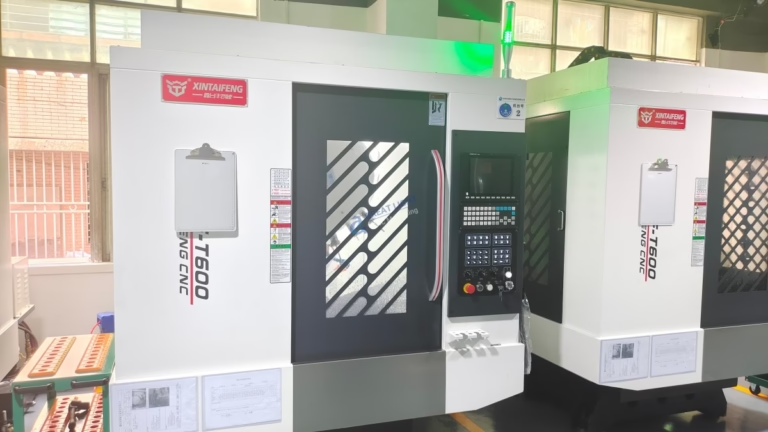
On a 3-axis mill, a core with angled shutoffs, deep pockets, and a curved parting line needs three or four setups. Each setup means unclamping, cleaning, re-indicating, and re-entering the datum. On a simultaneous 5-axis center, the table tilts and the tool reaches the same geometry in one or two setups. That is where the days come from.
Tilting the tool also lets us use shorter, stiffer cutters. A long tool hanging out of the holder chatters, and chatter shows up as witness marks that a polisher then has to grind out by hand. Short tools hold tolerance better and leave a finish closer to final. In practice a cavity can come off the machine at Ra 0.8–1.6 μm and need only light spotting.
High-speed machining paths matter just as much. Small stepovers, high spindle speed, and constant chip load keep heat in the chip instead of the workpiece. That protects the hardness of pre-hardened steel such as P20, NAK80, or 718. If the cut overheats the surface, the mold loses hardness exactly where the plastic will flow.
- 1One-setup geometryTilted table reaches angled shutoffs without refixturing.
- 2Shorter toolsLess chatter means less bench work later.
- 3Controlled heatPre-hardened steel keeps its hardness.
Steel choice decides whether the window holds
Pre-hardened grades are the default for a prototype mold because they arrive at 28–40 HRC and can be cut directly. P20 and 718 are common for general parts, NAK80 for a better polish, and 1.2343-type steel when the resin is abrasive or the run may extend to tens of thousands of shots. None of these need a hardening cycle before cutting.
A through-hardened tool steel changes the plan. The block is machined soft, hardened at 1,000–1,050 °C, tempered, then finished by EDM or high-speed milling and hand-polished. That is a sound route for a long production mold. For a seven-day prototype it usually does not fit, because the furnace cycle plus a second setup eats three or four days.
Aluminum is the other fast option. A 7075 or QC-10 cavity machines quickly and is fine for low-volume trial shots, but it wears at gates and shutoffs. If the prototype mold is expected to run 5,000 shots or more, steel is the cheaper decision in the end.
- 1Stay pre-hardened28–40 HRC, no furnace queue.
- 2Aluminum for trials onlyWatch gate wear on longer runs.
- 3Hardened steel resets the planBudget the extra days, do not compress them.
Where the seven days actually go
Day one is DFM and programming. We check draft, wall thickness, gate location, ejector placement, and parting line, then cut the toolpaths. The 3D model is frozen at the end of this day. Files delivered as STEP or Parasolid with a defined shrinkage factor save hours before the spindle even starts.
Days two and three are roughing and semi-finishing on the 5-axis centers. Day four is finishing of cavity, core, and inserts, plus electrode milling if sharp internal corners are needed. Day five covers EDM for those corners, fitting, and spotting the shutoffs with layout blue.
Day six is assembly, water-line pressure test, and the first sample shot on a trial press. Day seven is dimensional inspection of the shot part against the drawing, adjustment if needed, and packing. This sequence assumes the mold is small to medium, the steel is pre-hardened, and no design change lands mid-week.
- 1Day 1DFM, toolpath programming, geometry frozen.
- 2Days 2–4Rough, semi-finish, finish, electrodes.
- 3Days 5–7EDM, spotting, assembly, sample shot, inspection.
What genuinely cannot be rushed
Heat treatment is the clearest wall. A vacuum furnace cycle plus tempering takes a fixed number of hours, and skipping temper leaves residual stress that cracks a cavity weeks later. No amount of overtime removes that time. If the mold needs hardened steel, the honest answer is a longer lead time.
Deep EDM work on sharp ribs is the second wall. A 0.5 mm electrode burning a 30 mm deep rib runs for many hours, and the burn is unattended but not faster for it. Shops that promise to compress this usually mean they will ship the mold with an unfinished corner and let you discover it at the press.
Texturing and engraving sit at the edge. Laser marking with a minimum character height of 1.5 mm is quick and can be done in-house. Acid etching for a leather grain needs an outside vendor and scheduling, which pushes past the window in most cases.
- 1Heat treatFixed furnace hours, cannot be compressed.
- 2Deep EDMBurn time is set by rib depth and electrode size.
- 3Texture etchingOutsourced, so it adds calendar days.
Which molds fit a 7-day build
Use this to sanity-check a scope before you send it out.
| Mold feature | Fits 7 days | Needs 10–15 days | Why |
|---|---|---|---|
| Cavity size | Under 400 mm | Over 600 mm | Roughing time scales with volume |
| Steel | P20, 718, NAK80 | Hardened 1.2343 | Furnace cycle plus second setup |
| Sliders and lifters | 0–2 | 4 or more | Each one needs its own fit-up |
| Surface finish | Ra 0.8–1.6 μm | Mirror, Ra under 0.2 μm | Bench polishing is manual |
| Hot runner | None | Full hot half | Manifold and wiring lead time |
| Shutoff geometry | Simple, flat parting | Angled, 3D parting | 5-axis helps but adds checks |
| Expected shots | Up to 5,000 | Over 20,000 | Wear life needs harder steel |
| Sample shots | One trial | Multiple DOE rounds | Each round needs press time |
When to take the fast route, and when not to
If your part is under 400 mm, uses pre-hardened steel, and needs up to a few thousand trial shots, a 7-day prototype mold is a sound choice. If it needs hardened steel, mirror polish, or a full hot runner, accept a 10–15 day build instead of forcing a deadline the process cannot meet.
Questions engineers ask before booking the window
What files do you need to start the clock?
Send a STEP or Parasolid model with wall thickness, gate location preference, and the resin grade including any glass content. A 2D drawing with critical dimensions helps us set the inspection plan.
If shrinkage data is not decided yet, tell us the material and we will apply a standard factor and note it on the DFM sheet.
Can a design change be absorbed mid-week?
Only if it lands before finishing starts. A change after semi-finishing means new toolpaths, a new electrode, and usually a new timeline.
We freeze geometry at the end of day one for exactly this reason. Changes after that are quoted as a new scope.
How many trial shots are included?
The seven-day plan includes one sample shot run for dimensional checking. Additional DOE rounds depend on press availability and are scheduled separately.
We inspect the shot parts before shipment and can supply reports on request.
Is aluminum ever the right call for a prototype mold?
Yes, when you need a handful of shots to prove fit and the resin is not abrasive. 7075 machines fast and holds a decent finish.
Do not use aluminum at gates and shutoffs if you expect thousands of shots. The wear shows up as flash within a few hundred cycles.
How is confidentiality handled on mold drawings?
Uploads are secure and confidential, and we sign an NDA on request before any file transfer. Customer drawings are not shared outside the project team.
We hold ISO 27001:2022 for information security, which covers how files are stored and accessed.
What tolerance can a prototype mold cavity hold?
We work to ±0.005 mm on critical mold dimensions and inspect 100% before shipment. The molded part tolerance is a separate matter and depends on resin shrinkage.
For the part itself, expect to tune dimensions after the first shot rather than hitting every nominal on shot one.
Send the model, get a real schedule
We quote and return a DFM analysis within 12 hours, then tell you honestly whether the part fits a seven-day build or needs longer.
12-hour quoteDFM analysis includedNo MOQ
More from the shop floor
We publish setup notes, tooling trials and inspection data from the factory floor.











