
The Mobile Phone Supply Chain Moves Into Vape Hardware
Vape hardware now borrows die-casting, battery tab welding, and stacked tolerance practice from phone builds. This page explains what that shift changes on the shop floor, which parts it fits, and where CNC still beats a die-cast tool. Written for design engineers and sourcing leads who need to pick a process before committing to tooling.
In this article
- 1
- 2
- 3
- 4
- 5
- 6
- 7
Why the Mobile Phone Supply Chain Fits Vape Assembly
A phone build and a vape build share the same physical problem list. Both squeeze a lithium cell, a power board, a switch, and a shell into a body that has to survive a pocket. Both run on thin-wall die castings, stamped contacts, and small injection-molded parts. When a phone-tier supplier retools a line for a vape program, most of the process knowledge already transfers.
The overlap is not cosmetic. Cell tabs on a phone pack are welded at fixed energy and pressure; the same weld schedule works on a vape cell of similar capacity. Die-cast frames on a phone mid-frame hold flatness across a 150 mm span; a vape chassis is smaller, so the same tool wear budget buys more parts.
What changes is the duty cycle. A phone sees steady current draw and a controlled charge curve. A vape sees burst discharge at 15–30 A, then idle. That pushes contact resistance and thermal path to the front of the design review, ahead of cosmetics.
- 1Shared processesDie casting, stamped contacts, laser welding, small-part injection molding
- 2Shifted priorityBurst current and heat path matter more than drop-test cosmetics
Battery Tabs, Contacts, and Resistance Budgets
Every milliohm between the cell and the coil turns into heat inside a hand-held body. A phone supply chain already tracks this. Weld quality on nickel tabs is checked by pull force and by cross-section, not by eye. The same discipline applies to a vape contact block.
Start with the interface, not the cell. A spring contact rated at 0.5 N may look fine on a datasheet, but at 20 A the contact resistance dominates. Plated copper alloy with a defined normal force beats a thin stamped strip every time. Specify the plating thickness and the alloy, not just the shape.
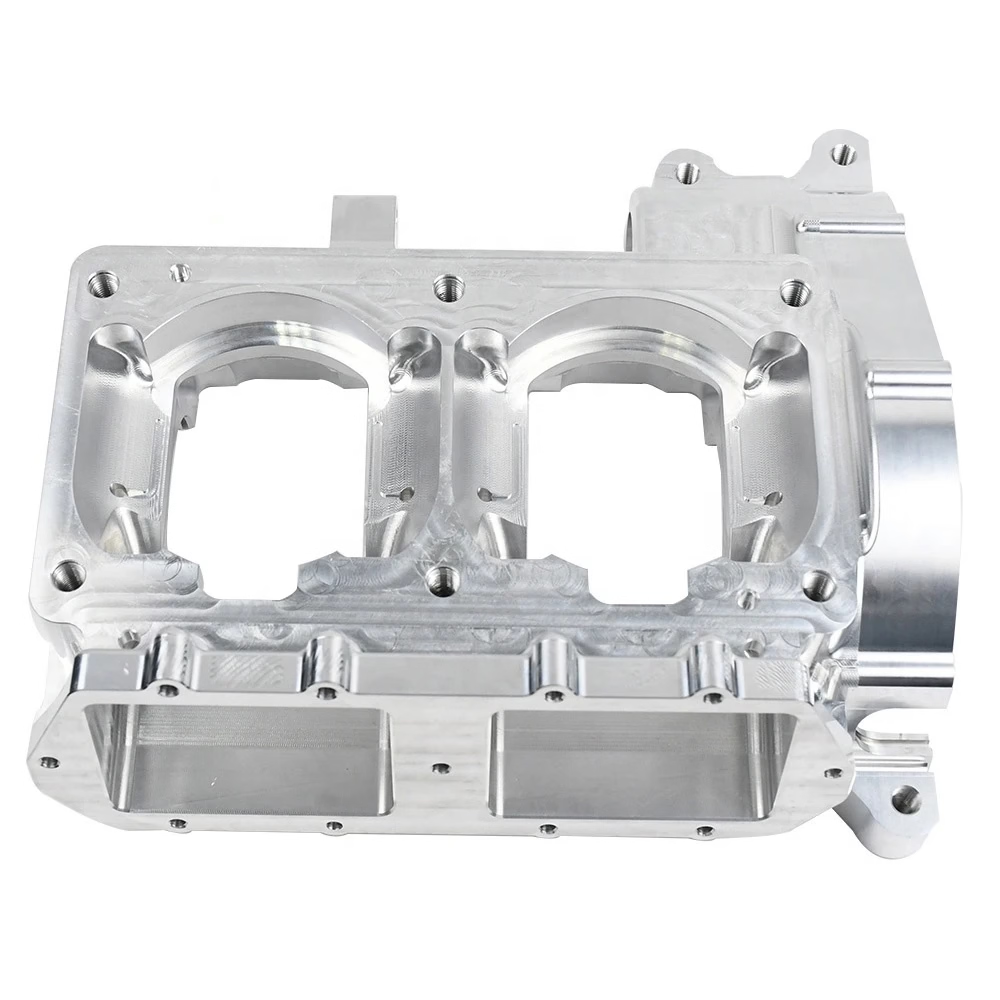
Machined contact blocks let you control the mating face flatness. On a 5-axis mill we hold ±0.005 mm on the seat and Ra 0.8–1.6 μm on the face, which keeps the joint predictable across a production run. Die casting can do the same job at volume, but the first tool has to prove the flatness before you commit.
- 1Check pull forceWeld tabs by destructive pull, not visual inspection
- 2Control normal forceDefine spring rate and plating thickness on the drawing
- 3Measure milliohmsFour-wire resistance on the assembled contact stack
Tolerance Stacks in a 20 mm Body
A vape chassis stacks four to six parts in a space a phone would use for one. Each interface adds variation. If the shell, the frame, the board, and the contact block each carry ±0.10 mm, the stack can eat the entire button travel before assembly.
The fix is not tighter tolerance everywhere. It is a datum plan. Pick one machined face as the primary datum, locate the board against it, and let the cosmetic shell absorb the rest. Phone assembly lines do this on camera brackets and speaker modules.
This is where CNC earns its place in a low-volume program. A machined frame at ±0.005 mm gives you a hard reference for the whole stack. Once the design freezes and volumes climb, that frame can move to die casting with the same datum called out on the tool drawing.
- 1One primary datumLocate the board against a single machined face
- 2Let the shell floatCosmetic parts take the loose tolerance
- 3Freeze before toolingMove to die casting only after the stack is verified
Die Casting vs CNC for the Same Housing
Die casting wins on cost per part once the tool is amortized. It gives you wall sections of 0.8–1.2 mm, integrated bosses, and a finish that needs little machining. For a vape shell at 10,000 pieces a year, that is usually the right call.
CNC wins on time to first article. No tool, no gate design, no draft angle to argue about. A 5-axis machine can cut a housing with undercuts and a sealing groove in one setup, and the same program runs the revision next week. For 50 to 500 units, that gap is decisive.
The middle case is a hybrid. Cast the body, then machine the sealed face, the thread, and the contact seat. This keeps the low cost per part and puts the tight tolerance only where the function needs it. We machine castings like this on 3-axis and 4-axis mills every week.
One caution. Cast aluminium (ADC12) machines differently from 6061. It is more abrasive and can porosity-blowout on a thin rib. Leave 0.4–0.6 mm of stock for the finish pass and expect a shorter tool life.
- 1Die cast at volume10,000+ parts a year, simple geometry, low unit cost
- 2CNC at low volume50–500 units, undercuts, revisions, no tool spend
- 3Hybrid for functionCast the body, machine the sealing face and thread
Leak Paths and Sealing Faces
A vape body has to hold liquid and vapor. A phone body only has to keep dust out. That raises the bar on the sealing face: flatness, surface finish, and no porosity at the seal land.
A machined groove at Ra 0.8–1.6 μm with a controlled depth takes an O-ring reliably. A cast groove often needs a finish pass because draft angle and parting-line flash break the seal. If the groove is cast, specify the machining allowance on the drawing.
Test the seal, not the drawing. A simple pressure-decay check on the assembled body catches a bad land before it reaches the customer. We run 100% inspection before shipment and can supply dimensional and seal reports on request.
- 1Control the landFlatness and finish on the seal face, not the whole body
- 2Allow stockLeave 0.4–0.6 mm for a finish pass on cast grooves
- 3Verify by testPressure decay on 100% of assembled bodies
Surface Finish and Plating Choices
Cosmetics and function pull in opposite directions on a vape body. A brushed or bead-blasted shell hides fingerprints and tool marks. A polished shell shows every scratch from the pocket.
For functional faces, plating matters more than looks. Electroless nickel gives a uniform coat on a complex contact block and holds solderability. Gold plating on the contact pads keeps resistance low over thousands of cycles. Anodizing on the shell should be hardcoat if the part sees abrasion.
Laser marking is often the last step. Minimum character height is 1.5 mm for a readable mark. Plan the marking area on a flat or gently curved face so the mark stays in focus.
- 1ShellBead blast or brush, then hardcoat anodize
- 2ContactsElectroless nickel, then gold on the pad
- 3Marking1.5 mm minimum character height, flat face
When Each Process Fits a Vape Program
Judged on volume, geometry, and tolerance need
| Process | Best volume | Hold on tolerance | Watch out for |
|---|---|---|---|
| Die casting (ADC12) | 10,000+ parts a year | ±0.10 mm as cast | Porosity on thin ribs; draft on seal grooves |
| 3-axis CNC | 50–2,000 units | ±0.005 mm on flat faces | Undercuts need a second setup |
| 4-axis CNC | 50–2,000 units | ±0.005 mm on indexed faces | Extra setup time per rotation |
| 5-axis CNC | 1–500 units | ±0.005 mm on contoured faces | Higher hourly rate; worth it for complex shape |
| Cast plus finish machining | 5,000+ parts a year | ±0.005 mm on machined faces | Allow 0.4–0.6 mm stock on cast faces |
| Stamped contact + CNC seat | Any volume | Dependent on the seat | Normal force and plating drive resistance |
Pick the Process by Volume, Not by Habit
Under 500 units with undercuts or a sealing groove, machine the body on 5-axis and skip the tool. Above 10,000 units a year with simple geometry, die cast and machine only the seal land and thread. Anything in between, cast the body and finish-machine the functional faces.
Questions Engineers Ask
Can a die-cast vape body hold the same tolerance as a machined one?
Not as cast. A die casting typically holds ±0.10 mm on a stable feature and less on a thin rib. If a face needs ±0.005 mm, machine it after casting.
The practical route is to cast the body and add a finish pass on the sealing face, the thread, and the contact seat. That keeps the low cost per part and puts tight tolerance only where the function needs it.
How do I keep contact resistance low over thousands of cycles?
Define the alloy, the plating thickness, and the normal force on the drawing. A gold flash over electroless nickel on a copper alloy block is a common answer.
Then verify it. A four-wire resistance check on the assembled contact stack catches a bad plating batch before it ships.
What surface finish should I call out on a seal groove?
Ra 0.8–1.6 μm is a workable target for an O-ring land. Finer than Ra 0.2–0.8 μm adds cost without much gain unless the seal is a face seal on a gas path.
Control flatness more than finish. A wavy land at a good Ra will still leak.
Does the mobile phone supply chain change lead times for vape parts?
It changes the ramp, not the first article. Quotation and DFM feedback come back within 12 hours, and production can start within 24 hours for machined parts.
Machined parts ship in 3–5 days. Die-cast parts wait on the tool, which is a separate schedule.
What is the minimum order quantity for a first prototype?
There is no minimum order quantity. A single prototype and a 10,000+ part run go through the same process plan, just at different cost points.
Uploads are kept confidential and we can sign an NDA before you send drawings.
Send the Drawing, Get a Process Answer
Upload a STEP file and we will come back with a DFM note, a process choice, and a quotation within 12 hours.
12-hour quote100% inspectionNo MOQNDA on request
More Process Notes
We publish setup notes, tooling trials and inspection data from the factory floor.











