GreatLight CNC Machining Factory logo
CNC Machining
Rapid Prototyping
Materials
Industries
News
About GL

Get Instant Quote

Stainless Steel Machining

Stainless Steel CNC Machining for Tight-Tolerance Parts

We machine 303, 304, 316L, 420 and 17-4PH into seals, housings and valve bodies. 16 five-axis centers, ±0.005 mm tolerance and a 4,000 mm size ceiling. Send a drawing and get a quote with DFM notes in 12 hours.

303 / 304 / 316L / 17-4PH±0.005 mmRa 0.2–0.8 μmNo MOQ12-hour quote
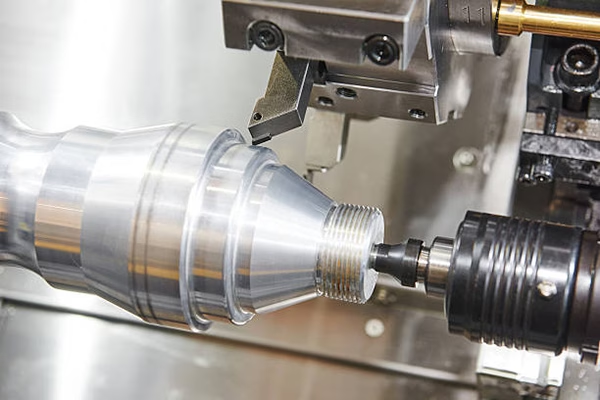
aluminum-vs-stainless-steel-cnc-lathing-machining-service
±0.005 mmAchievable tolerance on stainless parts
16Simultaneous 5-axis machining centers
4,000 mmMaximum processing size
99.99%Qualification rate before shipment
Common Problems

Where Stainless Parts Usually Go Wrong

The alloy is not hard to cut. It is hard to cut without moving, loading up or burning a tool.

01

Do your thin walls spring back after unclamping?

303 and 304 work-harden fast. Heavy clamping and dull inserts push the wall out of true, so a 1.5 mm web that measured on the machine ends up 0.06 mm off after the vise opens. We rough, stress-relieve, then finish with light passes and low clamping force.

02

Are your threads galling or tearing?

Austenitic grades weld to the tool edge under heat. A tapped M6 hole in 316L can come out with torn crests and a gauge that will not pass. We cut threads with form taps or single-point tools at controlled speed, and check with go/no-go gauges.

03

Does 17-4PH come back soft or undersized?

This grade machines in the annealed state and then ages to H900 or H1075. If the shop skips the shrink allowance, holes and bores close up after heat treat. We machine to pre-age dimensions and confirm hardness and size after aging.

04

Is your Ra callout treated as a suggestion?

A seal groove at Ra 0.4 μm is a functional requirement, not a finish note. If the surface is left at Ra 3.2 μm, the O-ring leaks and the whole assembly fails leak test. We inspect the groove surface and report the measured value.

Our Approach

How We Machine Stainless Steel Parts

Stable setups, correct inserts, and inspection that matches the drawing callout.

cnc-alloy-steel
Setup and Tooling

Rigid setups beat aggressive feeds

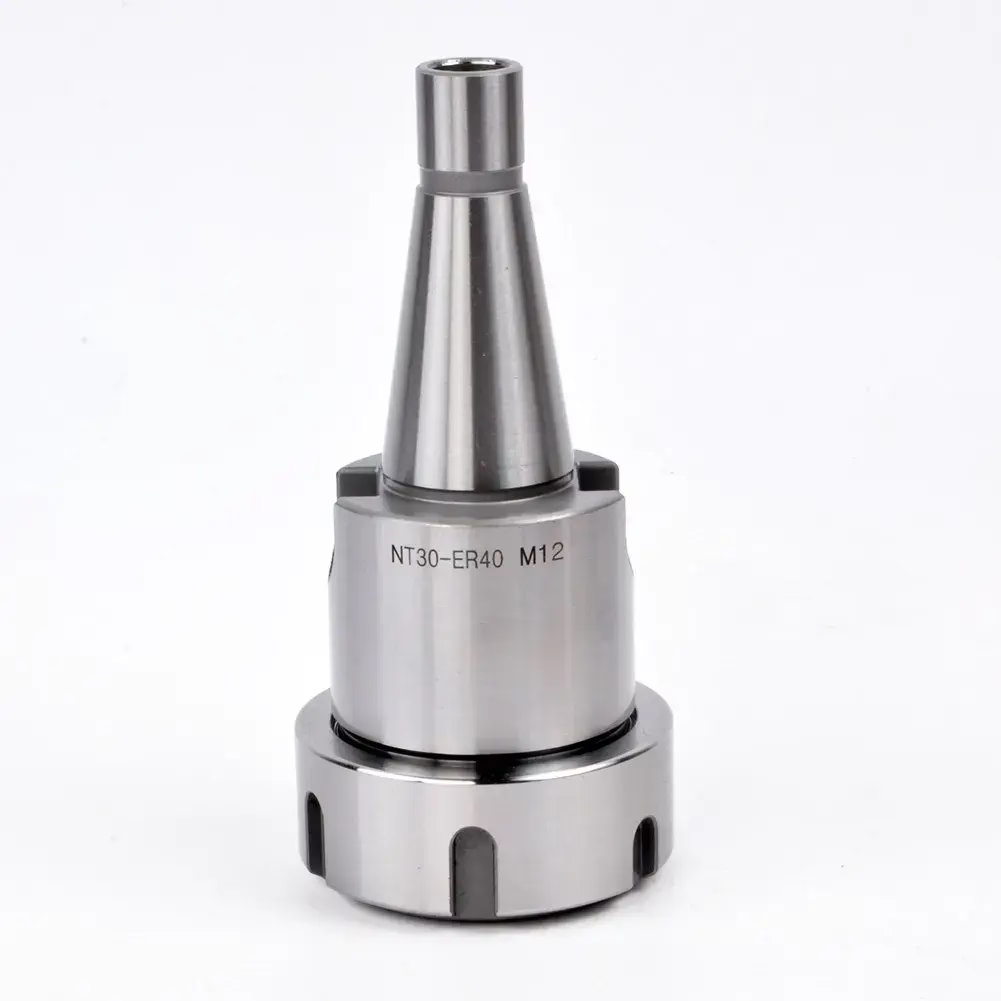
Stainless steel cnc machining rewards stiffness over speed. We keep tool overhang short, use balanced holders and run carbide grades made for austenitic and PH grades. Coolant goes to the cutting edge, not over the part.

For parts with thin floors or long bores, we add support between operations instead of adding passes. That keeps the geometry you modeled.

  • 1
    Insert grade matched to the alloyDifferent grades for 316L, 17-4PH and 440C.
  • 2
    Low-clamp finishingReduces distortion on walls under 2 mm.
  • 3
    Chatter controlTuned speeds and shorter overhang on deep pockets.

Get Instant Quote

okay-here-are-several-rephrased-product-titles-ranging-from-more-concise-to-3
Multi-Axis Capacity

One setup, more true position

Every re-clamp adds error. Our 16 simultaneous 5-axis centers and 16 mill-turn centers cut ports, flanges and angled holes in a single setup. True position holds because the datum never moves.

For long shafts and manifolds, the 4,000 mm travel machine handles parts that would otherwise need splicing or welding.

  • 1
    5-axis for angled featuresCuts valve bodies and impellers without repositioning.
  • 2
    Mill-turn for round partsTurns and mills shafts in one cycle.
  • 3
    Ø400 mm rotary tableIndexed work for repeatable hole patterns.

Get Instant Quote

Grade Selection

Pick the Grade Before You Pick the Process

The same part behaves differently in each grade. This is what we see on the floor.

GradeTypical UseMachining Notes
303Shafts, fittings, bushingsFree-machining; best surface finish
304 / 304LHousings, brackets, tanksWork-hardens; light finishing passes
316 / 316LMedical, marine, food contactGalls easily; form taps preferred
420 / 440CWear parts, valve seats, knivesHeat treat after machining
17-4PHAerospace, pump shaftsMachine oversize, then age
430 / 431Decorative and mild corrosionMagnetic; good for shafts
Services

What We Can Do With Your Part

One shop for machining, finishing and inspection.

01

5-Axis CNC Machining

Complex stainless geometry cut in one setup. Best for valve bodies and impellers with angled ports.

02

4-Axis and 3-Axis Milling

Plate work, housings and brackets. Good fit for flat parts with drilled patterns.

03

CNC Turning and Mill-Turn

Shafts, fittings and bushings. Turned and milled in a single cycle.

04

Rapid Prototyping

One-off stainless prototypes for fit checks before tooling spend.

05

Surface Finishing

Passivation, bead blasting, polishing and plating matched to the grade.

06

Inspection and Reports

Dimensional reports and material certs on request with the shipment.

Capabilities

Machine Range and What Fits Where

Use this to judge whether your part is a fit before you send it.

Machine TypeTravel or SizeTypical Parts
5-axis centersUp to 750 × 1,150 × 550 mmValve bodies, impellers
Large travel mill4,000 × 400 × 150 mmLong shafts, manifolds
Compact 3-axis500 × 500 × 450 mmPlates, small housings
Mill-turn centersØ400 mm rotary tableFittings, bushings, shafts
Tolerance±0.005 mmSeal grooves, bearing bores
Finish rangeRa 0.2–3.2 μmFrom as-machined to fine
Why GreatLight

Data Behind the Decision

15Y

15 years in metal

Founded in 2011. Three wholly-owned plants and 150 technicians across Dongguan and Singapore.

127

127 CNC machines

Enough spindle capacity to run prototypes and production without pushing your job to the back.

12h

Quote in 12 hours

Quotation plus free DFM analysis. Production can start within 24 hours of approval.

0

No minimum order

From one prototype to 10,000+ part runs. Same process, same inspection.

100%

Inspection before shipment

Raw material check, in-process monitoring and final inspection on every lot.

ISO

Four systems in place

ISO 9001:2015, IATF 16949:2016, ISO 13485:2016 and ISO 27001:2022.

7,600 m²Manufacturing space
3Wholly-owned plants
150Technicians on staff
< 2%Historical late-delivery rate
Industry Fit

What Each Industry Requires, and What We Deliver

electronic-product-housing-prototype

Medical device housings

316L bodies with clean bores and no trapped chips.

  • Ra 0.8 μm
  • Passivated
  • 100% inspected
cnc-machined-prototype-parts-for-product-demonstrations

Aerospace brackets

17-4PH parts machined oversize, then aged to final size.

  • ±0.005 mm
  • H900 aging
  • Material certs
6a7c7b8a05b1f9f10be636920614a594

Pump and valve components

Seal grooves held to finish, not just to size.

  • Ra 0.4 μm grooves
  • Leak-tested fit
  • 5-axis
8e504068bc026d2caf660337b3ba4192-1

Food and marine hardware

316L parts finished for washdown and chloride exposure.

  • 316L
  • Bead blasted
  • No MOQ
FAQs

Questions Engineers Ask Us

Which grade should I choose for a machined part?

Start with the environment, not the machinability. Chlorides or washdown push you to 316L. A shaft running in a bushing usually wants 303 for finish, or 17-4PH if you need strength after aging.

If corrosion is mild and cost matters, 430 or 431 machines well. We will tell you when a grade change is worth it and when it is not.

Can you hold ±0.005 mm on stainless?

Yes, on features that allow it. A bearing bore in a rigid housing is a normal job at that tolerance.

A long unsupported wall will move no matter who cuts it. We flag those features in the DFM review and propose a workable tolerance instead of promising one we cannot hold.

How do you handle 17-4PH heat treatment?

We machine in the annealed condition, leaving an allowance for the size change that comes with aging. Then the lot goes to H900 or H1075 as your drawing calls out.

After aging we check hardness and critical dimensions. If a bore closed up, we catch it before shipment, not at your assembly line.

What surface finish can you achieve on seal grooves?

Ra 0.2–0.8 μm is achievable on turned and milled surfaces with the right tool and pass. As-machined work typically sits at Ra 1.6–3.2 μm.

Tell us the function of the surface. A groove that seals needs a finish callout. A bracket face usually does not, and paying for it is wasted money.

Do you passivate stainless parts after machining?

Yes. Passivation removes free iron left by cutting tools and restores corrosion resistance on 300-series grades.

We also offer bead blasting, polishing and plating. Pick the finish based on where the part lives, not on how it looks in a photo.

What is your minimum order quantity?

There is none. One prototype and a 10,000-part run go through the same setup and inspection process.

Small runs are useful for proving a design. When the design is stable, we scale the same program rather than rewriting it.

How fast can I get parts?

Quotation and free DFM analysis come back within 12 hours. Production can start within 24 hours of approval, and parts ship in 3–5 days for standard jobs.

Complex geometry or outside finishing adds time. We tell you the real date up front rather than revising it later.

How do you protect my design files?

Uploads are secure and confidential. We sign an NDA on request before reviewing drawings.

Our quality systems include ISO 27001:2022 for information security, so file handling follows a documented process.

Send a Stainless Drawing, Get a Real Answer

Upload your STEP file and tolerances. We reply with a quote, a DFM review and a machining plan within 12 hours.

12-hour quote100% inspectionNo minimum orderNDA on request

Trusted by engineers and manufacturers worldwide

Tesla Ford Motor Company BYD Auto Denso Magna International Boeing Airbus Medtronic KUKA FANUC