
Shortened CNC Machining Services: How to Pick a Supplier Without Gambling on Quality
This guide is written for engineers and sourcing managers who need parts in days, not weeks. We explain how shortened cnc machining services actually compress a schedule, which parts suit a compressed run, and which checks separate a real rush job from a promise. By the end you should be able to read a quote and tell whether the lead time is realistic.
In this article
- 1
- 2
- 3
- 4
- 5
- 6
- 7
- 8
Key takeaways
What to compare before you commit to a supplier
Grid applies to aluminum and stainless work under 4,000 mm; exotic alloys shift every row to the right.
| Criterion | What to ask for | Weak answer looks like | Strong answer looks like |
|---|---|---|---|
| Quote turnaround | Time to quote and DFM notes | "We will get back to you this week" | Quote plus DFM within 12 hours |
| Production start | Hours from PO to first chip | "Depends on the queue" | Start within 24 hours |
| Machines on the floor | Count and axis configuration | "We have many machines" | 127 machines, 16 simultaneous 5-axis |
| Tolerance | Achievable tolerance, stated as a number | "High precision" | ±0.005 mm, verified by report |
| Surface finish | Ra range for the quoted process | "Smooth finish" | Ra 0.8–1.6 μm as standard |
| Minimum order | Whether one piece is accepted | "MOQ 100 pieces" | No MOQ, one to 10,000+ parts |
| Certifications | Which standards the plant holds | ISO 9001 only, no scope | ISO 9001, IATF 16949, ISO 13485, ISO 27001 |
| Inspection | What is measured and what ships with the parts | "We check the first part" | 100% inspection before shipment, reports on request |
Pick the supplier whose timeline you can audit
Speed is easy to promise and hard to verify. Choose the shop that separates quote, material, machining, and inspection into named blocks, states tolerance and finish as numbers, and holds the certifications your industry requires. Everything else is a slogan.
Where the days actually go in shortened cnc machining services
A compressed schedule is not one fast operation. It is four waits stacked end to end: quoting, material, machining, and inspection. Buyers usually focus on machining because it is the visible part, then get surprised when the other three eat the week. When we quote a rush job, we break the timeline into those four blocks and tell you which one is the constraint. That answer changes the plan more than any promise about spindle speed.
Material is the quiet bottleneck. 6061-T6 and 304 stainless plate are often on the shelf. Inconel, Ti-6Al-4V, and 17-4PH usually are not, and no amount of machining capacity fixes a two-week mill delivery. If your design allows a stocked alloy, say so early. A material swap from Inconel to 17-4PH can save more calendar days than any shop-floor optimization.
Machining time shrinks most when you cut setups. A part with features on five faces needs five fixturings on a 3-axis machine, and each fixturing carries its own alignment risk. On a simultaneous 5-axis center with a Ø400 mm rotary table, the same part often runs in one or two setups. Fewer setups means less queue time between operations, which is where compressed schedules are usually won or lost.
Inspection is the block people forget. A rush job does not skip metrology. It needs a defined inspection plan agreed before the first chip, because final inspection on a tight-tolerance part can take hours per batch. Ask what will be measured, on what equipment, and what report ships with the box. If the answer is vague, the schedule is vague too.
Which parts suit a shortened run, and which do not
Shortened cnc machining services fit parts where geometry is defined and the risk sits in the schedule, not the design. Prototype brackets, housings, manifolds, fixture plates, and replacement parts for a stalled line are typical. The design is frozen or nearly frozen, the material is available, and the only question is how fast a machined part can be in hand.
They fit poorly when the design is still moving. If dimensions change daily, a compressed run just produces scrap faster. The same applies to parts needing long heat-treat cycles, thick anodize builds, or specialized coatings that run on their own queue. Machining can be rushed; chemistry and thermal cycles cannot be compressed without changing the result.
Size matters too. We run up to 4,000 mm on large travels and down to compact envelopes of 500 × 310 × 200 mm. A part that fits one envelope but not the other may need a different machine, which means a different queue. Send the bounding box with the RFQ so the shop routes it correctly the first time.
Tolerance is the other boundary. Our standard capability is ±0.005 mm, with fine finishes down to Ra 0.2–0.8 μm when the process supports it. Very tight tolerances on a rush schedule are possible, but each added decimal place adds inspection time. If a dimension is non-critical, say so. Releasing unnecessary tolerances is the cheapest speedup available.
Certifications, capacity, and confidentiality as buying criteria
Certifications are a filter, not a ranking. ISO 9001:2015 covers the quality system. IATF 16949:2016 is required for automotive production parts. ISO 13485:2016 applies to medical device work. ISO 27001:2022 matters when your CAD files and drawings are sensitive. A shop without the certificate your industry requires cannot be qualified no matter how fast it quotes.
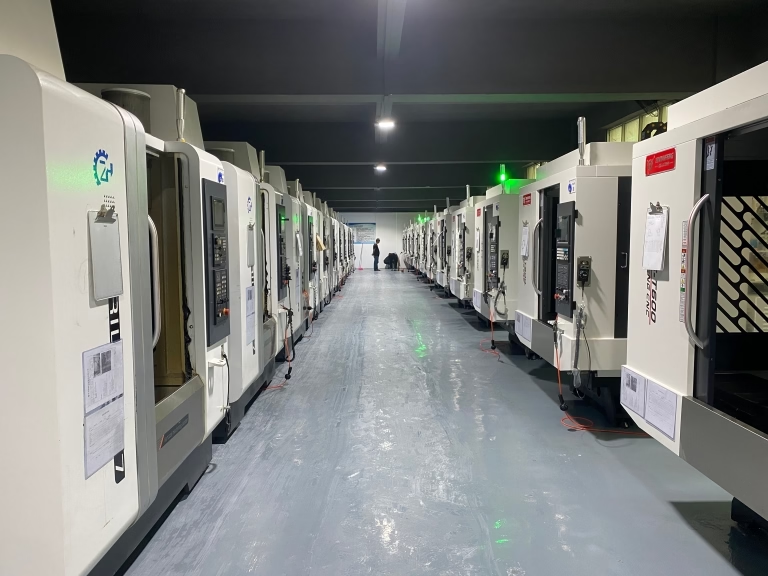
Capacity should be read as a number, not an adjective. Ask how many machines, how many axes, and what the largest travel is. We operate 127 high-precision CNC machines across three wholly-owned plants, including 16 simultaneous 5-axis machining centers, 12 four-axis mills, 27 three-axis machines, and 16 mill-turn centers. That mix matters because a rush job is routed to whichever machine is free and capable, not to a sales promise.
Confidentiality is part of the deliverable. Uploads should be handled as confidential by default, and an NDA should be available on request rather than negotiated for weeks. For defense-adjacent, medical, and consumer electronics work, ask how files are stored, who can open them, and how long they are retained.
Finally, look at how the shop handles the historical record. A plant that tracks its own late-delivery rate is managing the schedule, not just quoting it. Our historical late-delivery probability is below 2%, and we would rather show you that number than claim perfection.
How to read a quote for shortened cnc machining services
A usable quote names the process, the machine class, the tolerance, the finish, and the inspection plan. If any of those is missing, the price is not comparable to another quote. Two suppliers can both say "CNC machined aluminum" and mean a 3-axis mill with an as-machined finish versus a 5-axis center with bead blasting and a full dimensional report.
Look for where the quote is silent. Silence usually sits on the expensive items: setup charges on low quantities, fixturing for complex geometry, secondary finishing, and inspection time. Ask for those as separate lines. A shop that can break them out understands its own cost structure, which is a good sign for schedule accuracy.
Compare quantity breaks on the same sheet. With no minimum order quantity, a single prototype and a 10,000-part run should both appear, even if the second is only an estimate. That lets you see how much of the rush premium is setup and how much is recurring.
Ask what happens if a dimension fails. The answer should describe rework or remachining, not a discount. A shop that plans the failure path has usually built the schedule around inspection, which is where rush jobs actually fail.
- 1Process and machine class3-axis, 4-axis, 5-axis, or mill-turn. Each has a different setup count.
- 2Tolerance and finishStated as numbers, not adjectives.
- 3Inspection planWhat is measured and what report ships.
- 4Failure pathWhat happens if a dimension is out of spec.
Pitfalls that stall rush jobs
The most common stall is an incomplete drawing. Missing thread callouts, undefined radii, and unclear datums force a back-and-forth that costs a day per round. Send a 3D model plus a drawing with critical dimensions flagged. Free DFM analysis at quote stage catches most of this before the machine is booked.
The second stall is a late material decision. If the alloy is not confirmed when the PO lands, the shop cannot release the material order, and the schedule slips before machining starts. Confirm alloy, temper, and stock form as early as possible.
The third is unstated cosmetic requirements. Anodize color, bead-blast texture, and laser marking placement are finishing steps with their own queues. Laser marking has a minimum character height of 1.5 mm, so small text needs design adjustment, not a rush request.
The fourth is treating inspection as a formality. On tight-tolerance parts, inspection capacity can be the binding constraint. Agree the plan up front and the last block in the timeline stops being a surprise.
Step by step: running a compressed job end to end
- 1Send model, drawing, and quantityInclude STEP or native CAD plus a PDF drawing with critical dimensions marked. State the target date and the quantity range.
- 2Review the quote and DFM notesExpect a quotation and free DFM analysis within 12 hours. Read the DFM notes before approving; they often remove a setup.
- 3Confirm alloy, temper, and finishLock the material grade and surface finish in writing. This releases the material order and the finishing queue.
- 4Approve the inspection planAgree which dimensions are critical, what equipment measures them, and what report ships with the parts.
- 5Release the POProduction can start within 24 hours of PO and material release. Ask for the first-article checkpoint if the geometry is complex.
- 6Track to shipmentParts ship in 3–5 days for typical aluminum and stainless work. Confirm the shipping address and any marking requirements early.
Questions buyers ask before a rush order
How fast can shortened cnc machining services actually deliver?
For typical aluminum and stainless parts, we quote and return DFM analysis within 12 hours, start production within 24 hours of PO and material release, and ship in 3–5 days.
Exotic alloys, multi-step finishing, and very tight tolerances add time. The quote should show which block is the constraint.
Is there a minimum order quantity for a rush job?
No. Runs from a single prototype to 10,000+ parts go on the same quote sheet.
On very low quantities, setup and inspection dominate the price, so the per-part number looks high. That is normal and worth comparing line by line.
What tolerance can hold on a compressed schedule?
Our standard capability is ±0.005 mm (±0.0002 in), with finishes from Ra 1.6–3.2 μm as-machined up to Ra 0.2–0.8 μm where the process supports it.
Rush scheduling does not change the machine capability, but it does change inspection throughput. Flag only the dimensions that matter.
Which certifications should a supplier hold?
It depends on your industry. Automotive production work generally needs IATF 16949:2016, medical device work needs ISO 13485:2016, and sensitive files call for ISO 27001:2022.
We hold ISO 9001:2015, IATF 16949:2016, ISO 13485:2016, and ISO 27001:2022.
How are drawings and CAD files protected?
Uploads are treated as secure and confidential, and an NDA is available on request.
If your program requires a specific retention or access policy, raise it before the RFQ so the file handling is agreed up front.
What part sizes can be machined quickly?
Large travels reach 4,000 × 400 × 150 mm, medium envelopes include 750 × 1,150 × 550 mm and 600 × 600 × 600 mm, and compact machines cover 500 × 500 × 450 mm and 500 × 310 × 200 mm.
Send the bounding box with the RFQ so the job is routed to the right machine the first time.
Send your drawings and get a real timeline
Upload a model and drawing, and we will return a quotation plus free DFM analysis within 12 hours.
12-hour quote100% inspectionNo MOQNDA on request
More from GreatLight
We publish setup notes, tooling trials and inspection data from the factory floor.











