
Short Run CNC Machining Services: How to Pick a Supplier
Short run cnc machining services cover runs from one prototype to a few thousand parts, where tooling cost is not worth amortizing. This guide is for engineers and buyers choosing a supplier. You will get the criteria that actually change part cost and delivery, plus the checks that catch a weak shop before the first chip is cut.
In this article
- 1
- 2
- 3
- 4
- 5
- 6
- 7
What matters most in a short run supplier
Which process fits your run
Use the row that matches your part count and geometry, then read across.
| Process | Best part count | Typical tolerance | Watch out for |
|---|---|---|---|
| 3-axis CNC | 1 to 500 | ±0.01 mm | Needs one setup per face |
| 4-axis CNC | 50 to 2,000 | ±0.01 mm | Rotary workholding adds cost |
| 5-axis CNC | 1 to 5,000 | ±0.005 mm | Programming time is higher |
| Mill-turn | 1 to 3,000 | ±0.005 mm | Bar stock size limits part envelope |
| Vacuum casting | 20 to 200 | ±0.2 mm | Master pattern still needed |
| Die casting | 5,000+ | ±0.05 mm | Tooling cost must be amortized |
| Sheet metal | 1 to 10,000 | ±0.1 mm | Flat parts only, bend radius limits |
| 3D printing | 1 to 100 | ±0.1 mm | Weaker material properties |
Pick the shop that answers technical questions directly
Short run work rewards suppliers who plan setups and measure results, not the ones with the longest equipment list. Match tolerance, lead time, and certification to your part, then verify on the first order.
What short run cnc machining services actually cover
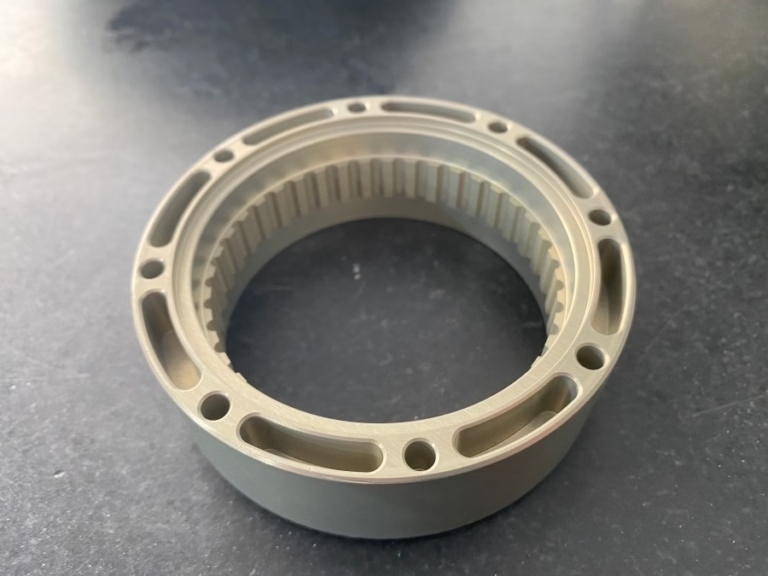
Short run work sits between one-off prototyping and high-volume production. In practice that means runs of roughly 1 to a few thousand parts, where the cost of a dedicated mold or die cannot be spread across enough units to make sense. The parts are cut from solid stock on CNC mills, lathes, or mill-turn centers, driven directly by your CAD files.
The economics are different from long runs. Setup, programming, and fixturing are fixed costs, so they weigh heavily on the first part and shrink as quantity rises. Cutting time is the variable. A shop that plans the process around fewer setups will usually quote lower than one that optimizes only spindle speed.
This is why the process choice matters more at low volume than at high volume. A part that needs five faces machined can be done as five 3-axis setups or one 5-axis setup. The 5-axis route costs more per hour but often lands cheaper overall, and it removes the stack-up error that comes from re-fixturing the same part repeatedly.
Materials are rarely a constraint. Aluminum 6061, 7075, and 6082, stainless 303 and 17-4PH, steels such as 4140, titanium Ti-6Al-4V, and engineering plastics like POM and PEEK are all standard. The choice of material changes feeds, speeds, and tool wear, not the basic approach.
- 1Runs of 1 to a few thousandBelow the point where tooling cost is justified.
- 2Cut from solid stockMilling, turning, mill-turn, and drilling.
- 3Setup-heavy economicsFixed cost per setup, not per part.
Five checks before you release a short run job
Tolerance is the first filter, but only if it is measurable. A supplier claiming ±0.005 mm should be able to tell you which machine holds it, how the part is fixtured, and how it is verified. If the answer is a caliper and a good mood, the claim is marketing. For most short run parts, ±0.01 mm is achievable on 3-axis work, while ±0.005 mm usually needs a 5-axis or mill-turn setup with temperature-stable conditions.
Lead time splits into two numbers that are often confused: quote turnaround and production lead time. A shop that returns a DFM analysis within 12 hours and can start cutting within 24 hours is telling you something about its scheduling discipline. Delivery in 3 to 5 days is realistic for small runs when material is in stock. If the material has to be ordered, add the mill lead time, not the machine time.
Minimum order quantity is the third check. A supplier with no MOQ lets you buy one part, test it, and revise the design before spending on a batch. That is the whole point of short run work. A shop that pushes you toward 500 units to hit a price break is optimizing its own setup cost, not your risk.
Certifications matter depending on your industry. ISO 9001:2015 covers general quality management. IATF 16949:2016 is the automotive and EV standard. ISO 13485:2016 applies to medical devices. ISO 27001:2022 covers information security, which matters if you are sending proprietary CAD files. Match the certificate to your sector rather than collecting them all.
Finish and inspection round out the list. As-machined surfaces run Ra 1.6–3.2 μm, high-finish parts sit at Ra 0.8–1.6 μm, and fine finishes reach Ra 0.2–0.8 μm. Ask whether inspection is sampled or 100%, and whether you get a report. A shop that inspects every part before shipment and offers documentation on request is easier to audit later.
- 1Tolerance with a methodAsk which machine and which gauge.
- 2Two lead timesQuote speed and production speed are separate.
- 3MOQ that matches your riskOne part should be an option, not a favor.
- 4Certification by industryIATF for auto, ISO 13485 for medical.
When short run CNC is the wrong call
Short run machining is not always the answer. If your annual volume is above roughly 5,000 units and the geometry is stable, die casting or injection molding will beat machining on unit cost once tooling is amortized. The crossover point depends on part complexity and material, but the direction is consistent.
Thin-wall parts and large flat panels are also difficult. A 4,000 mm maximum processing size sounds generous, but a long thin part will deflect under cutting forces no matter how good the machine is. Sometimes the better route is sheet metal fabrication, which handles flat geometry without the same rigidity problem.
Parts with internal channels or lattice structures are better served by 3D printing. Machining cannot reach inside a closed cavity. If the design needs conformal cooling channels or a hollow lattice, printing is the practical choice, and the material properties will be weaker than wrought metal.
Finally, be honest about surface finish requirements. If the drawing calls for a mirror polish on a complex 3D contour, hand polishing cost can exceed the machining cost. Design the finish you actually need, not the finish that looks impressive on a spec sheet.
- 1High volume, simple shapeDie casting or molding wins above ~5,000 units.
- 2Long thin partsDeflection limits accuracy on 3-axis and 5-axis alike.
- 3Closed internal channels3D printing reaches what a cutter cannot.
How to read a supplier's capability list
Machine counts tell you about capacity, not about your part. A shop with 127 high-precision CNC machines, including 16 simultaneous 5-axis centers, 12 four-axis mills, 27 three-axis machines, and 16 mill-turn centers, can absorb a sudden order without pushing your job out. That matters when you are on a tight schedule.
Work envelope matters more than count. A Ø400 mm rotary table suits round parts that need multi-face access. A 750 × 1,150 × 550 mm travel handles mid-size housings. The 4,000 × 400 × 150 mm travel is for long, slim parts. Match the envelope to your part before you assume the shop can hold it.
Ask about the plants, not just the equipment list. Three wholly-owned plants across 7,600 m² with 150 technicians is a structure that can split work between sites when one line is loaded. That is a scheduling advantage, not a marketing line.
The last check is communication. A DFM analysis inside 12 hours, production starting within 24 hours, and a stated late-delivery probability below 2% are the kind of claims you can verify on the first order. If the shop cannot answer a technical question directly, the quote will not fix that.
- 1Capacity is not capabilityCounts show headroom, envelope shows fit.
- 2Match the work envelopeRotary table, mid-size travel, or long travel.
- 3Verify on the first orderQuote speed and start time are testable.
Step by step: from CAD file to shipped parts
A typical short run job moves through these stages. Each one has a parameter you can check.
- 1Send the 3D model and 2D drawingInclude STEP or IGES plus a drawing with tolerances, material, and finish. Missing GD&T on a critical feature is the most common cause of a slow quote.
- 2Read the DFM feedbackA good shop flags thin walls under 0.8 mm, deep pockets, and features that need a custom cutter. Expect this within 12 hours.
- 3Confirm material and stock formPlate, bar, or near-net forging changes both price and lead time. Aluminum 6061-T6 plate is usually fastest to source.
- 4Agree on the setup planCount the setups before you approve the quote. Three setups at ±0.01 mm is often cheaper than one 5-axis setup at ±0.005 mm if the tolerance allows it.
- 5Approve first article inspectionAsk for a CMM report on the first part, not the last. Catching a datum error here saves the whole batch.
- 6Run the batch and inspectRaw material check, in-process monitoring, and final inspection. Request reports if your sector needs traceability.
- 7Ship and archiveParts ship in 3–5 days on small runs. Keep the setup sheets so a repeat order skips the programming step.
Questions buyers ask before the first order
How many parts count as a short run?
There is no fixed number, but the practical range is 1 to a few thousand parts. The line is economic: once the per-part cost of tooling falls below the per-part cost of machining, a casting or molding process takes over.
For simple aluminum parts that crossover is often around 5,000 units. For complex geometries with tight tolerances, machining stays competitive much longer.
Can I get just one part?
Yes. A supplier with no minimum order quantity will run a single part, which is the normal way to validate a design before committing to a batch.
Expect the unit price to be high on that first part because setup is spread across one unit. The second order is where the cost drops.
What tolerance should I specify?
Specify only what the function needs. General machining holds ±0.01 mm on most features without extra cost. Tightening to ±0.005 mm adds inspection time and may force a different machine.
Over-tolerancing is one of the most common reasons a short run quote comes back higher than expected.
How fast can parts ship?
Quotation and DFM analysis can come back within 12 hours, production can start within 24 hours, and small runs typically ship in 3–5 days.
That assumes the material is in stock. Exotic alloys such as Inconel or titanium may need to be ordered, which adds mill lead time on top.
How do I protect my design?
Uploads should be handled as confidential, and a non-disclosure agreement can be put in place before you send files. Ask about this before the first upload, not after.
Information security certification such as ISO 27001:2022 is a useful signal that file handling is audited rather than informal.
What finishes are available on short runs?
Common options include anodizing in clear, color, hardcoat, and conductive types, electroless nickel, zinc, silver and gold plating, powder coating, black oxide, bead blasting, tumbling, brushing, and polishing.
Laser marking and engraving are also standard, with a minimum character height of 1.5 mm for legibility.
Send your CAD file and get a DFM review
Upload a STEP file and drawing, and we return a quotation with DFM feedback within 12 hours. No minimum order quantity, from one prototype to 10,000+ part runs.
12-hour quoteNo MOQ100% inspectionNDA on request
More from the shop floor
We publish setup notes, tooling trials and inspection data from the factory floor.











