
5-Axis CNC Milling Machine: How It Cuts, and When It Pays Off
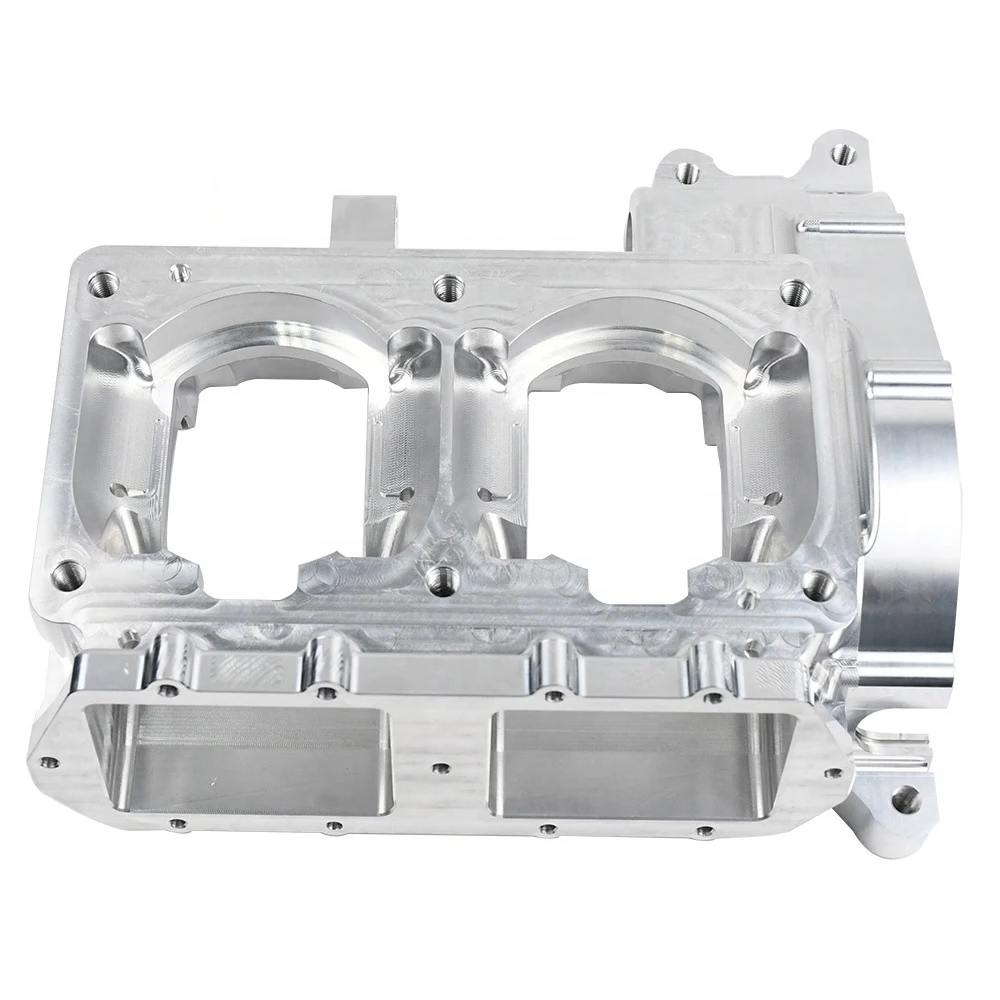
A 5-axis CNC milling machine moves the tool or the part along five axes at once so more faces are reachable in one setup. This page explains the mechanics, the workholding limits, and the part shapes that justify the extra cost. Written for engineers and buyers who need to decide between 3-axis, 4-axis and 5-axis routing.
In this article
- 1
- 2
- 3
- 4
- 5
- 6
- 7
- 8
What matters before you quote
How a 5-axis CNC milling machine actually moves
A 3-axis mill moves X, Y and Z in straight lines. A 5-axis CNC milling machine adds two rotary axes on top of that, so the cutting tool can approach a surface from an angle instead of only from straight above. The three linear axes stay. The two rotary axes are what change everything about how you plan a job.
The two rotary axes are usually named A and B, or B and C. A rotates around the X axis. B rotates around Y. C rotates around Z. A trunnion machine puts A and C on the table, so the part tilts and spins while the spindle stays vertical. A swivel-head machine puts the rotary axes in the spindle head, so the tool tilts and the table stays flat.
That single design choice decides your workholding. On a trunnion table the part swings through an arc, so you need clearance above and below it. A tall part can hit the table casting at 45°. On a swivel head the part sits still, which is easier for long shafts and welded frames, but the spindle head is a heavier, more flexible structure than a fixed one.
GreatLight runs 16 simultaneous 5-axis machining centers among 127 high-precision CNC machines. Rotary tables up to Ø400 mm handle trunnion work. The largest travels reach 4,000 × 400 × 150 mm for long, slender parts. Medium frames cover 750 × 1,150 × 550 mm and 600 × 600 × 600 mm. Compact frames cover 500 × 500 × 450 mm and 500 × 310 × 200 mm.
Simultaneous and 3+2 are not the same thing. A 3+2 machine locks the rotary axes at an angle and then cuts in three linear axes. It gives you five-face access without simultaneous motion. A simultaneous machine keeps all five axes interpolating at once. Most impellers, blisks and contoured medical implants need true simultaneous motion. Bracket families usually do not.
- 13+2 positioningRotary axes index and lock. Cheaper programming, stiffer cut, five faces in one setup.
- 2Simultaneous 5-axisAll five axes move together. Needed for swept surfaces, undercuts and ruled contours.
- 3Trunnion tablePart tilts. Best for compact, dense parts with features on many faces.
- 4Swivel headTool tilts. Best for long parts and heavy fixtures that should not move.
Why tool access drives the tolerance you can hold
The main reason to quote a 5-axis CNC milling machine is reach. A deep pocket with a sloped floor, a port on the side of a housing, or a hole that meets a curved surface at an odd angle all need the tool to come in at an angle. On a 3-axis machine you either tilt the part in a fixture or you accept a longer tool.
Long tools deflect. A tool with a 4:1 length-to-diameter ratio bends under cutting load, and the bend shows up in the wall straightness and the floor flatness. On a 5-axis machine you can use a short, stiff tool and tilt it to reach the same feature. That is where the tighter number comes from, not from the control.
GreatLight holds ±0.005 mm (±0.0002 in) on 5-axis work. That figure assumes a well-supported tool, a rigid fixture and a controlled temperature. It is not automatic. A thin wall 0.8 mm thick will still move after clamping release, no matter which machine cut it.
Surface finish follows the same logic. As-machined 5-axis work lands around Ra 1.6–3.2 μm. With a finishing pass and the right stepover, Ra 0.8–1.6 μm is normal. Fine finishing down to Ra 0.2–0.8 μm is possible on aluminium and brass, but it costs cycle time and usually only pays off on sealing faces and optical bores.
Clearance is the other half of access. A tilted tool holder needs room around the part. Deep ribs, tall bosses and clamps can all block the approach angle. If you send a STEP file, the CAM programmer can check reach before quoting. Without a model, we quote from the drawing and flag the risk.
- 1Short tool, tiltedBetter stiffness and better finish than a long tool held vertical.
- 2UndercutsFeatures behind a lip are reachable on 5-axis, blocked on 3-axis.
- 3Clearance checkModel the holder, not just the cutter. The holder hits first.
Setup count is where tolerance is won or lost
Every time you move a part from one fixture to another, you re-establish a datum. Each re-fixture adds a small stack of error: fixture location, clamp force, thermal drift, operator touch-off. On a 3-axis route a complex housing might take four setups. On a 5-axis CNC milling machine the same housing often takes two, or one.
Fewer setups also mean fewer chances to scrap a nearly finished part. If a feature is cut wrong on setup four, the value added in setups one to three is gone. That is a cost argument, not just an accuracy argument, and it is usually the one that wins with a program manager.
Programming cost moves the other way. A simultaneous 5-axis toolpath takes longer to program and longer to verify than a 3-axis one. Post-processor quality matters. A weak post can produce a toolpath that looks fine on screen and gouges on the machine. For a one-off prototype with simple geometry, 3-axis is often cheaper end to end.
Workholding is the constraint people underestimate. A trunnion table needs the part clamped in a way that lets it rotate 360°. Vises, toe clamps and soft jaws all eat clearance. Sometimes the right answer is a custom fixture, sometimes it is a 3+2 route with the part laid flat between indexes. We decide this at the DFM stage, before metal is cut.
- 1Datum stackFour setups, four datum errors. One setup, one.
- 2Programming costSimultaneous 5-axis paths take longer to program and verify.
- 3Clearance lossClamps and vises block the tilt. Plan the fixture with the toolpath.
Material behavior on five axes
Aluminium is the easy case. Grades 6061, 6061-T6, 2024, 5052, 5083, 6063, 6082, 7075 and ADC12 all cut well on a 5-axis CNC milling machine. They allow high spindle speeds and light finishing passes, which is how you get Ra 0.8–1.6 μm on a contoured surface. 7075 is stronger but more prone to distortion in thin sections.
Stainless is slower. Grades 303, 304, 316, 316L, 420, 430, 431, 440C and 17-4PH (SUS630) work-harden, so a light rubbing pass dulls the tool and hardens the surface. The fix is a firm feed per tooth and a cut that stays under the hardened layer. On a 5-axis toolpath that means fewer, deeper passes rather than many shallow ones.
Steel and titanium push the machine harder. Grades 1018, 1045, 4130, 4140, 4340, A36 and tool steel are routine. TA1, TA2, TC4 (Ti-6Al-4V), Inconel and magnesium AZ31B / AZ91D are not. Titanium and Inconel generate heat at the cutting edge, so coolant delivery and tool life dominate the cycle. Magnesium needs its own handling rules for chips.
Plastics behave differently again. ABS, PC, PMMA, POM, PA, PEEK, PP, HDPE and carbon fibre all machine on 5 axes, but clamping force can dent a soft part and carbon fibre dust needs extraction. PEEK and carbon fibre also wear tools fast. The machine is rarely the limit here; the fixture and the chip control are.
- 1AluminiumFast, forgiving, best finish. 6061-T6 and 7075 are the workhorses.
- 2StainlessWork-hardens. Firm feed, avoid light rubbing passes.
- 3Titanium and InconelHeat at the edge. Coolant and tool life set the cycle.
- 4Plastics and compositesClamping dents and dust control matter more than axis count.
Checking a part that was cut on five axes
A contoured surface is harder to verify than a flat one. A caliper or a micrometer gives you a point measurement. On a swept blade or an organic implant surface, point measurements do not describe the shape. You need either a CMM with enough probe access or a full surface scan compared against the CAD model.
GreatLight inspects 100% of parts before shipment. The route is a raw material check, in-process monitoring, and a final inspection. Reports are available on request. For 5-axis work the inspection plan is usually agreed before the first cut, because the datum scheme on the machine and the datum scheme on the CMM have to match.
The 99.99% qualification rate we publish covers the parts we ship. It does not mean every feature is perfect on the first attempt. It means the parts that leave the door meet the drawing. Scrap and rework happen upstream, at the DFM and first-article stage, which is where they should happen.
Certifications matter if your part feeds a regulated line. GreatLight holds ISO 9001:2015, IATF 16949:2016, ISO 13485:2016 and ISO 27001:2022. The first two suit industrial and automotive work. ISO 13485 suits medical devices. ISO 27001 covers how we handle your drawings and models.
One practical point on inspection access. A 5-axis part often has features that a touch probe cannot reach either. If a feature is hard to machine, ask early how it will be measured. Designing a measurement access path into the part is cheaper than arguing about a deviation later.
- 1Point vs surfaceCaliper for holes, CMM or scan for contours.
- 2Datum matchMachine datum and CMM datum must be the same scheme.
- 3ReportsInspection reports available on request, not automatic.
What drives cost on a 5-axis job
Machine rate is higher on a 5-axis CNC milling machine than on a 3-axis one. The machine costs more, the programming takes longer and the operator needs more skill. If a part can be made on 3 axes, making it on 5 usually costs more per part, not less.
The saving comes from setup count and from features that 3-axis cannot reach at all. A housing that needs four fixtures on 3-axis might need one on 5-axis. The setup hours and the scrap risk both drop. On a 200-part run that often outweighs the higher hourly rate. On a single prototype, it often does not.
Lead time at GreatLight is short by design. Quotation and free DFM analysis come back within 12 hours. Production can start within 24 hours. Parts ship in 3–5 days. The historical late-delivery probability is below 2%. Those numbers assume the drawing and the model agree and the material is in stock.
There is no minimum order quantity. One prototype and a 10,000+ part run both go through the same route. Uploads are secure and confidential, and an NDA is available on request. If your part data is sensitive, say so at the start and we will route the files accordingly.
- 1Higher hourly rate5-axis machines cost more per hour than 3-axis.
- 2Lower setup countOne fixture instead of four can flip the total cost.
- 3Volume decidesPrototypes often favor 3-axis. Production runs often favor 5-axis.
- 4No MOQFrom one piece to 10,000+ parts on the same route.
Which machine fits which part
Pick the lowest axis count that reaches every feature.
| Part shape | Best machine | Why |
|---|---|---|
| Flat plate, holes on one face | 3-axis | No angled features, fastest cycle |
| Shaft with cross holes | 4-axis | Part indexes, tool stays vertical |
| Housing, five faces open | 3+2 five-axis | One setup, indexed angles |
| Impeller or blisk | Simultaneous 5-axis | Swept blades need continuous motion |
| Long frame, 4,000 mm | 5-axis, long travel | Fits 4,000 × 400 × 150 mm envelope |
| Medical implant, organic form | Simultaneous 5-axis | Contoured surfaces, tight blend |
| Thin wall, 0.8 mm | Any, with care | Clamping and stress dominate |
| Prototype, 1 piece | 3-axis if reachable | Programming cost stays lower |
The rule we use
If every feature can be reached from the top or from a single indexed face, cut it on 3 or 4 axes and save the money. If the part has angled faces, undercuts or swept surfaces, put it on a 5-axis CNC milling machine and cut it in one setup. Reach decides, not part count.
Questions engineers ask us
Does a 5-axis CNC milling machine hold tighter tolerance than a 3-axis machine?
Not by itself. The machine geometry can be more accurate, but the real gain comes from cutting in fewer setups, which removes datum shifts.
A well-fixtured 3-axis part can beat a poorly planned 5-axis one. Tolerance follows the setup plan and the tool stiffness.
What is the difference between 3+2 and simultaneous 5-axis?
On 3+2 the two rotary axes index to an angle and lock. The cut then happens in three linear axes. It is stiffer and cheaper to program.
On simultaneous 5-axis all five axes interpolate at once. You need it for swept blades, ruled surfaces and undercuts. If the geometry does not demand it, 3+2 is usually the better choice.
What part size can you machine?
The largest travel is 4,000 × 400 × 150 mm. Medium frames cover 750 × 1,150 × 550 mm and 600 × 600 × 600 mm.
Compact frames cover 500 × 500 × 450 mm and 500 × 310 × 200 mm. Rotary tables go up to Ø400 mm.
Which materials can be cut on five axes?
Aluminium 6061, 6061-T6, 2024, 5052, 5083, 6063, 6082, 7075 and ADC12. Stainless 303, 304, 316, 316L, 420, 430, 431, 440C and 17-4PH.
Steel 1018, 1045, 4130, 4140, 4340, A36 and tool steel. Titanium TA1, TA2, TC4, plus Inconel and magnesium AZ31B / AZ91D. Plastics include ABS, PC, PMMA, POM, PA, PEEK, PP, HDPE and carbon fibre.
How do you inspect a contoured 5-axis surface?
Point tools like calipers are not enough for swept surfaces. We use a CMM with suitable probe access, or a surface scan compared against the CAD model.
The inspection plan is agreed before cutting, and the machine datum and CMM datum must match.
How fast can you quote and ship?
Quotation and free DFM analysis come back within 12 hours. Production can start within 24 hours, and parts ship in 3–5 days.
There is no minimum order quantity, from one prototype to 10,000+ parts. Inspection reports are available on request.
Send the model, get a real answer
Upload your STEP file and we will tell you which machine fits, what the setup plan looks like, and where the tolerance risk sits. Quote and free DFM analysis within 12 hours.
12-hour quote100% inspectionNo MOQNDA on request
More from the shop floor
We publish setup notes, tooling trials and inspection data from the factory floor.











