
CNC Machine Tools Research: What Refurbishment Actually Restores
A machine can be twenty years old and still hold ±0.005 mm, or five years old and scrap a whole batch. This page explains what wears out, what refurbishment can bring back, and when a retrofit is the wrong call. Written for engineers and maintenance leads who have to justify the spend.
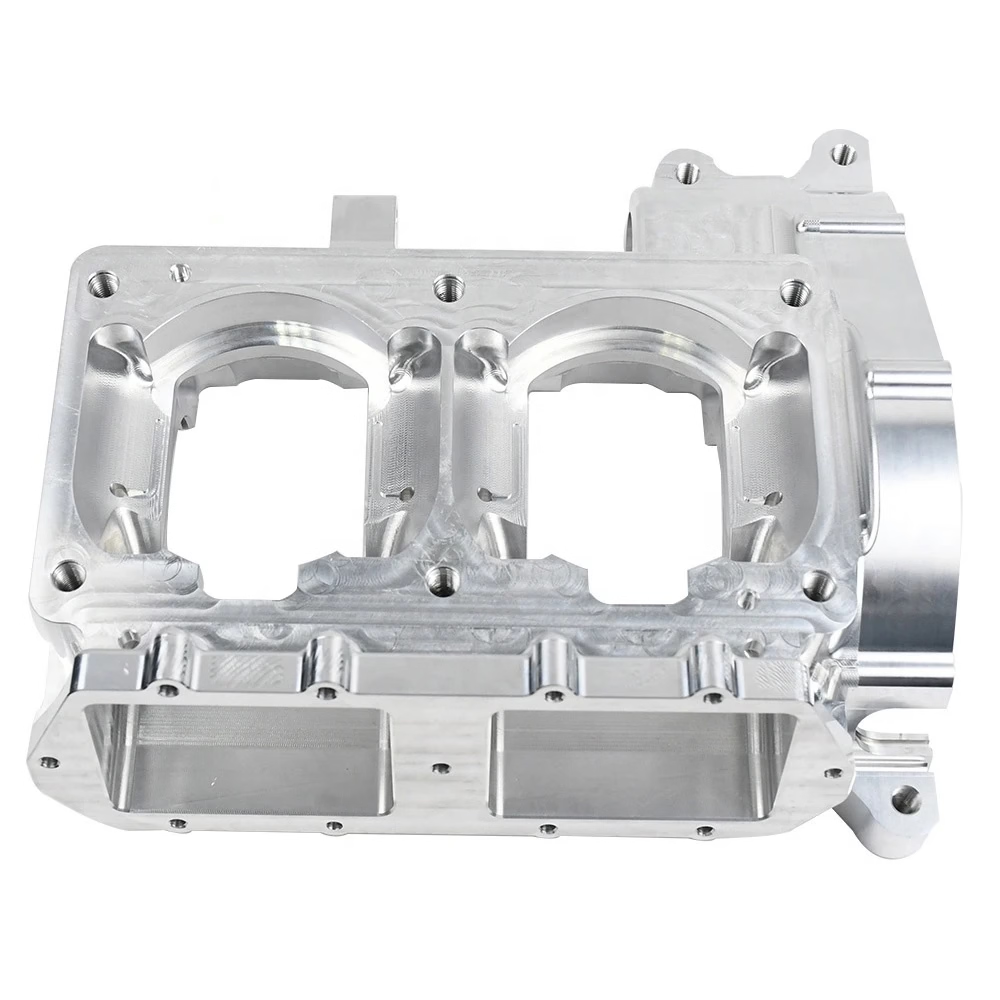
CNC machine tools research: where accuracy actually comes from
Every CNC machine tool is a chain. The controller sits at one end, the cutting edge at the other, and between them are ballscrews, guideways, bearings, the bed casting and the spindle. Accuracy is the product of that whole chain, not of the control unit alone. A new controller on a worn bed produces fast, well-interpolated scrap.
The chain has two parts with very different behavior. Geometric error lives in the iron: guideway straightness, squareness between axes, spindle axis to table alignment. Dynamic error lives in the drive and control: servo gain, following error, interpolation cycle time. Replacing a controller fixes the second group and does nothing for the first.
This is why two machines with identical control hardware can hold very different tolerances. On a small part, thermal drift and servo tuning dominate. On a long part, guideway straightness and screw pitch error dominate. The failure mode tells you which half of the chain to look at.
Measure before you decide. A laser interferometer gives positioning error over the full travel. A granite square and dial indicator give squareness. Ballbar testing gives circularity and servo mismatch in one short run. Those three tests separate a control problem from a mechanical one in about half a day.
What wears, and how you can tell
Guideways are the first thing to go. Linear roller guides wear into a pattern that follows the most-used travel band, so error is small near the center and grows toward the ends. You see it as parts that measure well on short moves and drift on long ones. Scraping or replacing the guide rails restores straightness; adjusting the controller does not.
Ballscrews lose preload before they lose geometry. The screw looks fine, backlash measures a few microns, and the finished surface starts to chatter on climb milling. Re-balling the nut with oversized balls is a common fix. On machines used for heavy roughing, the thrust bearings at the fixed end often fail first.
The spindle is the third wear point. Runout at the tool taper, rising temperature at constant load, and a finish that degrades through the shift all point to bearing wear. A spindle rebuild with new bearings and re-ground taper restores the original runout. Check the drawbar force too; weak clamping shows up as tool pull-out on heavy cuts, not as runout.
The bed casting rarely wears, but it moves. Stress relief after years of thermal cycling can shift geometry by tens of microns. This is why a rebuild always ends with re-alignment, not just part replacement. If the casting itself is cracked, the machine is finished regardless of what the control says.
What a control retrofit can and cannot do
A modern control brings faster interpolation, better look-ahead, and easier programming. On a 3-axis machine doing simple profiles, that rarely changes the tolerance you can hold. On a 5-axis machine cutting contoured surfaces, look-ahead and jerk-limited acceleration change the surface finish noticeably, because the limiting factor was the motion planning, not the iron.
A retrofit cannot fix geometry. If squareness is out by 0.03 mm over 500 mm, no amount of servo tuning removes it. It will also not fix thermal growth, which is a physical property of the structure and the coolant strategy. Adding linear scales can compensate for screw pitch error, but the scale reads the table, not the tool tip, so the rest of the chain still matters.
Cost is the practical limit. A control retrofit on a machine with worn guideways buys you a faster path to the same bad part. The sensible order is always mechanical first, then metrology, then control. Shops that do it backwards spend twice.
One more constraint: spare parts. If the servo drives and motors are also being replaced, the retrofit becomes a full electrical rebuild. That is fine on a large machine where the casting is valuable. On a small machine, the electrical rebuild alone can exceed the price of a comparable used machine.
How to measure before you commit
Start with a cut test on a part you already make. Measure the feature that matters to your customer, not a test bar. Run twenty parts across a full shift and plot the size trend. A trend that drifts in one direction is thermal. A trend that jumps is mechanical or electrical. Random scatter is usually clamping or tool wear.
Then run the metrology. Laser interferometry over full travel gives you positioning and repeatability numbers you can put in a spreadsheet. Ballbar gives circularity and servo mismatch in a five-minute test. Spindle runout and drawbar force take another twenty minutes. Together these tell you whether the machine needs mechanical work, tuning, or nothing.
Compare the numbers to what the part needs, not to the machine spec sheet. A machine that has lost half its original accuracy may still be three times better than the tolerance on your parts. Refurbishment is not free, and neither is the downtime. Do the arithmetic on scrap rate and cycle time before you sign off.
Finally, record the baseline. Whatever you measure before the rebuild is the only way to prove afterward that the money did something. We ask for that baseline on every rebuild inquiry, and the shops that have it make the decision in a day instead of a month.
When refurbishment is the wrong call
Refurbishment wins when the casting is sound, the machine is large, and the geometry can be restored by scraping and re-balling. Large gantry and bridge mills fall into this group. The iron is the expensive part, and it is still good. Replacing guide rails, ballscrews and spindle bearings on a machine like that costs far less than a new one and restores most of the original capability.
Replacement wins when the structure itself is compromised, when the machine is small and standard, or when the required tolerance has moved beyond what the design can reach. A cracked casting, a bed with deep wear scars, or a machine whose original spec was already marginal for your parts are all signals to stop. So is a control platform with no spare parts and no post-processor support.
There is a middle case worth naming. If the machine holds tolerance but is too slow, the answer may be a spindle speed increase or a tooling change, not a rebuild. If it holds tolerance but the operator spends hours setting it up, the answer is probing and work offsets. Neither is a refurbishment project.
The honest test is this: can you name the specific error you are trying to remove, and can you measure it now? If yes, refurbishment is an engineering project with a defined end. If no, you are buying hope, and the machine will still be the wrong size for the job when the invoice clears.
Symptom, cause, and the right response
Three columns, read left to right. The response column is what actually fixes the cause.
| Symptom | Likely cause | Response |
|---|---|---|
| Drift grows along long moves | Guideway wear in one band | Re-scrape or replace guide rails |
| Chatter on climb milling | Lost ballscrew preload | Re-ball the nut, check thrust bearings |
| Finish degrades through shift | Spindle bearing wear | Spindle rebuild, re-grind taper |
| Circularity error at quadrant points | Servo mismatch, backlash | Tune servo, then re-check backlash |
| Tool pull-out on heavy cuts | Weak drawbar force | Replace belleville springs, re-set force |
| Size error changes with room temp | Thermal drift, no compensation | Add warm-up cycle, enable comp |
| Good short moves, bad long moves | Screw pitch error, scale error | Pitch error compensation or linear scales |
Mechanical first, control second
If the casting is sound and the geometry can be re-scraped, rebuild the iron and keep the machine. If the structure is cracked, the bed is deeply worn, or the original spec was already marginal for your parts, replace it. Tuning a worn machine only makes it fail faster.
Common questions
How long does a machine tool refurbishment take?
It depends on scope. A guideway re-scrape and re-ball on a mid-size vertical mill typically runs several weeks once parts are on site. A full mechanical and electrical rebuild on a large gantry machine takes longer.
The bigger variable is part lead time. Ground ballscrews and spindle bearings are often made to order. Get the parts list quoted before you commit to a schedule, or you will be holding a stripped machine for a month.
Can linear scales replace the need for mechanical work?
No. Scales close the loop on table position, which removes screw pitch error and thermal growth of the screw itself. They do not correct guideway straightness, squareness between axes, or spindle-to-table alignment.
A machine with scales and worn guideways will position accurately and cut inaccurately. The readout looks perfect while the part is out of square.
What tolerance can a rebuilt machine hold?
A properly rebuilt machine can return close to its original specification. On machines we machine parts on, that means ±0.005 mm where the setup and material allow it, with surface finish in the Ra 0.8–1.6 μm range for most profiles.
The limit is usually the structure, not the rebuild. A light machine will still deflect under heavy cuts no matter how well the guideways are scraped.
Is a control retrofit worth it on a 3-axis machine?
Rarely for accuracy. On simple 3-axis profiles the old control is usually not the limiting factor. Retrofit makes more sense when you need network access, modern tool management, or a control platform you can still get spares for.
On 5-axis contouring, the calculus changes. Look-ahead and jerk-limited acceleration directly affect surface finish, so a newer control can pay for itself in finishing time.
How do you decide between rebuilding and buying used?
Price the rebuild scope first, including metrology and downtime. Then compare against a used machine of the same size and class, plus the cost of verifying its geometry.
A used machine is a known quantity only after you measure it. Budget the same metrology on both options, and the comparison becomes honest.
Does refurbishment change the machine's certification or accuracy class?
A rebuild does not automatically re-certify a machine to any standard. The original nameplate and class stay as they were unless the builder re-issues them.
What you get is measured performance. Ask for an error map and a cut-test report, and judge the machine on those numbers rather than on a label.
Send us the error you are trying to remove
Tell us the machine, the tolerance you need, and what you measured. We will come back with a DFM view and a quotation within 12 hours.
12-hour quote100% inspectionNDA on request
More CNC machine tools research
We publish setup notes, tooling trials and inspection data from the factory floor.











