
Quick CNC Machining Services: How to Vet a Supplier in One Pass
This guide is for engineers and procurement teams who need machined parts fast but cannot afford a rework loop. It lists the checks that decide whether a quick CNC machining services quote is realistic: tolerance capability, lead time, MOQ, certifications and quote format.
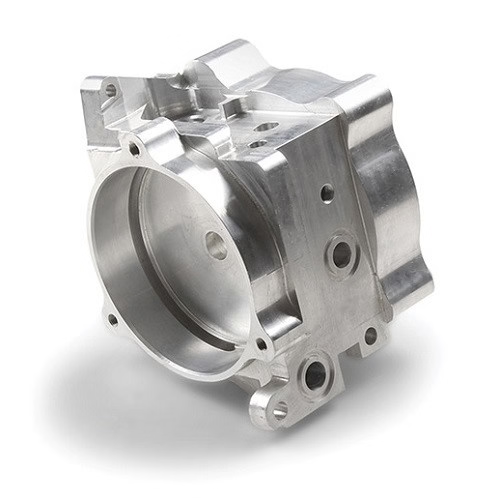
What this guide covers
- 1
- 2
- 3
- 4
- 5
- 6
- 7
- 8
Five things that decide a quick turnaround quote
What to check against your part and your deadline
Use the left column as your requirement, then read across.
| Your requirement | What to ask for | Red flag |
|---|---|---|
| Simple bracket, 3 days | 3-axis mill, as-machined Ra 1.6–3.2 μm | Quoted 5-axis rates for a 2-setup job |
| Tight bore, ±0.005 mm | In-process probing and final CMM report | Tolerance promised without inspection plan |
| One prototype only | No minimum order quantity | Setup fee that exceeds part price |
| Automotive part | IATF 16949:2016 on the certificate | ISO 9001 offered as an equivalent |
| Implant or surgical tool | ISO 13485:2016 and material traceability | No material certs offered |
| Confidential design | NDA on request, secure uploads | Files requested by plain email only |
| Part longer than 1 m | 4,000 mm maximum processing size | Quoted without checking travel |
| Cosmetic aluminum housing | Anodizing plus bead blasting sample | Finish described only in words |
The short version
Pick a quick CNC machining supplier on setup count, inspection plan and quote detail, not on the fastest promised date. If the quote names the tolerance it can hold, the lead-time split and the certificate behind it, the date is probably real.
Match tolerance class to the feature, not the drawing title block
A drawing that says ±0.005 mm everywhere does not mean every feature needs it. On a 6061 aluminum housing, a ±0.005 mm bearing bore is routine. The same callout on a 0.8 mm wall or a 6 mm deep slot in 17-4PH is where quotes get padded or parts get scrapped. Before you send an RFQ, mark the two or three features that actually mate with something else. Everything else can sit at a looser band and cost less.
Geometry drives setup count more than size does. A part with features on five faces needs either five 3-axis setups or one 5-axis setup. Each extra setup adds fixture time, re-datum risk and queue time. That is why a shop with 16 simultaneous 5-axis machining centers can quote a 3-day turnaround on a part that a 3-axis shop needs a week for.
Wall thickness and depth-to-diameter ratio set the real limit. A 0.5 mm wall on a 100 mm aluminum part will move after clamping releases, even if it measured in tolerance on the machine. A 10:1 deep pocket in titanium needs a long reach tool with reduced feed, which adds hours. Flag these features in the RFQ so the shop can quote them honestly instead of discovering them after the first cut.
- 1Tight where it matesReserve ±0.005 mm for bearing bores, seal grooves and locating pins.
- 2Looser where it does notOpen tolerances on clearance holes and non-mating surfaces cut cycle time.
- 3Thin walls moveBelow 1 mm on aluminum, plan a stress relief or a second finish pass.
- 4Deep pockets costOver 8:1 depth-to-diameter, expect slower feed and more tool changes.
Where fast turnaround actually comes from
Quick CNC machining services are not fast because the spindle runs faster. They are fast because the shop removed waiting: quotation and free DFM analysis within 12 hours, production start within 24 hours after you approve, and parts shipping in 3–5 days. Ask for those three numbers separately. A single quoted lead time hides which stage is the bottleneck.
Material availability is the most common hidden delay. 6061-T6 and 304 stainless plate are usually on the floor. Inconel, Ti-6Al-4V and PEEK often are not, and a mill certificate for a medical or aerospace job adds more time. If your alloy is specialty, say so in the RFQ so the quote reflects it.
Finishing is the second hidden stage. Anodizing, electroless nickel and powder coating are outside processes at many shops. A machined part can be done in 3 days and still sit a week at the anodizer. If your deadline is hard, ask whether the finish is done in-house and whether it is already in the 3–5 day window.
Finally, check the shop's schedule risk, not just its promise. A supplier that reports historical late-delivery probability below 2% is tracking on-time performance. Ask for that number. If a shop cannot state one, you are buying a hope, not a date.
- 1Split the timelineQuote, production start and ship date are three different commitments.
- 2Check the alloySpecialty materials and mill certs add days, not hours.
- 3Check the finishOutside finishing can double total lead time.
MOQ, quantity breaks and how quote line items should read
For prototypes and low-volume production, a no minimum order quantity policy matters more than a per-part price. It lets you run one part to test fit, then order 10,000+ parts once the design is frozen. If a shop quotes a low part price but adds a large one-time setup fee, the effective cost of a single prototype can be several times the part itself.
Ask for the quote to be itemized: material, machining, setup, finishing, inspection and freight. Three-line quotes that bundle everything hide the piece that scales badly. On a 500-part run, setup cost per part falls to almost nothing, so the machining rate dominates. On a one-off, setup dominates. The same shop can look cheap or expensive depending on which line you are reading.
Quantity breaks should be quoted at real volumes. Ask for price at 1, 10, 100 and 1,000 pieces. A flat price across all four tells you the shop did not model the job. A steep drop from 1 to 10 and a slow decline after 100 is the normal shape and usually a sign of an honest quote.
- 1One prototype is allowedNo MOQ means you can validate before committing to tooling.
- 2Setup is one-timeWatch how fast it amortizes across the quantity break.
- 3Ask for four price points1, 10, 100 and 1,000 pieces show the real cost curve.
Certifications, inspection and what each one actually covers
ISO 9001:2015 is the baseline. It says the shop has a documented quality system, not that it can hold ±0.005 mm on your part. IATF 16949:2016 adds automotive-specific requirements such as PPAP discipline and traceability. ISO 13485:2016 covers medical device manufacturing and brings material and process traceability. ISO 27001:2022 covers information security, which matters when you upload CAD files and drawings to a supplier portal.
Inspection is the part most buyers under-specify. Ask three questions: is inspection 100% before shipment, what is checked at each stage, and can you get a report. A working answer is raw material check, in-process monitoring and final inspection, with reports on request. A shop with a 99.99% qualification rate usually has a defined inspection plan behind it.
For first articles, ask for the dimensional report to list the features you care about, not a generic sheet. If a critical bore is not on the report, the report does not protect you. For medical and aerospace work, ask whether material certificates and process records travel with the shipment.
Data handling is a separate check. If your design is confidential, confirm that uploads are secure and confidential and that an NDA is available on request. Get the NDA signed before you send the model, not after.
- 1ISO 9001Baseline quality system for general industrial parts.
- 2IATF 16949Required for automotive production parts and PPAP.
- 3ISO 13485Medical devices, with traceability of material and process.
- 4ISO 27001Information security for your files and drawings.
When a quick CNC shop is the right call, and when it is not
CNC machining wins when the part needs metal or engineering plastic, tight tolerance, and a real material. It handles aluminum 6061-T6, 7075 and 2024; stainless 303, 304, 316L and 17-4PH; steels such as 4140 and 4340; titanium TC4; and plastics from POM to PEEK. It also handles the geometry that casting and molding cannot do without tooling: undercuts, thin ribs and deep pockets.
It loses on cost when the part is simple, hollow and needed in thousands. Die casting, vacuum casting or sheet metal fabrication will beat it on unit price at volume. CNC stays useful for the bridge: the 20 parts you need next week while the mold is being cut.
Size is another boundary. A 4,000 mm maximum processing size with 4,000 × 400 × 150 mm travel covers long rails and frames. Small precision work runs on 500 × 500 × 450 mm and 500 × 310 × 200 mm compact machines, and a Ø400 mm rotary table handles round parts that need features on the outside diameter.
If your part needs a finish, confirm the shop controls it. Anodizing in clear, color, hardcoat and conductive types, electroless nickel, zinc, silver and gold plating, powder coating, black oxide, bead blasting and laser marking are common. Laser marking has a minimum character height of 1.5 mm, so a fine part number may need a different marking method.
- 1Good fitMetal or engineering plastic, tight tolerance, low to mid volume.
- 2Poor fitSimple hollow parts at high volume, where casting wins.
- 3Size rangeUp to 4,000 mm long, down to compact precision work.
How to run a quick-turn RFQ in seven steps
- 1Send STEP and a marked-up PDFInclude the 3D model and a 2D drawing. Circle the features that mate and the tolerance they need. Note the alloy and temper, for example 6061-T6, not just aluminum.
- 2State quantity and target dateGive the prototype quantity and the production quantity separately. Add your hard date and whether it is a ship-by or a receive-by date.
- 3Ask for DFM feedbackA useful quote returns notes on wall thickness, tool reach and any feature that cannot hold the tolerance. Free DFM analysis within 12 hours is a normal target.
- 4Read the lead-time splitConfirm quotation time, production start, for example within 24 hours of approval, and ship time in 3–5 days. If only one number is given, ask for the others.
- 5Confirm MOQ and price breaksCheck that one piece is acceptable and ask for pricing at 1, 10, 100 and 1,000 pieces. Compare the setup line, not just the part price.
- 6Verify certificates and inspectionMatch the certificate to your industry: IATF 16949, ISO 13485 or ISO 27001. Confirm 100% inspection before shipment and ask for a dimensional report on the critical features.
- 7Sign the NDA before uploadingIf the design is confidential, get the NDA in place first. Use the supplier's secure upload channel rather than plain email attachments.
Questions buyers ask before releasing a fast order
How fast can a quick CNC machining job actually ship?
A common working pattern is a quote and DFM analysis within 12 hours, production start within 24 hours after approval, and parts shipping in 3–5 days.
Those windows assume standard alloys such as 6061-T6 or 304 stainless and a finish that the shop controls. Specialty alloys and outside finishing can extend the schedule.
Can I order a single prototype without a large setup fee?
Look for a supplier with no minimum order quantity, running from one prototype to 10,000+ part runs.
Ask for the setup fee as a separate line item so you can see what you pay for the first piece and what disappears at volume.
What tolerance should I put on the drawing?
Put ±0.005 mm only on features that mate, such as bearing bores and seal grooves. Use a looser general tolerance elsewhere.
If the whole drawing is called out at ±0.005 mm, expect a higher price and a slower quote because the shop has to inspect every feature.
Which materials are usually available for fast turnaround?
Aluminum 6061, 6061-T6, 2024, 5052, 6063, 6082 and 7075; stainless 303, 304, 316L, 420, 440C and 17-4PH; steels 1018, 1045, 4130, 4140 and 4340; brass C36000; and plastics such as ABS, POM, PC, PA and PEEK.
Titanium TC4, Inconel and magnesium AZ31B are machinable but often need to be ordered in, which affects the date.
How do I protect my design when I upload files?
Ask for an NDA before sending the model, and use a supplier that states uploads are secure and confidential.
ISO 27001:2022 covers information security management and is a useful signal when your drawings are sensitive.
What surface finishes can be added without a long delay?
Anodizing in clear, color, hardcoat and conductive types; electroless nickel, zinc, silver and gold plating; powder coating and black oxide; bead blasting, tumbling, brushing and polishing.
Laser marking and engraving are also common, with a minimum character height of 1.5 mm.
Send your model and get a quote with DFM notes
Upload your STEP file and drawing. We return a quotation with free DFM analysis within 12 hours, and production can start within 24 hours of approval.
12-hour quoteNo MOQ100% inspectionNDA on request
More machining notes
We publish setup notes, tooling trials and inspection data from the factory floor.











