
Precision CNC Machining Services China: A Buyer's Checklist
This guide is for engineers and procurement teams sourcing precision CNC machining services China suppliers. It covers the checks that decide whether a shop can hold your tolerance, inspect it honestly, and ship on schedule. Read it before you send an RFQ.
In this article
- 1
- 2
- 3
- 4
- 5
- 6
- 7
- 8
Key takeaways
What to compare before you commit
Use this table as a first-pass filter. If a supplier cannot answer a row, that row is the risk.
| Check | What to ask | Good sign |
|---|---|---|
| Tolerance | What is your repeatable tolerance on my part size? | ±0.005 mm on size, stated per feature |
| Inspection | Which instrument, and can I see a report? | CMM report with raw data on request |
| Certifications | Which certificates cover my industry? | ISO 9001, plus IATF 16949 or ISO 13485 |
| Equipment | How many 5-axis and mill-turn centers? | 16 simultaneous 5-axis centers |
| Max part size | What is your largest travel? | 4,000 × 400 × 150 mm |
| Lead time | When do you quote, start, and ship? | Quote in 12 hours, ship in 3–5 days |
| MOQ | Do you run single parts? | No MOQ from one prototype to 10,000+ |
| Confidentiality | How are files stored and who sees them? | NDA on request, secure uploads |
The bottom line
Pick the shop that explains the process, not the one with the tightest number on the page. Tolerance, inspection, and traceability are the three checks that protect your project.
How to read a tolerance claim
A supplier page that says ±0.005 mm tells you the best case. It does not tell you where that number applies. On a 4,000 mm long part, ±0.005 mm is a different problem than on a 40 mm bracket. Ask which features the tolerance covers and how it is verified after machining.
Heat and clamping move metal. A thin wall will move after the vise opens. A long shaft will bend under its own weight. A shop that understands this will quote a process, not just a number. They will tell you where to add a rib, where to leave stock, and where to expect a second op.
For most industrial parts, ±0.05 mm is enough. Precision CNC machining services China suppliers often quote tighter than the drawing needs because it sounds better. That adds cost and time with no benefit. Send the drawing and ask what tolerance the part actually needs.
- 1Feature-by-featureTolerance applies to specific dimensions, not the whole part.
- 2Size mattersA 40 mm part and a 4,000 mm part do not share the same repeatability.
- 3Ask for the processA supplier who explains the setup is more likely to hit the number.
Inspection is where quotes fall apart
Anyone can buy a CMM. Not everyone programs it, runs it, and shares the output. Ask for a sample inspection report before you place an order. Look for datum callouts, feature labels, and actual measured values, not just a pass stamp.
In-process checks catch problems before the part is finished. A shop that only inspects at the end may find a bad feature after the anodize. That part is scrap. Ask where the checks happen: after first article, after heat treat, after finishing.
For medical and automotive work, traceability matters as much as the measurement. Material certs, heat lot numbers, and process records should match the part number on the box. If a supplier cannot link a part back to its material batch, the inspection report is incomplete.
- 1First articleFull dimensional report before the run starts.
- 2In-processChecks after critical ops, not just at the end.
- 3Final100% inspection before shipment, reports on request.
Which certificate actually covers your part
ISO 9001:2015 covers quality management. It says the shop has a process and follows it. It does not say the shop can make your part. IATF 16949:2016 adds automotive requirements: PPAP, control plans, and stricter traceability. ISO 13485:2016 adds medical device requirements: validation, cleanroom discipline, and design controls.
ISO 27001:2022 covers information security. For buyers sending proprietary CAD files, this matters. It means the shop has controls around who can access your data, how it is stored, and how it is deleted. It is not the same as an NDA, but it supports one.
A certificate has a scope. Check that the scope covers your process and material. A shop certified for aluminum machining may not be certified for titanium. Ask for the certificate number and the scope statement, then verify it.
- 1ISO 9001Baseline process control for general industrial work.
- 2IATF 16949Automotive production, PPAP, and traceability.
- 3ISO 13485Medical devices, validation, and design controls.
- 4ISO 27001Information security for your CAD and documents.
Match machine capacity to your part envelope
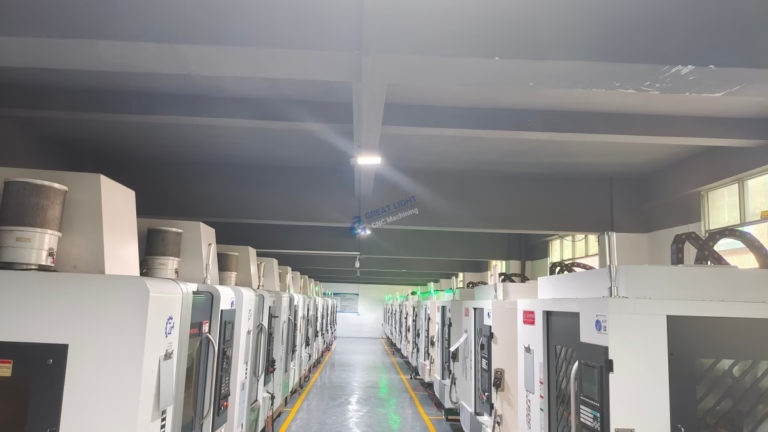
A shop with 127 machines sounds capable. The question is whether those machines fit your part. A 4,000 × 400 × 150 mm travel handles long rails and beams. A 500 × 500 × 450 mm travel handles compact housings. If your part does not fit the work envelope, the machine count is irrelevant.
Five-axis work is not always faster. For a part with features on three faces, a 5-axis center can finish in one setup. That removes two fixtures, two datum shifts, and the error that comes with them. For a simple plate, a 3-axis machine is cheaper and just as accurate.
Mill-turn centers reduce handling for parts that need both turning and milling. A valve body or a fitting with cross-holes is a good fit. Ask how the shop decides between mill-turn and separate ops. The answer tells you whether they plan the process or just load the machine.
- 1Envelope firstConfirm the travel covers your largest dimension.
- 25-axis for accessUse it when features need multiple faces in one setup.
- 3Mill-turn for round partsTurning plus cross-features without re-fixturing.
MOQ, lead time, and quote details
MOQ is a hidden cost. A shop that requires 500 pieces forces you to commit before the design is frozen. A shop with no minimum order quantity lets you run one prototype, test it, and change the design. That is worth more than a lower piece price on a part you will revise.
Lead time has three parts: quote, production start, and shipping. A quote in 12 hours with free DFM analysis is useful. Production that starts within 24 hours keeps a project moving. Parts that ship in 3–5 days close the loop. Ask for each number separately, because a fast quote with a slow start is not fast.
The quote should list material, finish, tolerance, inspection, and any secondary operations. If it only shows a price, you will find the extras later. Ask what is not included: fixturing, first article, surface finish, and packaging are common gaps.
- 1No MOQFrom one prototype to 10,000+ part runs.
- 2Quote in 12 hoursWith free DFM analysis, not just a price.
- 3Ship in 3–5 daysAfter production start, with 100% inspection.
Step by step: qualifying a supplier
Run these steps in order. Each one filters out a different kind of risk.
- 1Send a drawing with real tolerancesInclude material, finish, and the features that matter. Do not send a model without a drawing; the tolerance is the drawing's job.
- 2Read the DFM feedback, not just the priceA useful response points out thin walls, deep pockets, and tight radii. If the reply is only a number, the shop did not look at the part.
- 3Ask for the inspection methodWhich instrument, which features, and what report format. A CMM report with raw values is the standard for ±0.005 mm work.
- 4Check the certificate scopeMatch the certificate to your industry. IATF 16949 for automotive, ISO 13485 for medical, ISO 9001 for general industrial.
- 5Confirm the machine envelopeSend your largest dimension and ask which machine will run it. Confirm the travel covers the part plus fixturing.
- 6Place a prototype order firstOne part is enough to test communication, inspection, and finish. No MOQ makes this step cheap.
- 7Review the first article reportCompare measured values to the drawing. If a feature is out, fix it before the production run, not after.
- 8Agree on packaging and shippingConfirm how parts are protected, labeled, and shipped. Surface finish damage in transit is a common and avoidable loss.
Questions buyers ask
What tolerance can precision CNC machining services China suppliers hold?
The repeatable number depends on part size and geometry. For many parts, ±0.005 mm is achievable on critical features. For long or thin parts, expect looser values on unsupported sections.
Ask for the tolerance per feature, not a single number. A supplier who answers with specifics is more reliable than one who quotes the tightest number on the page.
Do I need to pay for a first article inspection?
Ask what is included in the quote. First article inspection is often part of the process, but the report format and level of detail vary. Confirm before the order starts.
If the report is not included, ask for the price separately. It is usually cheaper than scrapping a production run because a feature was out.
How do I protect my design when sourcing overseas?
Use a supplier with ISO 27001:2022 controls and sign an NDA. Both matter. The certificate covers the systems; the NDA covers the legal commitment.
Keep the CAD files on a secure upload, not email. Ask who can access the files and how they are deleted after the project.
Is a lower piece price worth a higher MOQ?
Only if the design is frozen. Before that, a high MOQ locks in a design you may need to change. A shop with no minimum order quantity lets you iterate without waste.
Run the numbers on total cost, not unit price. Scrap from a forced run often costs more than the difference in piece price.
Which materials are available for CNC machining in China?
Common metals include 6061 and 7075 aluminum, 303 and 316 stainless, 4140 steel, and Ti-6Al-4V titanium. Engineering plastics include POM, PEEK, and PC.
Availability is not the same as machinability. Ask how the shop handles your material. Titanium and Inconel need different speeds, tooling, and coolant than aluminum.
How fast can a quote and a first shipment move?
A useful quote with DFM feedback can come back within 12 hours. Production can start within 24 hours of approval. Parts can ship in 3–5 days after that.
Treat these as process targets, not promises. Confirm the schedule for your specific part and quantity before you commit.
Send your drawing, get a real answer
Upload a drawing and we will return a quote with DFM feedback, tolerance notes, and an inspection plan.
12-hour quote100% inspectionNo MOQNDA on request
More from the shop floor
We publish setup notes, tooling trials and inspection data from the factory floor.











