
PETG vs ABS: Main Differences for Real Parts
PETG and ABS are the two workhorse thermoplastics in prototyping. This comparison covers mechanical behavior, heat and chemical resistance, printing and machining characteristics, and the cost trade-offs. You will know which one to pick before you send a drawing to a shop.
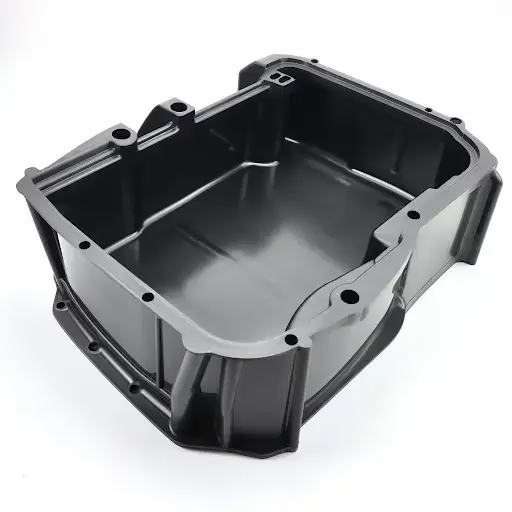
PETG vs ABS: core property comparison
Values are typical ranges for unfilled grades. Your resin supplier's datasheet overrides these numbers.
| Property | PETG | ABS | What it means for the part |
|---|---|---|---|
| Tensile strength | 48–53 MPa | 40–45 MPa | PETG resists pull-apart loads better |
| Flexural modulus | 2.0–2.2 GPa | 2.1–2.4 GPa | ABS is slightly stiffer in bending |
| Heat deflection (1.82 MPa) | ~70 °C | ~85–95 °C | ABS survives hotter environments |
| Impact at room temp | Good, ductile | Very good, tough | ABS absorbs shock in thick sections |
| Impact at 0 °C | Brittle, low | Still ductile | ABS wins for cold or outdoor duty |
| Chemical resistance | Acids, alcohols, salts | Oils, greases, weak alkalis | Match the resin to the fluid it touches |
| Print bed and enclosure | No enclosure needed | Enclosure strongly advised | ABS needs a warm, draft-free chamber |
| Linear shrink rate | 0.2–0.5% | 0.4–0.8% | ABS moves more, so tolerances drift |
How PETG vs ABS differ under load
Start with the failure mode you care about. PETG is a glycol-modified PET. The glycol group slows crystallization, which keeps the resin clear and gives it more elongation before break. In a tensile test, unfilled PETG usually lands around 48–53 MPa and stretches noticeably before it gives up. ABS sits lower on tensile strength, roughly 40–45 MPa, but it holds stiffness better and deforms plastically instead of cracking.
Impact is where the two split hardest, and temperature decides the winner. At room temperature ABS is the tougher material, especially in sections thicker than 3 mm. Cool the same part to 0 °C and PETG turns brittle while ABS stays ductile. If the part will see winter shipping, a cold warehouse, or outdoor service in a northern climate, that single fact usually ends the debate.
Stiffness is close enough that it rarely decides a design. PETG runs about 2.0–2.2 GPa in flexural modulus and ABS about 2.1–2.4 GPa. That gap is smaller than the difference between two suppliers of the same resin. If your bracket needs more rigidity, add a rib or a gusset rather than switching polymer.
Fatigue life matters for parts that cycle. PETG handles repeated low-stress flexing well because it yields gradually. ABS tolerates higher peak loads but cracks faster once a sharp corner starts a crack tip. Round your internal corners on either material.
Heat deflection and chemical resistance
Heat deflection temperature is the cleanest dividing line. At 1.82 MPa load, unfilled PETG deflects near 70 °C. ABS holds to roughly 85–95 °C. A part that sits near a motor, a lamp housing, or an engine bay needs ABS unless you move to a higher-grade polymer. A desktop enclosure that never sees 50 °C does not.
Watch the glass transition point, not just the deflection number. PETG softens progressively as it approaches 70 °C, so a clamped part can creep and lose preload long before it visibly deforms. ABS keeps more of its shape until closer to its limit, then fails faster.
Chemical resistance is often the real selection driver. PETG stands up to dilute acids, alcohols, and salt solutions, which is why it shows up in fluid-handling fixtures. ABS resists oils, greases, and weak alkalis but swells in ketones and some aromatic solvents. Neither material belongs in continuous contact with acetone, and ABS dissolves outright in it.
UV exposure is a common oversight. Both resins yellow and chalk outdoors. ABS degrades faster under direct sun, so an outdoor bracket in ABS needs paint or a UV-stabilized grade. PETG lasts longer unpainted but still is not a marine-grade polymer.
Printing and machining PETG vs ABS
On an FDM printer, PETG is the easier material. It prints on a bed at 70–80 °C with no chamber, sticks well to PEI or glue stick, and warps only on very tall thin parts. ABS wants a nozzle near 240–260 °C, a bed at 100–110 °C, and an enclosure that holds the air around 40–50 °C. Skip the enclosure and a 150 mm ABS plate will lift at the corners.
PETG has its own trap. It is stringy, and it bonds so well to some build surfaces that you can tear a sheet pulling a part off. Reduce flow slightly and raise retraction. Do not dry PETG too hot either; 60–65 °C for 4 hours in a dryer is enough.
Both materials machine acceptably on a CNC. ABS cuts cleaner, produces a continuous chip, and takes a sharper edge. PETG is gummier, tends to smear at high spindle speed, and needs a sharp cutter with a positive rake. Flood coolant is not required, but air blast helps clear the chip.
For tight-tolerance work, remember that these are unfilled plastics. Thermal expansion is roughly ten times that of aluminum, so a plastic part measured at 20 °C can drift out of tolerance on a warm shop floor. We hold ±0.005 mm on metal parts and confirm plastic tolerances against the drawing and the service temperature before quoting.
Cost, volume, and when to switch materials
Material price per kilogram is close enough that it rarely flips a decision. What moves the number is process. ABS is the cheaper injection-molding resin at volume and has decades of tooling experience behind it. PETG sheet and filament cost slightly more, but PETG needs no heated chamber, which lowers the cost of short-run FDM work.
Volume changes the answer. Below roughly 50 parts, printing or CNC machining is usually the practical route, and PETG's easier processing often wins on total cost. Above a few thousand parts, injection molding takes over and ABS becomes the default because the tooling and cycle times are well understood.
Pick PETG when the part sees moisture, mild acids, or alcohol, needs optical clarity, or must print without an enclosure. Pick ABS when the part runs hot, takes impact below 10 °C, or will be molded in high volume. If neither survives the environment, look at PC, POM, or PEEK before you compromise the design.
One more practical point. Neither resin is a structural engineering plastic. If the load path is critical, model it in aluminum or steel, or at least prototype in the final resin. A PLA print that passed a bench test tells you nothing about ABS at 80 °C.
The verdict
Choose PETG when the part sees moisture, alcohol, or mild acids, needs clarity, or must print without a heated chamber. Choose ABS when the part runs hot, takes impact below 10 °C, or will be injection molded at volume.
PETG vs ABS: questions engineers ask
Can PETG and ABS be used in the same assembly?
Yes, and it is common. They do not react with each other, so a PETG cover on an ABS housing is fine.
The risk is thermal expansion. PETG and ABS expand at different rates, so a joint that is clamped tight at 20 °C can loosen at 60 °C. Use a compliant gasket or a slotted hole where the two materials meet.
Which one is food safe?
Neither resin is automatically food safe. Food contact depends on the specific grade, the additives, and the surface finish.
FDM parts also trap bacteria in the layer lines, so a printed part is hard to certify for direct food contact regardless of resin.
Is ABS still worth using now that PETG exists?
Yes, for heat and cold impact. ABS holds to roughly 85–95 °C and stays ductile at 0 °C, and PETG does neither.
ABS also has the deeper molding history, so high-volume tooling and cycle times are well established.
How do I stop ABS from warping?
Enclose the printer and hold the chamber around 40–50 °C, set the bed to 100–110 °C, and keep the nozzle near 240–260 °C.
Add a brim for tall thin parts, slow the first layer, and avoid a fan on the lower layers.
Can these plastics be CNC machined to tight tolerances?
They can be machined, but unfilled plastics are not a tight-tolerance material in the way aluminum is.
Thermal expansion is roughly ten times higher, so the measurement temperature matters. Send the drawing with the service temperature and we will confirm what the process can hold.
Which material is better for outdoor use?
PETG lasts longer unpainted because ABS chalks and yellows faster under UV.
Neither is a marine-grade polymer. For permanent outdoor duty, add a UV-stabilized grade or a protective coating.
Send the drawing, get a material recommendation
Upload your part file and we will come back with a material call, DFM notes, and a quote within 12 hours.
12-hour quote100% inspectionNo minimum order quantity
More from the shop floor
We publish setup notes, tooling trials and inspection data from the factory floor.











