
Is outsourcing CNC machining suitable for you?
This page explains the economics and the technical boundaries behind sending machined parts to an outside shop, so an engineer or buyer can decide with numbers instead of instinct. It covers when an external shop wins, when an in-house machine still wins, and which part features quietly break the plan. Read it before you send an RFQ.
In this article
- 1
- 2
- 3
- 4
- 5
- 6
- 7
Key takeaways
What you actually pay for when a part leaves your floor
A machined part carries four cost layers: material, programming and setup, spindle time, and inspection. In-house you already own the first three in the form of stock, CAM seats, and people. When the part goes to an outside shop, that shop spreads its own fixed cost across many customers, so you pay a share of a machine you never bought.
That sharing is the whole mechanism. A shop running 127 CNC machines keeps its spindles loaded across automotive, medical and aerospace work. Your 40-piece run fills a gap it would otherwise leave idle. You get the amortized rate instead of the full ownership rate.
The trade is control. You hand over scheduling, tool selection and first-article judgment. That is fine when the drawing is stable and painful when it is not.
So the honest question is not whether outsourcing is cheaper. It is whether the work you give away is stable enough, and complex enough, that someone else's existing setup beats building your own.
- 1Owned costMachine depreciation, floor space, tooling inventory, operator hours.
- 2Shared costThe same items spread across an outside shop's full order book.
- 3Switching costDrawing review, first article, and any rework when a feature is misread.
Which part features push you toward an outside shop
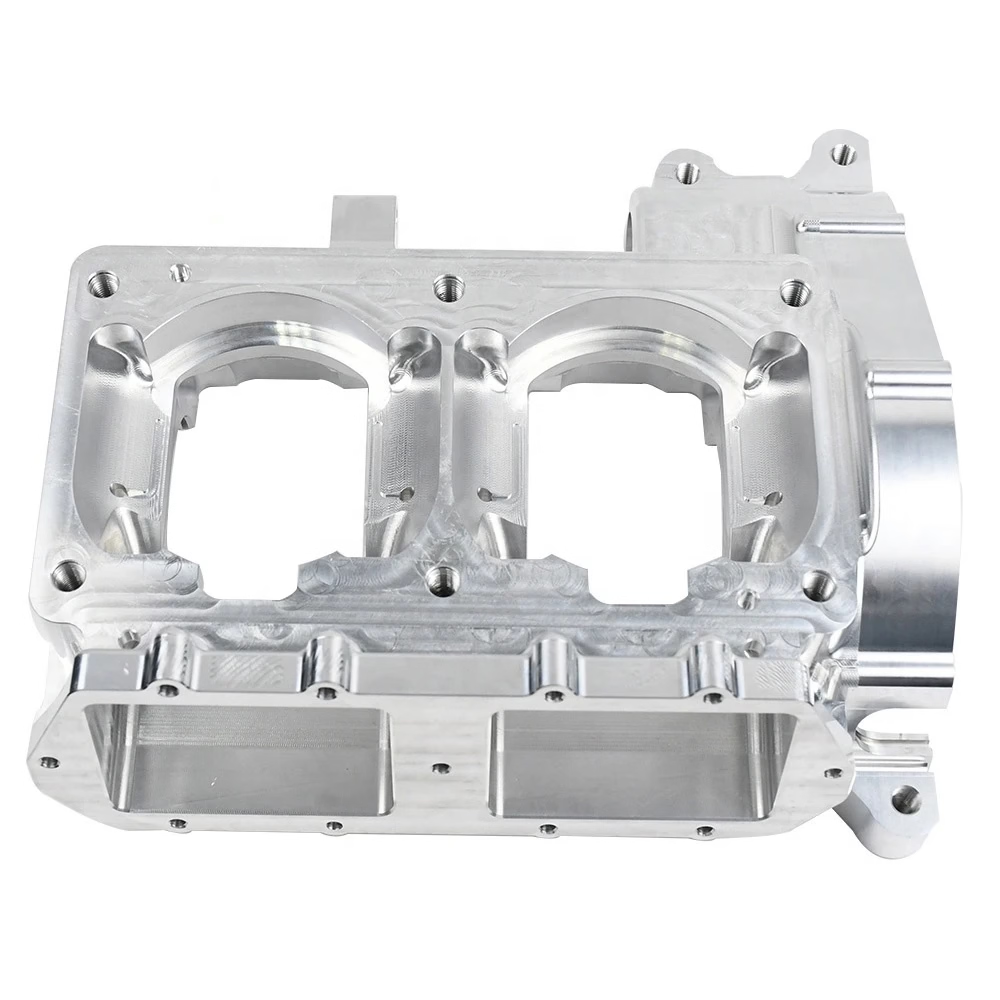
Five-sided access is the clearest signal. A part with undercuts, angled ports, or features on four faces in one setup needs a simultaneous 5-axis center. Buying one for a single program is hard to justify. Sending the job out uses a machine that already exists, and one setup instead of four reduces the stacked tolerance error that comes with re-fixturing.
Long parts are the second signal. Anything approaching 4,000 mm of travel stops being a normal mill job. Few shops keep that envelope, but the ones that do keep it busy, and the setup knowledge travels with the machine.
Hard or nasty material is the third. Inconel, titanium Ti-6Al-4V and 17-4PH eat tool life and demand rigid setups with conservative stepovers. A shop that cuts these weekly has the speeds and feeds already dialed in, plus the right holders.
Note what is not on this list: tight tolerance alone. A ±0.005 mm bore on a simple turned part is routine. It does not by itself justify moving the work.
- 1Undercuts and multi-face featuresOne 5-axis setup beats four 3-axis setups with re-fixturing error.
- 2Parts near 4,000 mmEnvelope and rigidity matter more than hourly rate at that size.
- 3Titanium, Inconel, hardened steelTool life and thermal control decide the real cost.
When keeping the work in-house is the right call
If the part is a plate with a few drilled holes, keep it. The quote will not beat your own machine time once freight and a first-article loop are added, and you lose a day to shipping each way.
If the geometry is still moving every week, keep it. Outsourcing rewards frozen drawings. Sending revision C, then D, then E to an outside shop means three setups, three first articles, and three chances for a misread dimension.
If the process knowledge is the product, keep it. When a feature is the reason customers buy from you, the toolpath and the fixture design are part of your advantage. Outside shops sign NDAs, and we treat uploads as confidential, but an agreement protects information rather than making sharing free.
If the deadline is measured in hours, keep it. An outside partner can start production within 24 hours and ship in 3–5 days, which is fast for a supply chain, but the machine in your own bay is still faster for a one-piece emergency.
- 1Simple prismatic partsSetup and freight outweigh any hourly saving.
- 2Unstable revisionsEach revision resets programming and first-article work.
- 3Core proprietary geometryWhen the toolpath is the product, keep it close.
How an outside shop changes your lead time and inventory
Machining time is only part of the clock. Add quoting, first article, freight and customs. A domestic shop compresses the middle; an overseas shop compresses the rate but stretches the transit. Neither is universally better, and the right choice depends on how much buffer stock you hold.
Buffer stock is the quiet variable. A shop that holds your design can run 10,000+ part runs and repeat them later without re-teaching the setup. That turns a one-time decision into a standing capacity you can draw on. A shop that has to relearn your part every time gives you none of that.
Start with a prototype. Sending one part for a first article at ±0.005 mm tells you more about a partner than any brochure. If the first article matches the drawing and the inspection report is complete, the run is low risk. If it does not, you have lost a week rather than a quarter.
Keep the tolerance realistic at that stage. Calling out Ra 0.2–0.8 μm everywhere adds polishing and inspection hours you may not need. Ra 0.8–1.6 μm is a sensible general callout.
- 1Prototype firstOne part proves setup, tolerance and reporting before a volume commitment.
- 2Repeatable capacityA shop that keeps your fixture and program can rerun without relearning.
- 3Realistic finish calloutsReserve Ra 0.2–0.8 μm for sealing faces and bearing seats.
The failure modes nobody quotes for
Most outsourcing failures are not machining failures. A vendor misses a note, a plating spec changes the fit, or a shipping damage claim arrives after the deadline. None of these appear on a price sheet.
Material substitution is the most expensive one. Certification matters: for medical work the supplier should hold ISO 13485:2016, for automotive IATF 16949:2016, and for general precision work ISO 9001:2015. Ask for the mill certificate against the heat number on the stock, not just a general compliance statement.
Surface finish changes dimensions. Anodizing builds a few micrometres per face, hardcoat more. Electroless nickel adds a measurable layer. If a bore is toleranced before plating and assembled after, it may not fit.
Then there is documentation. Agree on the inspection report format before cutting. A first article report is standard; a full dimensional report on every part in a 5,000-piece run is a different conversation about cost.
- 1Plating shifts fitsTolerance the bore for the finished coating, not the machined state.
- 2Certifications by industryISO 9001, IATF 16949, ISO 13485 and ISO 27001 cover different risks.
- 3Reporting scopeDecide which parts get full dimensional reports up front.
In-house machining vs an outside partner
Match the part to the column, not the price to the quote.
| Part or business signal | Favors in-house | Favors outside partner |
|---|---|---|
| Geometry | Simple prismatic, 3 faces or fewer | Undercuts, angled ports, 5-sided access |
| Tolerance | Loose or one critical dimension | Several tight fits on one part |
| Revision rate | Changes every week | Drawing frozen for at least a quarter |
| Part size | Fits an existing 600 mm envelope | Approaching 4,000 mm travel |
| Material | Aluminium 6061, mild steel | Ti-6Al-4V, Inconel, 17-4PH |
| Volume pattern | Steady weekly demand | Spiky, seasonal or one-off runs |
| Documentation need | Internal record only | Certified reports for an audit |
| Deadline | Hours, one emergency part | 3–5 day ship after a 12-hour quote |
The verdict in one line
If your part needs 5-axis access, hard material, or more than 1,000 mm of travel, outsource it; if it is simple, still moving, or due tomorrow, keep it on your own floor.
Questions engineers ask next
Is outsourcing CNC machining suitable for a one-off prototype?
Often yes, because no minimum order quantity applies and a prototype gives you a real first article to inspect. You pay a setup share, but you also get an independent check on the drawing before committing to volume.
If the part is a simple plate or bracket, your own machine is still faster. The value of an outside prototype is in the hard features: 5-axis access, thin walls, or a material you do not stock.
How do I protect the design when I send drawings out?
Sign an NDA before releasing files, and ask how uploads are stored and who can open them. Information security certification such as ISO 27001:2022 is a reasonable filter for suppliers handling sensitive work.
Split the release. Send a simplified drawing for quoting and the full CAD only after the NDA is countersigned.
What tolerance should I expect from an outside shop?
±0.005 mm is a normal precision callout on critical features, and ±0.0002 in in imperial drawings. That applies to specific dimensions, not every dimension on the print.
Over-tolerancing raises cost more than any other single decision. Tolerance only the fits that need it, and let the rest run at general machining tolerance.
Does a lower hourly rate always mean a lower part price?
No. The quote includes setup, programming, inspection and freight. A cheaper spindle rate with a longer setup, or with one part per fixture, can land higher than a faster shop.
Compare the total per part, and ask how many parts sit on the fixture at once. That single answer usually explains a price gap.
How do I know a supplier can hold the tolerance before I commit?
Ask for the inspection method and the report format, then buy one prototype. A CMM report on the first article tells you whether the shop measures what you measure.
Check the certifications that match your industry: ISO 9001:2015 for general precision, IATF 16949:2016 for automotive, ISO 13485:2016 for medical devices.
What happens if the drawing changes after the first run?
Expect a new setup and a new first article for any change that moves a datum or adds a feature. Small changes to a non-critical dimension are usually absorbed.
Tell the shop which dimensions are still open at the quoting stage. They can leave stock on those faces so a revision does not scrap the run.
Send one part and judge the result
Upload your drawing and get a quotation with a free DFM analysis within 12 hours.
12-hour quoteNo minimum order quantity100% inspection before shipmentNDA on request
More from the shop floor
We publish setup notes, tooling trials and inspection data from the factory floor.











