
Outsourcing CNC: Benefits and Best Practices for Engineers
A practical guide for design engineers and sourcing managers who need machined parts without adding a machine shop. It covers where outsourcing CNC actually pays off, which supplier numbers to verify before you send a drawing, and the order details that decide whether the first run ships clean.
In this article
- 1
- 2
- 3
- 4
- 5
- 6
- 7
- 8
What matters before you outsource
When outsourcing CNC beats keeping the work in-house
Match the situation to the signal that decides it.
| Situation | Outsource | Keep in-house |
|---|---|---|
| Part size | Over 1,000 mm, or 4,000 mm travel needed | Fits a 500 × 500 mm envelope |
| Tolerance | Tighter than ±0.02 mm on one setup | Loose fits, ±0.1 mm and up |
| Volume | 1 to 10,000+ pieces, no MOQ | Steady high volume, one geometry |
| Equipment | 5-axis or mill-turn work you do not own | 3-axis milling and drilling |
| Engineering load | You have CAM capacity but no spare spindle time | You have idle machines and staff |
| Compliance | Automotive, medical or aerospace paperwork | Internal use, no traceability asked |
| Timeline | Prototype in days, then a bridge run | Predictable monthly releases |
The short version
Outsource CNC when the geometry needs a machine you do not own or a schedule you cannot hit. Keep it in-house when the part is simple, the volume is steady and your spindles are idle. The deciding factor is almost never price per piece; it is whether the drawing, the tolerance callout and the inspection plan are clear before the first cut.
The real benefits of outsourcing CNC work
The first benefit is capital. A 5-axis machining center costs more than most product teams spend on tooling for a whole program, and it needs floor space, power and a trained operator. When you outsource CNC, that money stays in the product. You rent the capability per part instead of buying it per decade.
The second benefit is process range. A supplier running 127 high-precision CNC machines can put a part on the right machine instead of the nearest one. A deep pocket with a curved floor goes to a 5-axis center. A turned shaft with cross holes goes to a mill-turn center. You get the shortest route to the geometry, not the route your shop happens to own.
The third benefit is speed on the front end. Quotation and free DFM analysis arrive within 12 hours, and production can start within 24 hours after that. For a design team chasing a build review, that turnaround is the difference between testing next week and testing next month.
Which parts belong with an outside shop
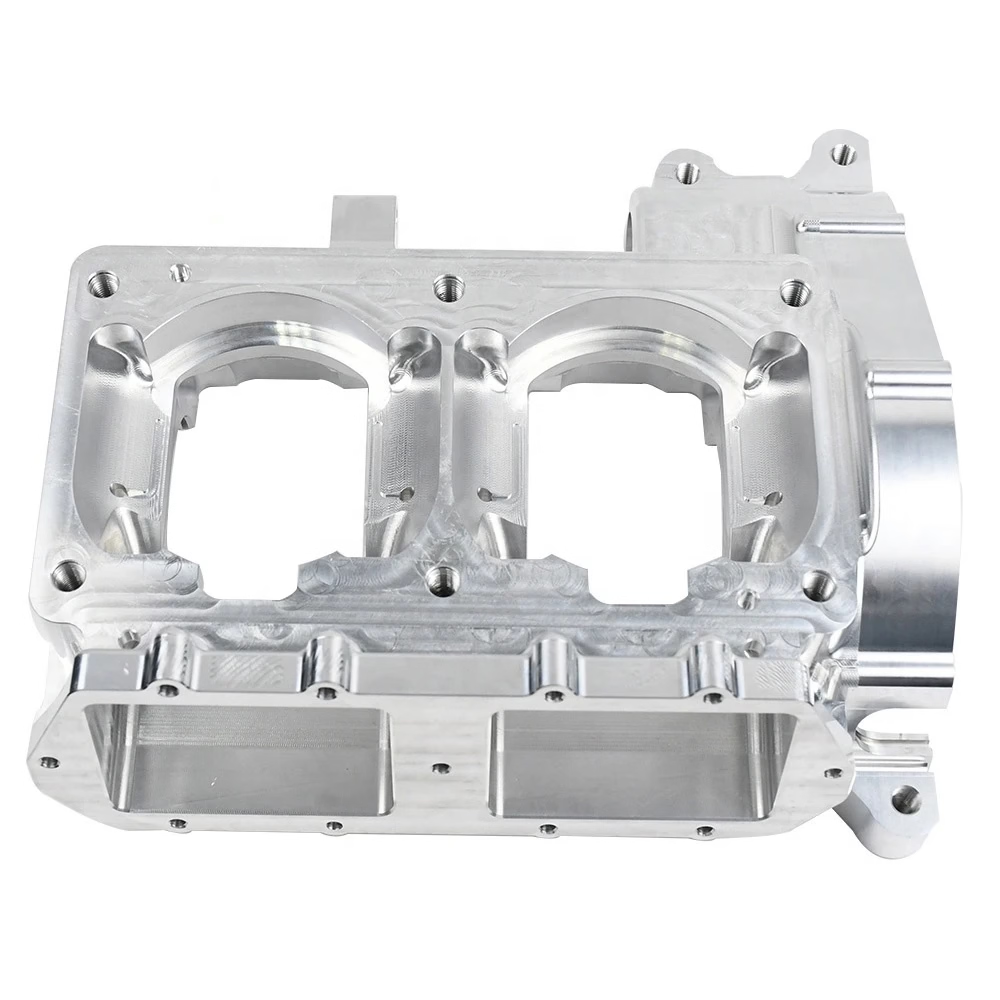
Outsourcing fits parts with a hard setup problem. A housing with features on five faces is a natural fit: one 5-axis setup replaces three fixtures and two re-clamps. Every re-clamp adds stack-up error, and a supplier with a Ø400 mm rotary table can often hold ±0.005 mm on features that would drift in a manual sequence.
It also fits low and mid volume. With no minimum order quantity, a single prototype and a 10,000+ piece run both make sense. You can prove the design on one part, then release the same file for a bridge production run without requalifying a new shop.
Outsourcing fits when the material is awkward. Titanium TC4 (Ti-6Al-4V), Inconel, 17-4PH stainless and magnesium AZ31B cut slowly and wear tools. A shop that machines these weekly has the feeds, the coolant strategy and the scrap stock already worked out.
- 1Good fitOne-off prototypes, complex 5-axis geometry, exotic alloys, overflow when your spindles are full.
- 2Weak fitA part you already run well in-house with stable demand and loose tolerances.
- 3Send instead of guessIf the geometry needs two re-clamps, ask for a DFM note before you accept the quote.
How to judge a CNC supplier before the first order
Start with tolerance. Ask what the shop holds routinely, not what the machine spec sheet says. A workable answer looks like ±0.005 mm (±0.0002 in) on critical features, with surface finish bands named by Ra. If the answer is only a machine model number, keep asking.
Then ask about inspection. The useful answer is a sequence: raw material check, in-process monitoring, final inspection, 100% before shipment, reports on request. A shop that cannot describe its inspection order will not produce one when a first article fails.
Check certifications against your industry. ISO 9001:2015 covers general quality systems. IATF 16949:2016 matters for automotive and EV parts. ISO 13485:2016 is the one that counts for medical devices. ISO 27001:2022 covers how your files are handled. Send the drawing that matches your sector.
Finally, test communication. Send one part with a real question attached. How fast and how specifically the answer comes back tells you more than any capability deck.
What actually drives the quote
Material type sits at the top. Aluminium 6061-T6 cuts fast and cheap. 304 stainless takes longer. Titanium TC4 and Inconel can multiply cycle time several times over for the same shape. Ask which alloy grade the quote assumes, because 6061 and 7075 are not interchangeable on strength or price.
Part complexity comes next. Feature count, depth-to-diameter ratio and how many faces need machining all add setups. A part that fits one 5-axis setup stays near the low end. A part that needs four fixtures climbs quickly, and those fixtures get charged somewhere.
Volume and finish follow. Unit price drops as quantity rises, but surface finishing can dominate a small order. Anodizing, bead blasting or laser marking add handling steps, and laser marking needs a minimum character height of 1.5 mm to stay legible.
The hidden cost is ambiguity. A drawing with an unclear datum or an unspecified corner radius will be quoted with an assumption. That assumption becomes a change order. Clear GD&T on the print is cheaper than a revision after cutting.
Where outsourcing goes wrong
The common failure is a drawing that is not ready. Missing datums, tolerance callouts on non-critical features, and step files without a revision number all cause rework. The shop machines what the file says. If the file is vague, you get a part that meets the file and misses the function.
The second failure is a spec mismatch on finish. Call out Ra 0.8–1.6 μm for sealing faces and Ra 0.2–0.8 μm for sliding contact, and say which surfaces those apply to. A blanket finish callout on every face raises cost and often still misses the one face that matters.
The third failure is silent scope creep. Small changes after the first article, a different material grade, an added engraving, a tighter tolerance on one bore. Each one looks minor. Together they push the schedule and the invoice. Put changes in writing and confirm the new date before cutting continues.
Step by step: running a clean outsourcing order
- 11. Freeze the drawing and the revisionSend a STEP file plus a 2D print with datums, GD&T and a revision letter. Note the material grade, for example 6061-T6 rather than 6061.
- 22. Ask for the quote and a DFM readRequest quotation and free DFM analysis together. Expect both within 12 hours. Read the DFM note before comparing prices.
- 33. Confirm which machine will run itAsk whether the part goes on a 5-axis center, a mill-turn center or a 3-axis machine, and how many setups that means.
- 44. Fix the inspection planAgree on critical dimensions, sampling and report format. Confirm 100% inspection before shipment and who signs the first article.
- 55. Lock the finish and markingName the finish per surface: anodizing, electroless nickel, bead blasting, black oxide. For laser marking, keep character height at 1.5 mm or more.
- 66. Set the paperwork and NDASign the NDA before sending files if the design is sensitive. Uploads stay secure and confidential either way.
- 77. Approve the first article, then release volumeCheck the first piece against the print, then approve the run. Production can start within 24 hours and parts ship in 3–5 days.
Questions engineers ask before outsourcing
What is a realistic minimum order quantity for outsourced CNC parts?
There is no minimum order quantity, so one prototype is a valid order. The same process runs from a single piece to 10,000+ part runs.
Below about five pieces the setup cost dominates unit price. That is normal and not a sign of a bad quote.
How tight a tolerance can an outside shop hold?
Routinely ±0.005 mm (±0.0002 in) on critical features, with surface finish from Ra 0.2–0.8 μm for fine work up to Ra 1.6–3.2 μm as machined.
Tighter than that is possible on specific features, but ask before you design to it. The answer depends on the feature, not the shop in general.
How fast can parts ship after I approve the quote?
Quotation and free DFM analysis come back within 12 hours. Production can start within 24 hours, and parts ship in 3–5 days.
Finish steps such as anodizing or plating add time. Ask for the finish lead time separately from the machining lead time.
Which certifications should the supplier hold?
ISO 9001:2015 for general quality, IATF 16949:2016 for automotive and EV, ISO 13485:2016 for medical devices, and ISO 27001:2022 for information security.
Match the certificate to your industry and ask for the current scope, not just the logo.
How do I protect my design when I send files?
Uploads are secure and confidential, and an NDA is available on request. Sign it before the first file transfer if the design is sensitive.
Send only the files the quote needs. A STEP plus a 2D print is normally enough.
What should I compare between two quotes?
Compare the assumed material grade, the tolerance on critical features, the finish per surface, the inspection plan and the shipping date.
A lower number with no inspection plan is not a lower cost. It is a deferred cost.
Send a drawing, get a quote and a DFM read
Upload your STEP file and print. We return a quotation and free DFM analysis within 12 hours, with the tolerance, finish and inspection plan written out.
Quote in 12 hoursNo MOQ100% inspectionNDA on request
More from GreatLight
We publish setup notes, tooling trials and inspection data from the factory floor.











