
NC Machining Center: How Precision Manufacturing Actually Works
An NC machining center moves a cutting tool along programmed axes to remove metal from a workpiece. This page explains the machine, its limits and the part features it handles well. It is written for design engineers and buyers who need to judge whether a job belongs on one of these machines.
In this article
- 1
- 2
- 3
- 4
- 5
- 6
- 7
Key takeaways
What an NC Machining Center Is, In Shop Terms
Strip the panels off and an NC machining center is a rigid frame, a spindle that spins a cutting tool, and a set of slides that position that tool against a clamped workpiece. The letters NC stand for numerical control. The machine reads numbers from a program and moves the slides to match. There is no handwheel in the loop during a cut.
That distinction matters more than it sounds. On a manual mill, the operator feels the cut through the handle and backs off when the tool complains. On an NC machining center, the feed rate, spindle speed and depth of cut are decided before the tool touches metal, then repeated exactly on every part in the run. Consistency comes from the program, not from the operator's hands.
The common wording causes confusion. Many shops say CNC when they mean the same machine, and the two terms are used almost interchangeably on a shop floor. The practical difference is historical: early NC machines read punched tape, and the C was added later when a computer handled the tool path math. For a buyer, the label matters less than the axis count, the spindle and the tool changer.
A typical vertical machine carries 20 to 30 tools in a carousel and swaps one in a few seconds. Horizontal machines often hold more, and pallet changers let one machine cut while another part is loaded. Those details decide throughput, not the NC versus CNC label.
Axes, Spindle And Tool Changer: How The Cut Happens
Linear axes are named X, Y and Z. X and Y move the table or the column sideways, Z moves the spindle up and down. Ball screws and linear guides carry those slides, and servo motors drive them through closed-loop feedback. The control compares the commanded position with the encoder reading thousands of times per second and corrects the difference. That correction is what holds a tolerance of ±0.005 mm on a good machine.
Rotary axes add letters. A is rotation about X, B about Y, C about Z. A trunnion table that tilts and rotates gives two rotary axes on top of three linear ones, which is what people mean by five-axis. With the part tilted, the tool can reach a face that would otherwise need a second setup, or a compound angle no three-axis setup can hold.
The spindle is the second half of the story. Speed range, taper size and bearing stiffness set what the machine can cut. A 12,000 rpm spindle with a BT40 taper handles aluminium and mild steel all day. Hardened tool steel or titanium pushes you toward a heavier taper and lower speed. Neither is better in the abstract. They suit different work.
The tool changer is the part that quietly eats cycle time. A 20-tool carousel that swaps in 3 seconds turns a job with eight tools into a short interruption. A slow changer on the same job adds minutes per part. When a shop quotes a run, tool change time is inside the price.
- 13-axisOne face per setup. Cheapest per hour, most setups.
- 24-axisAdds rotation about one axis. Good for shafts and round parts with flats.
- 35-axisTwo rotary axes reach compound angles in a single setup.
From CAD Model To Finished Part
The chain starts with a solid model. A CAM programmer picks tools, sets stock to leave, and generates tool paths that the post-processor turns into machine code. The programmer also decides the workholding, because a tool path that cannot be reached is worthless. On a part with tight tolerances, workholding is often the harder half of the job.
Then comes the first article. The operator sets the work offset, touches off tools, and cuts one part. Someone measures the critical features and compares them with the drawing. If a dimension drifts, the programmer adjusts the offset or the path and the next part is checked again. Once the process holds, the run goes ahead with in-process checks at set intervals.
Material behaviour sits underneath all of it. Aluminium 6061 cuts clean and fast but moves when you take heavy cuts, so roughing and finishing are split. Stainless 304 work hardens if the tool rubs instead of cutting, so feeds stay aggressive and coolant stays on the cut. Titanium Ti-6Al-4V conducts heat poorly, and the heat goes into the tool edge. Each material rewrites the parameters.
This is why a quote is not just a price per hour. It reflects the number of setups, the tool list, the stock removal and the inspection plan. Two shops quoting the same drawing can differ by a wide margin because they planned the job differently.
Where An NC Machining Center Stops Being The Right Answer
Subtractive machining has a shape problem. A rotating cutter leaves a radius equal to its own corner. A square internal corner with a sharp floor cannot be milled without a special tool, and even then the depth is limited. If a drawing calls for a true sharp internal corner, either the design changes or the feature is made another way.
Wall thickness is the other limit. A free-standing wall of 0.5 mm on a 60 mm tall aluminium part will chatter and deflect under cutting force. Sometimes the answer is a support rib left in during machining and removed later. Sometimes the part should be cast, printed or formed. A good shop says so before cutting chips.
Volume changes the economics. One prototype on a five-axis machine is cheap compared with tooling for a casting. At 10,000 parts a year, the same feature may be far cheaper to cast and then finish machine on the critical faces. The crossover point depends on geometry, material and tolerance, not on a fixed number.
Hardness matters too. Above roughly 45 HRC, cutting gets slow and tool life drops. Pre-hardened tool steel at 30 to 40 HRC machines fine with the right carbide. Fully hardened parts are usually ground or wire-cut instead. If a feature needs both hardness and a complex 3D form, the process sequence has to be planned from the start.
Tolerance, Surface Finish And What They Cost
Tolerance is not a single number for the whole part. A datum hole might hold ±0.005 mm while a clearance slot holds ±0.1 mm. Giving the slot the same tolerance as the hole adds cost for nothing. Engineers who mark only the features that matter get lower quotes and fewer rejects.
Surface finish follows the same logic. As-machined faces sit around Ra 1.6–3.2 μm. A finer pass reaches Ra 0.8–1.6 μm, and a careful finish pass on the right material can reach Ra 0.2–0.8 μm. Every step down adds time on the machine. If a face is only a mounting surface, the coarse finish is fine.
Thermal drift is a real effect over a long run. The spindle and the ball screws warm up, and dimensions move by a few microns over the first hours. Shops handle it by warming the machine before the first article and by checking critical features at intervals. A part cut cold at 7 a.m. and one cut warm at 2 p.m. are not identical unless someone controls for it.
Measurement has its own uncertainty. A micrometer and a CMM do not read the same number on the same feature, and neither is wrong. Reports should state the instrument and the environment. When a drawing tolerance is tighter than the measurement uncertainty, the tolerance is not really inspectable.
Choosing The Right Machine Setup For The Part
Match the part geometry to the setup, not the other way around.
| Part feature | Setup to use | Why it fits |
|---|---|---|
| Flat plate, holes on one face | 3-axis | Single setup, lowest hourly rate |
| Shaft with flats and cross holes | 4-axis | Rotation reaches all sides without re-chucking |
| Compound angle ports | 5-axis | Tilted tool reaches the face in one setup |
| Deep cavity, tight floor radius | 3-axis plus EDM | Cutter corner radius cannot be milled away |
| Thin wall under 1 mm | Add support or change process | Cutting force deflects the wall |
| Hardened above 45 HRC | Grinding or wire EDM | Carbide tool life drops sharply |
| Prototype, 1 to 20 parts | 3-axis or 5-axis, no tooling | No casting or forging cost to absorb |
| 10,000 parts per year | Cast then finish machine | Tooling cost spreads over the volume |
When To Put The Job On An NC Machining Center
If the part is metal, under a few hundred millimetres, and needs tight tolerances or complex 3D form in low to medium volume, an NC machining center is the direct route. If the geometry has sharp internal corners, sub-millimetre free walls, or annual volume in the thousands of identical parts, plan for casting, forming or EDM alongside it. Choose the process that fits the feature, then choose the shop.
Questions Engineers Ask About NC Machining
Is an NC machining center the same as a CNC machine?
In daily use, yes. Both describe a machine that follows a program instead of a handwheel. The older NC label comes from machines that read punched tape, and the C was added when a computer handled the tool path math.
For a buyer, the label tells you almost nothing. Ask about axis count, spindle taper, tool capacity and the tolerance the shop can hold on your geometry.
What tolerance can an NC machining center hold?
On a well-maintained machine, ±0.005 mm is achievable on critical features when the setup is rigid and the material is stable. That is not a blanket number for the whole part.
Looser features should carry looser tolerances. Marking every dimension at ±0.005 mm raises cost and reject rate without improving function.
How many setups does a typical part need?
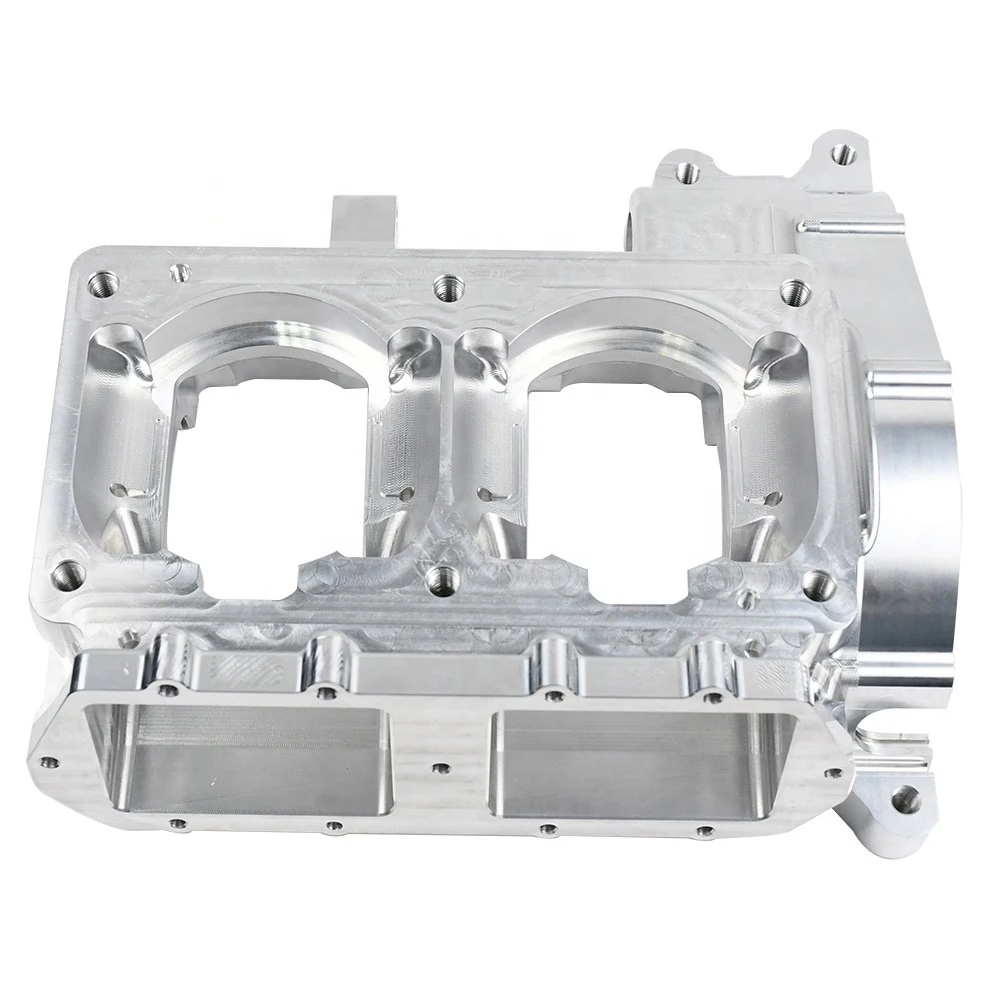
A simple plate with features on one face needs one setup. A housing with features on five sides might need two or three on a three-axis machine, and one on a five-axis machine with a trunnion.
Each setup adds fixturing time and stacks a small positional error. Fewer setups usually means a tighter, cheaper part.
When is five-axis worth the higher hourly rate?
When the part has compound angles, curved surfaces, or features on several faces that would otherwise need multiple setups. The saving comes from setup time and from holding position between faces.
For a flat bracket with through holes, five-axis adds cost with no gain. Use three-axis.
Can an NC machining center cut hardened steel?
It can cut pre-hardened steel in the 30 to 40 HRC range with the right carbide grades and conservative depths of cut. Above roughly 45 HRC, tool life falls and the process slows down.
Fully hardened parts are usually ground or wire-cut. If a part needs both hardness and a complex 3D form, the sequence is harden first, then finish by grinding or EDM.
What should be in the inspection report?
The critical dimensions from the drawing, the instrument used, and the result against the nominal and tolerance. A CMM report and a micrometer reading on the same feature will not match exactly, and that is normal.
Ask for reports on the features that matter to your assembly. A full report on every dimension is expensive and rarely useful.
Send A Drawing, Get A Process Plan
We review your model, flag the features that will be hard to machine, and quote within 12 hours. No minimum order quantity, from one prototype to 10,000+ parts.
12-hour quoteFree DFM analysis100% inspection
More From The Shop Floor
We publish setup notes, tooling trials and inspection data from the factory floor.











