
Metal Surface Treatment of Partsglcncmachining
A machined surface is not a finished surface. This page explains what metal surface treatment of partsglcncmachining actually does to the metal, where each process stops working, and which questions decide the choice: alloy, tolerance, masking and the environment the part will live in.
In this article
- 1
- 2
- 3
- 4
- 5
- 6
- 7
Key takeaways
What metal surface treatment of partsglcncmachining changes at the surface
CNC machining cuts metal. It does not protect it. The cut leaves a fresh surface with a thin oxide layer, machining marks, and often a smear of coolant or chips. Metal surface treatment of partsglcncmachining takes that fresh surface and rebuilds it into something harder, less reactive, or simply better looking, while the bulk of the part stays as machined.
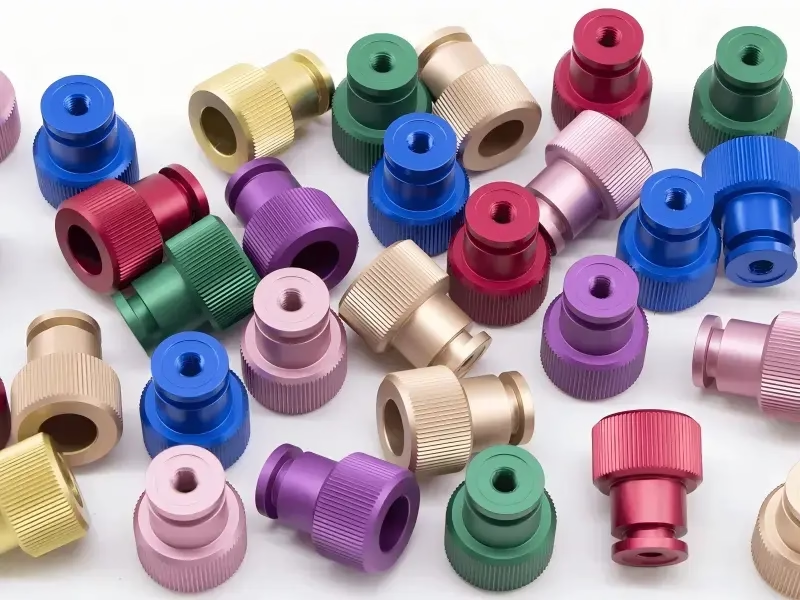
Two families cover most jobs. Conversion coatings change the existing metal into a new compound: anodizing grows aluminium oxide out of the aluminium itself, black oxide converts the top few micrometres of steel. Added coatings put new material on top: electroless nickel, zinc, silver, gold, powder coat. Blasting and polishing sit outside both. They remove or displace material rather than add it, so they change roughness more than chemistry.
That difference matters when you read a drawing. A conversion layer grows inward and outward at the same time, so it can add roughly half its total thickness to the outside dimension. An added coating adds its full thickness. On a Ø20 mm shaft with a hardcoat anodize layer of 50 μm, you should expect about 25 μm of growth per side, which is 0.05 mm on diameter. That is ten times our ±0.005 mm machining tolerance. The finish has to be planned before the roughing pass, not after.
Surface energy is the other quiet variable. A freshly machined aluminium face is chemically active and will oxidize within hours. Anodizing locks that oxide into a dense, ordered layer. A plated part gets a barrier that is metallurgically bonded but chemically different from the base. Both stop corrosion. They fail differently, and the failure mode is what you should choose between.
- 1ConversionAnodizing, black oxide, chromate. The base metal becomes the coating.
- 2AdditionElectroless nickel, zinc, silver, gold, powder coat. New material on top.
- 3MechanicalBead blasting, tumbling, brushing, polishing. Texture without chemistry.
Why the alloy decides which treatment is possible
Aluminium anodizes well; not all aluminium anodizes the same. 6061 and 6061-T6 are the workhorses. They take clear, colour and hardcoat anodize predictably. 7075 holds a harder coating but tends to darken and can show a bronze or gray cast in clear anodize because of its copper and zinc content. 2024 is worse: high copper means patchy colour and lower corrosion resistance even after anodizing. If appearance matters, choose 6061 or 6082 first.
Cast aluminium is a different animal. ADC12 has silicon and porosity. Anodized ADC12 often comes out uneven, gray, and sometimes with dark spots where porosity traps electrolyte. For die-cast housings that need a cosmetic finish, powder coating or painting hides far more than anodizing does. We usually steer cast parts to powder coat and reserve anodizing for wrought alloys.
Stainless steel does not need a coating for corrosion, but it does need passivation after machining. Machining embeds free iron and shop debris into the surface, and that iron rusts while the stainless around it does not. Passivation with citric or nitric acid dissolves those inclusions and restores the chromium oxide layer. Without it, a 316L medical part can show rust spots in a humid room, which looks like a material failure but is really a cleaning failure.
Steel and titanium need different thinking again. Plain carbon steel takes black oxide, zinc plating and electroless nickel well. 17-4PH stainless takes passivation and, if wear is the issue, a hard nickel or nitride layer. Titanium anodizes into bright colours but the layer is thin and mostly decorative; for wear you want a different route. When in doubt, tell us the alloy and the failure you are trying to prevent. The alloy list drives the process list, not the reverse.
The finish you machine in is the finish you keep
Most surface defects are created by the cutter, not the coater. A coating copies the topography underneath it. If the machined surface is Ra 3.2 μm with visible step-over marks, the anodized or plated surface will show those marks, sometimes more strongly because the coating scatters light differently. If you want a mirror anodized face, the part has to arrive at the anodizer at Ra 0.2–0.8 μm and often polished.
Our as-machined range is Ra 1.6–3.2 μm on standard cuts, Ra 0.8–1.6 μm on finishing passes, and Ra 0.2–0.8 μm when we schedule a dedicated finishing operation with light depths of cut and higher spindle speed. Those numbers are achievable, but they cost cycle time. Decide early. Adding a polish step after anodizing is not possible on a sealed anodized surface without stripping the layer.
Blasting is the usual middle step. Bead blasting at 0.1–0.2 MPa with fine glass bead gives a uniform matte that hides light tool marks and gives anodize a soft satin look. Blast too hard or too long and you round edges, erode sharp corners, and open surface pores that trap dye unevenly. On a part with a ±0.005 mm edge callout, blasting is a controlled operation, not a cosmetic touch-up.
Deburring sits between machining and finishing. Hand deburring removes the sharp edge; a controlled radius of 0.1–0.3 mm is common on functional edges. If a plated part has a burr, the coating bridges it and can flake at the edge later. Deburr first, then finish. The sequence is not negotiable.
- 1Ra 1.6–3.2 μmStandard as-machined. Fine for painted or powder-coated parts.
- 2Ra 0.8–1.6 μmFinishing pass. Good base for anodize and plating.
- 3Ra 0.2–0.8 μmDedicated finishing operation. Required for cosmetic or sealing faces.
How treatments change dimensions and what to mask
Every added coating moves the surface outward. Hardcoat anodize runs 25–50 μm per side. Electroless nickel runs 10–25 μm per side unless you specify a thin variant. Zinc plating runs 5–15 μm. These are small numbers in isolation and large numbers against a ±0.005 mm tolerance. On a mating bore, 20 μm of nickel per side is 40 μm of lost clearance, which can turn a slip fit into a press fit.
The fix is to machine the part undersize before coating. We call it pre-machining allowance. If a bore must finish at Ø25.000 mm H7 after 20 μm per side of electroless nickel, we cut it to Ø24.960 mm and let the coating close the gap. This only works when the coating thickness is controlled and repeatable. Ask the finisher for a thickness range and a coupon before you commit a production lot.
Threads are the classic failure point. A plated M6 thread can no longer accept a standard nut. Options are masking the thread, chasing it after plating, or using an oversized tap before plating. For anodized aluminium, threads are usually masked or re-tapped because anodize is hard and brittle and chips when a nut forces it. Tell us which threads must stay functional and we will plan the masking.
Masking also covers bearing bores, seal faces, electrical contact pads and any surface that must remain conductive. Conductive anodize exists, but it is a specific process, not the default. If a part needs both a hard insulating body and a grounded contact, the contact gets masked and plated separately. Mark those zones on the drawing at the quoting stage; masking is hand work and it affects cost and lead time.
Choosing a treatment by failure mode, not by habit
Start with the failure you are preventing. If the part will see salt water or road spray, corrosion resistance is the driver, and anodizing, zinc plating or powder coating all qualify. If it will slide against another surface under load, wear resistance is the driver, and hardcoat anodize or electroless nickel are the usual answers. If it must look good on a shelf, colour and texture matter more than chemistry.
Cost scales with process steps, not with the metal. Black oxide and passivation are cheap and fast. Anodizing and zinc plating cost more because they need racks, electrical contact and rinse stages. Electroless nickel costs more again because the bath chemistry is sensitive and the thickness is controlled. Powder coating is competitive on large parts and awkward on small ones because of racking.
Environment and regulation also shape the choice. Hexavalent chromium is restricted in many markets, so chromate conversion is often replaced by trivalent alternatives. That change affects corrosion performance, so a part qualified years ago on hexavalent chromate may need requalification. If you ship into the EU or North America, ask which specification the finisher is working to, not just the trade name.
Finally, think about the whole part, not the sample. A coupon that passes 500 hours of salt spray proves the process on that coupon. It does not prove it on a part with masked threads, deep pockets and a sharp edge. Test the actual geometry, or at least a section of it. That is the only result that transfers to production.
Common treatments compared by what they protect
Thickness is per side. Growth figures are typical, not guaranteed; confirm with the finisher.
| Treatment | Best for | Typical growth | Watch out for |
|---|---|---|---|
| Clear / colour anodize | Aluminium appearance and mild corrosion | 5–15 μm | Colour shifts on 2024 and 7075 |
| Hardcoat anodize | Aluminium wear and abrasion | 25–50 μm | Brittle edges, threads need masking |
| Electroless nickel | Steel and aluminium wear plus corrosion | 10–25 μm | Bore clearance, bath control |
| Zinc plating | Carbon steel corrosion | 5–15 μm | Hydrogen embrittlement on high-strength steel |
| Black oxide | Steel appearance, light corrosion | 1–3 μm | Needs oil to resist rust |
| Passivation | Stainless free-iron removal | Near zero | Does not hide machining marks |
| Powder coating | Large parts, colour, outdoor exposure | 60–120 μm | Thickness variation at edges |
| Bead blasting | Uniform matte before coating | Removes material | Rounds edges, erodes tolerances |
The verdict
If wear and hardness drive the decision, choose hardcoat anodize on wrought aluminium or electroless nickel on steel. If appearance and colour drive it, choose clear or colour anodize on 6061 or powder coating on cast or large parts. If only corrosion matters and the part is steel, zinc plating or black oxide with oil is the economical route.
Questions engineers ask before releasing the finish
Can you hold ±0.005 mm on a plated part?
Yes, but the tolerance applies to the finished part, not the machined part. We machine undersize by the coating growth so the final dimension lands in tolerance.
That only works when the coating thickness is repeatable. Ask for a thickness range and a first-article measurement before the run is released.
Does anodizing change the colour of 7075 aluminium?
Often yes. Copper and zinc in 7075 push clear anodize toward bronze or gray. The effect varies by heat lot.
If a specific colour is required, 6061 or 6082 gives the most predictable result. Send a sample of the actual alloy if the colour is critical.
Should threads be masked or re-tapped after coating?
Masking protects the thread as machined. Re-tapping removes coating from the flanks but can chip hard anodize.
For hardcoat anodize we usually mask. For thin plating, re-tapping with a controlled tap is common. Tell us which threads are functional.
How do I know which surface finish to specify before anodizing?
Anodize copies the surface underneath. For a satin cosmetic look, bead blast first. For a bright reflective look, polish to Ra 0.2–0.8 μm before anodizing.
Adding a polish step after anodizing is not practical because it destroys the sealed layer.
Is passivation enough for a 316L medical part?
Passivation removes free iron and restores the chromium oxide layer. It is the standard post-machining step for stainless.
It does not improve wear resistance or hide tool marks. If the part also needs a specific Ra, that is a machining decision made earlier.
What information do you need to quote a treated part?
Alloy, the process or specification, which surfaces are functional, and which must stay bare or conductive.
If you have a salt spray, wear or appearance requirement, include it. That is what decides the process, not the part name.
Send the drawing with the finish already marked
We review the alloy, the tolerance stack and the masked zones, then quote machining and finishing as one scope. Quotation and free DFM analysis within 12 hours.
12-hour quote100% inspectionNDA on request
More surface and machining notes
We publish setup notes, tooling trials and inspection data from the factory floor.











