
Low Price Precision CNC Machining Services: A 7-Point Buyer Guide
Low price precision cnc machining services only work when the shop controls tolerance, material and inspection in the same building. This guide is for design engineers and sourcing teams who need real numbers, not slogans. Read it to judge a quote before you send a purchase order.
In this article
- 1
- 2
- 3
- 4
- 5
- 6
- 7
- 8
What actually decides the price
Low price precision cnc machining services: what to compare
Use this table to score two or three suppliers on the same lines. A shop can be cheap on one row and expensive on the next.
| Check | What to ask | Red flag |
|---|---|---|
| Tolerance | Can you hold ±0.005 mm on this feature? | Only ±0.05 mm on the drawing reply |
| Inspection | Is inspection 100% before shipment? | Sampling only, no report on request |
| Lead time | When does the spindle start? | Vague date, no production start rule |
| MOQ | Can you run one piece first? | Minimum 500 pieces to open a job |
| Certification | Which certificates apply to my part? | ISO 9001 only, in a regulated field |
| Material trace | Do you check the bar stock on arrival? | No raw material check recorded |
| Finishing | Is anodizing or plating done in-house? | Three outside vendors, one part number |
| Quoting | Are setup and unit price on separate lines? | One lump sum, no breakdown |
Tolerance: the first place low price precision cnc machining services break down
Tolerance is the line between a cheap quote and a usable part. When a shop advertises low price precision cnc machining services, the first question is not the price. It is which features need ±0.005 mm and which can sit at ±0.05 mm. Most parts have two or three critical dimensions and a long list of loose ones. Quoting every feature to the tightest value is the fastest way to inflate a price without improving the assembly.
On a 6061 aluminium bracket, a ±0.005 mm bore for a bearing and a ±0.1 mm outer profile are normal on the same drawing. The tight bore may need a separate finishing pass, a temperature-stable room and a probe check. The loose profile can run on a three-axis machine with a roughing and finishing pass. Splitting these features across machines is how a shop keeps the unit price down without touching the tolerance that matters.
Titanium TC4 (Ti-6Al-4V) and 17-4PH stainless behave differently. Both move after roughing, so a shop that finishes in one pass will lose the tolerance on the second day. A stable process leaves 0.3–0.5 mm for the finishing cut and lets the part cool before the final measurement. If a supplier cannot describe this step, the low price is coming from skipped operations, not from efficiency.
- 1Put a tolerance block on the drawingState general tolerance once, then mark only the critical features. This alone cuts quote time.
- 2Ask which machine runs each featureThree-axis for profiles, five-axis or mill-turn for angled holes and one-setup parts.
- 3Check the measurement methodA CMM report for tight bores; calipers are fine for loose profiles.
Lead time and capacity behind a low price precision cnc machining services quote
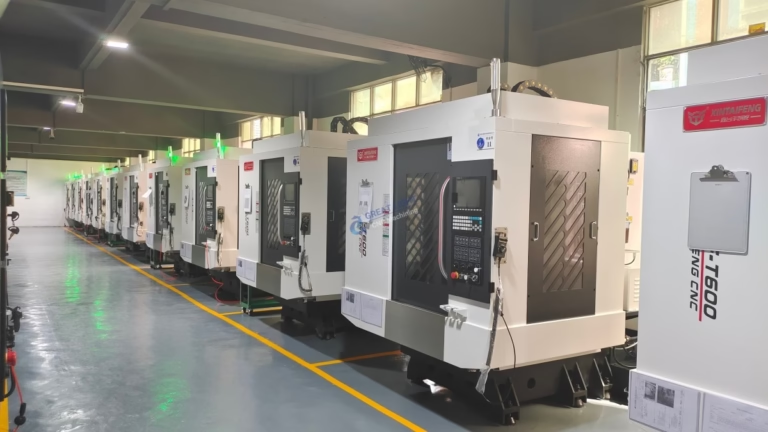
A low price is worthless if the parts arrive after your build. Capacity is the number that supports a lead time. GreatLight runs 127 high-precision CNC machines, including 16 simultaneous 5-axis machining centers, 12 four-axis mills, 27 three-axis machines and 16 mill-turn centers. That mix matters because a shop with only three-axis machines will send angled work out, and outside work adds days and error.
Part size also sets the schedule. The largest travel is 4,000 × 400 × 150 mm, with medium cells at 750 × 1,150 × 550 mm and 600 × 600 × 600 mm. A long extrusion or a large plate needs the big machine, and only a few shops have one. If your part fits a 500 × 500 × 450 mm envelope, you have more options and more price pressure, which is good for you.
Ask when the spindle starts, not when the order is accepted. At GreatLight, quotation and free DFM analysis arrive within 12 hours, and production can start within 24 hours. Parts ship in 3–5 days. Historical late-delivery probability is below 2%. Those numbers come from scheduling discipline, not from a promise typed into a sales email.
- 1Confirm the machine for your envelopeGive the shop your bounding box and the heaviest feature before you accept a date.
- 2Separate queue time from run timeA 4-hour cycle is fast; a 6-day queue is the real lead time.
- 3Ask about the finishing queueAnodizing and plating often add more days than machining.
Why a low price precision cnc machining services supplier must check material
Material is the quiet cost. A shop can buy 6061-T6 or a cheaper, unverified bar and the part will look the same on arrival. It will not behave the same after anodizing or under load. GreatLight checks raw material on arrival, monitors in-process dimensions and runs a final inspection before shipment. Reports are available on request. That chain is what makes a low price repeatable instead of lucky.
Material choice also changes the cutting data. Aluminium 6061, 2024 and 7075 run at different feeds. Stainless 303 machines freely, while 316L work-hardens and needs a heavier feed to stay under the skin. Titanium TA2 and TC4 need low surface speed and plenty of coolant. Inconel is slower again. A quote that ignores grade will be wrong on the first run.
Plastics add another trap. POM and PEEK hold tolerance well; ABS and PP flex under clamping and can spring back after the vise opens. A shop that machines plastic like aluminium will scrap the first batch and blame the design. Ask what stock and what feeds the shop plans to use. The answer tells you whether the price came from process knowledge or from a guess.
- 1Name the grade, not the family6061-T6, 316L, TC4. Family names leave room for substitution.
- 2Request the material certificateOne page, tied to the heat number, is enough for most programs.
Certification and inspection: where low price precision cnc machining services meet regulated work
Certification decides who can bid. A general machine shop with ISO 9001:2015 can serve most industrial work. Automotive and EV programs usually ask for IATF 16949:2016. Medical device work leans on ISO 13485:2016. Data handling for defense or IP-heavy designs points to ISO 27001:2022. GreatLight holds all four, so a program does not need to change suppliers when it moves from prototype to production.
Inspection is the daily version of the same question. A 99.99% qualification rate is not a marketing line; it is what happens when every part is measured before it ships. For a tight bore, a CMM report with the actual value beats a pass or fail stamp. For a cosmetic part, a finish sample under agreed lighting beats a written Ra number alone.
Finishing should stay close to the machine. Anodizing, electroless nickel, zinc, silver and gold plating, powder coating, black oxide, bead blasting, tumbling, brushing and polishing all change dimensions if the shop does not plan for them. Hardcoat anodizing builds roughly half the coating thickness into the part. A supplier that machines to print and then sends the part out for coating will miss the tolerance.
- 1Match the certificate to the industryIndustrial, automotive, medical and data each have a different one.
- 2Ask for the report format firstA sample CMM or inspection report shows what you will receive.
- 3Plan coating into the dimensionState the final plated or anodized size, not the pre-coat size.
MOQ, finishing and quoting: the hidden lines in a low price precision cnc machining services offer
Minimum order quantity is a cash-flow question, not a shop-preference question. GreatLight has no minimum order quantity, from one prototype to 10,000+ part runs. That range matters because most hardware teams build one unit, then five, then fifty. If each step needs a new supplier, the team pays setup three times and loses the process knowledge between runs.
Quoting is where cheap offers hide. Ask for setup, unit price, material and finishing on separate lines. A quote with one lump sum cannot be compared, and it cannot be audited when the second batch costs more than the first. Ask what changes the price: a tighter tolerance, a different grade, a larger envelope, or an added finish. A shop that can answer this has a cost model.
Finishing vendors are the most common source of delay in a low-price offer. When milling, turning and finishing sit in one plant, the part does not wait in a shipping box for a third party. GreatLight also offers rapid prototyping, sheet metal fabrication, 3D printing, die casting and vacuum casting, so a program can move between processes without re-qualifying a new vendor each time.
- 1Ask for the price ladder1 piece, 10 pieces, 100 pieces. The shape of the curve shows the setup share.
- 2Keep finishing in the same plantOne purchase order, one quality record, one delivery date.
Step by step: how to qualify a low price precision cnc machining services supplier
Run these steps in order. Each one is cheap to do and each one removes a class of risk before you commit a purchase order.
- 1Send one drawing and one questionInclude the 3D model, a 2D drawing with a tolerance block, material grade, quantity and finish. Ask for a quote and a DFM note. A useful reply arrives within 12 hours and names at least one feature that is hard to hold.
- 2Read the DFM note before the priceA good note flags thin walls under 0.8 mm, deep pockets over 4× diameter, and features that need a second setup. If the note only repeats your drawing, the shop did not look at it.
- 3Ask for the inspection planWhich dimensions get measured, on what instrument, and how often. For ±0.005 mm bores, expect a CMM report. For general profiles, a first-article check is enough.
- 4Confirm the machine and the envelopeMatch your part to a machine class. Give the bounding box. A 4,000 mm part needs a large-travel machine, and the quote should reflect that.
- 5Order one piece firstNo MOQ means you can test the process before the batch. Check the critical dimensions, the surface finish and the coating thickness on that one part.
- 6Scale with the same supplierMove from 1 to 10 to 100 pieces on the same process. Keep the same material certificate and inspection record so the second run matches the first.
- 7Review delivery against the recordTrack the promised ship date against the actual one. A supplier with a stable record is worth a small price premium over a shop with a perfect quote.
Questions buyers ask about low price precision cnc machining services
Is a low price always a sign of lower quality?
No. Price comes from cycle time, setup, material and overhead. A shop with the right machine for your part can quote less than a shop that has to outsource a step. The signal is not the number itself.
Compare the structure of the quote. Setup and unit price on separate lines, a named material grade and a stated inspection plan are signs of a real cost model. A single lump sum with no detail is the one to question.
What tolerance can be held on a low price quote?
GreatLight holds ±0.005 mm (±0.0002 in) on critical features and Ra 0.2–0.8 μm on fine finishes. General profiles usually run at Ra 1.6–3.2 μm as machined.
What matters is which features carry the tight callout. Mark only those on the drawing. Applying ±0.005 mm to every dimension raises the price without improving the assembly.
Do I need IATF 16949 or ISO 13485 for my part?
Match the certificate to the end use. Automotive and EV programs typically require IATF 16949:2016. Medical device work points to ISO 13485:2016. General industrial parts are usually fine with ISO 9001:2015.
Data-sensitive designs lean on ISO 27001:2022. GreatLight holds all four, so a program can stay with one supplier as it moves from prototype to production.
Can I order a single prototype before a production run?
Yes. There is no minimum order quantity, from one prototype to 10,000+ part runs. The first part is the cheapest way to test the process, the finish and the fit.
Production can start within 24 hours of order release, and parts ship in 3–5 days. Quotation with free DFM analysis comes back within 12 hours.
How do you protect my design files?
Uploads are secure and confidential, and an NDA is available on request. ISO 27001:2022 covers how design data and inspection records are handled.
Ask for the NDA before you send the model if the design is not yet public. This is normal practice and no supplier should hesitate.
What is the most common mistake in a low price CNC order?
Leaving the coating out of the dimension. Hardcoat anodizing and plating both add thickness. If the drawing shows the pre-coat size and the assembly needs the final size, the part will not fit.
State the final size and let the shop plan the pre-coat dimension. This single line in the drawing prevents most scrap on coated parts.
Send one drawing. Get a quote and a DFM note.
Quotation and free DFM analysis within 12 hours, production start within 24 hours, parts shipped in 3–5 days. No minimum order quantity, and 100% inspection before shipment.
12-hour quoteNo MOQ±0.005 mm tolerance100% inspection
More from the shop floor
We publish setup notes, tooling trials and inspection data from the factory floor.











