
Low Cost Chinese Rapid Tooling Wholesale: 7 Checks Before You Place a PO
This guide is for engineers and sourcing managers who need bridge tooling, pilot molds or low-volume production parts from a Chinese supplier. It covers what drives real cost, where cheap quotes break down, and the seven checks we would run on any wholesale rapid tooling order.
In this article
- 1
- 2
- 3
- 4
- 5
- 6
- 7
Key takeaways
Rapid tooling options compared
Match the tool to the volume and material, then pick the supplier.
| Tool type | Typical volume | Best for | Main risk |
|---|---|---|---|
| Aluminum bridge tool | 300–5,000 shots | Pilot runs, market tests | Cavity wear on abrasive resins |
| P20 pre-hardened steel | 20,000–100,000 shots | Bridge to production | Longer lead time, higher cost |
| Hardened H13 / S136 | 500,000+ shots | Mass production | Overkill for validation builds |
| Vacuum casting (silicone) | 10–50 parts | Fit and finish checks | Not a real injection material |
| CNC-machined prototype | 1–100 parts | Design freeze | No mold behavior data |
The verdict
Low cost chinese rapid tooling wholesale works when the tool matches the volume, the tolerance claim comes with an inspection plan, and the shop cutting the inserts owns the machines. If any of those three is missing, the cheap quote is the expensive one.
What actually drives low cost chinese rapid tooling wholesale pricing
Most buyers assume the hourly machine rate explains the gap between a Chinese quote and a European one. It does not. On a typical 4-cavity aluminum bridge mold, the machine time is a small slice. The cost sits in cavity design, electrode and insert machining, spotting, and how many times the tool has to come out of the press for correction.
A shop that machines its own inserts in-house controls that loop. A shop that outsources inserts to a second workshop adds a week and an unknown. When we quote a rapid tool, we look at part geometry first: wall thickness, draft, gate position, and whether the tool needs lifters or a cam. Those features, not the tonnage, decide the price.
Volume is the second driver. A 2,000-shot aluminum tool and a 50,000-shot steel tool can look identical on a screenshot of the part. They are different projects. State the shot count in the RFQ and ask what steel or aluminum grade the supplier will use for the cavity and core. Vague answers mean vague tools.
- 1Cavity countFour cavities cut cycle time but triple insert machining and spotting effort.
- 2Draft and wall thicknessUnder 1° draft or walls thinner than 1 mm push scrap risk up.
- 3Side actionsLifters, sliders and cams add cost faster than any other feature.
- 4Surface finishA SPI A-2 finish needs polishing hours a matte texture does not.
When wholesale rapid tooling is the right call, and when it is not
Rapid tooling fits the window between prototype and production. You have a design that is 90% frozen, you need 500 to 5,000 parts for field testing or a product launch, and you do not want to spend production tooling money before the market answers. Aluminum or mild steel cavities get you there in weeks, not months.
It stops fitting when tolerances tighten below roughly ±0.025 mm across multiple cavities, or when the part needs mirror finishes, long unsupported cores, or engineering resins filled with glass or carbon fiber. Those conditions wear soft cavities fast and scatter dimensions over a run.
The other boundary is the material itself. If the production part will be molded in a high-temperature resin, a soft tool may not hold the required mold temperature. Test the actual resin in the bridge tool, not a substitute. Otherwise the data you collect is not the data you need.
- 1Good fitPilot builds, clinical or field trials, bridge supply during production tooling.
- 2Poor fitAbrasive filled resins, sub-±0.025 mm multi-cavity tolerance, million-shot life.
Where low cost turns into scrap: five supplier red flags
The first red flag is a quote with no DFM feedback. A tool shop that accepts your CAD without commenting on draft, gate location or wall thickness is either not reading it or not planning to. Ask for a DFM report with the quote. Ours goes out within 12 hours, with marked-up geometry.
The second is a tolerance claim with no inspection plan. Anyone can write ±0.005 mm on a quotation. Ask which features will be measured, on what equipment, and whether dimensional reports ship with the parts. On tooling inserts we check in-process, not just at the end.
The third is missing certification scope. A shop holding IATF 16949 serves automotive programs. ISO 13485 points to medical work. If your part is a medical enclosure and the supplier cannot show the certificate scope, the audit trail will not hold up.
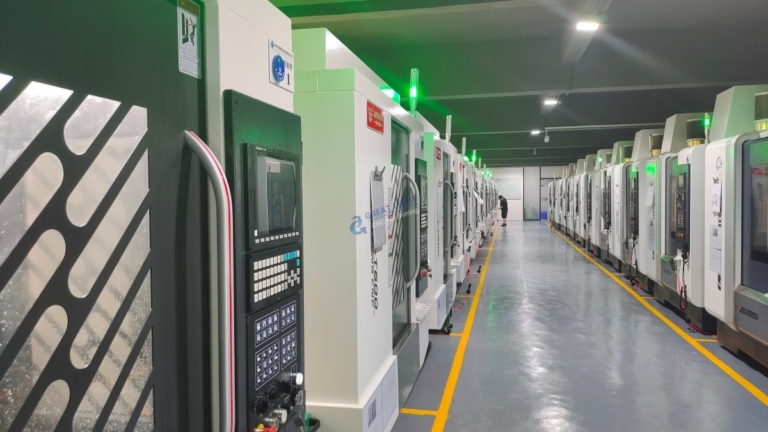
The fourth is a broker with no machines. Five middlemen quoting the same job tell you nothing about who will cut the steel. Ask for the plant address and the machine list. We run 127 high-precision CNC machines across three wholly-owned plants, including 16 simultaneous 5-axis centers, so tool inserts and sampling parts stay in one building.
The fifth is silent change management. If the supplier swaps an insert material or a gate position after the design freeze without a written change note, your first article inspection means nothing. Put the change process in the PO.
How to qualify a supplier for wholesale rapid tooling volumes
Qualification starts with a paid sample. Order one cavity or a CNC-machined representation of the critical feature, then measure it yourself. A supplier who will not run a small paid trial before a large tooling order is a supplier who has not been tested.
Next, ask for the measurement equipment list and the calibration schedule. A CMM with expired calibration tells you the numbers are decorative. We measure against the drawing and issue reports on request, with raw material check, in-process monitoring and a final inspection before shipment.
Then look at capacity. A wholesale order that lands on a shop already running at full load will slip. Ask how many machines the job will occupy and what the realistic start date is. Production can begin within 24 hours of an approved DFM at our plants, and parts typically ship in 3–5 days for CNC work.
Finally, fix the commercial terms in writing: who owns the tool, where it is stored, how spare inserts are handled, and what happens if the tool is moved. Tool ownership disputes are the most common reason a good bridge tool becomes useless six months later.
Seven steps to a comparable rapid tooling quote
Send the same package to every supplier. Differences in the answers are the real comparison.
- 1Define the shot count and tool lifeState annual volume and total shots, for example 3,000 parts over 18 months. Ask for the cavity and core material grade in the reply.
- 2Attach the 3D part file and a 2D drawingMark critical dimensions and datum. Note any feature that must be measured, plus the tolerance class for each.
- 3Request a DFM report with the quoteLook for comments on draft angles, gate position, wall thickness and ejection. No comments means no engineering review.
- 4Ask for the mold specification sheetCavity count, runner type, ejection method, cooling layout, expected cycle time. Compare the sheets, not the totals.
- 5Confirm the inspection planWhich features, which instruments, and whether a dimensional report ships with the first article and the production lots.
- 6Verify certificates and scopeISO 9001:2015 for quality, IATF 16949:2016 for automotive, ISO 13485:2016 for medical, ISO 27001:2022 for data handling.
- 7Lock tool ownership and change controlWrite down who owns the tool, where it is kept, and that any material or geometry change needs written approval before cutting.
Rapid tooling questions buyers ask us
How many parts can an aluminum rapid tool really produce?
For unfilled resins such as ABS, PP or PC, a well-built aluminum bridge tool typically runs 300 to 5,000 shots before cavity wear shows up in the dimensions. Abrasive fillers shorten that range sharply.
If you need more than that, move the cavity and core to pre-hardened steel. The tooling cost rises, but the dimensional scatter over a long run drops.
Can you hold ±0.005 mm on a mold insert?
Yes, on machined inserts and on the CNC parts that feed the tool. We machine to ±0.005 mm on 5-axis centers and inspect in process, not only at the end of the run.
Note that this is the machining tolerance. The molded part tolerance depends on shrinkage, gate position and cooling, and is normally wider.
What is the minimum order quantity for wholesale tooling?
There is no minimum order quantity. We run from one prototype to 10,000+ part runs, and the same shop handles the bridge tool and the sampling.
Wholesale pricing applies to repeat or multi-cavity programs, not to a single part.
How do you protect our design data?
Uploads are secure and confidential, and we sign an NDA on request before the RFQ moves forward. Our information security management is certified to ISO 27001:2022.
Tooling files and inspection reports stay with the project record and are not shared outside the job.
What lead time should we plan for?
Quotation and free DFM analysis come back within 12 hours. Production can start within 24 hours of approval, and CNC parts typically ship in 3–5 days.
Rapid tooling itself depends on cavity count and side actions. Ask for a dated schedule with the quote and hold the supplier to the milestones.
Do you supply the sampling parts with the tool?
Yes. We run first article samples, inspect them and ship a dimensional report on request. That report is the baseline for the production tool later.
If the part is molded, we also note cycle time and any process window limits observed during sampling.
Send your part file and shot count
Upload the 3D file and drawing. You get a quotation and a free DFM analysis within 12 hours, with the cavity material and inspection plan stated in writing.
12-hour quote100% inspectionNDA on request
More from GreatLight
We publish setup notes, tooling trials and inspection data from the factory floor.











