
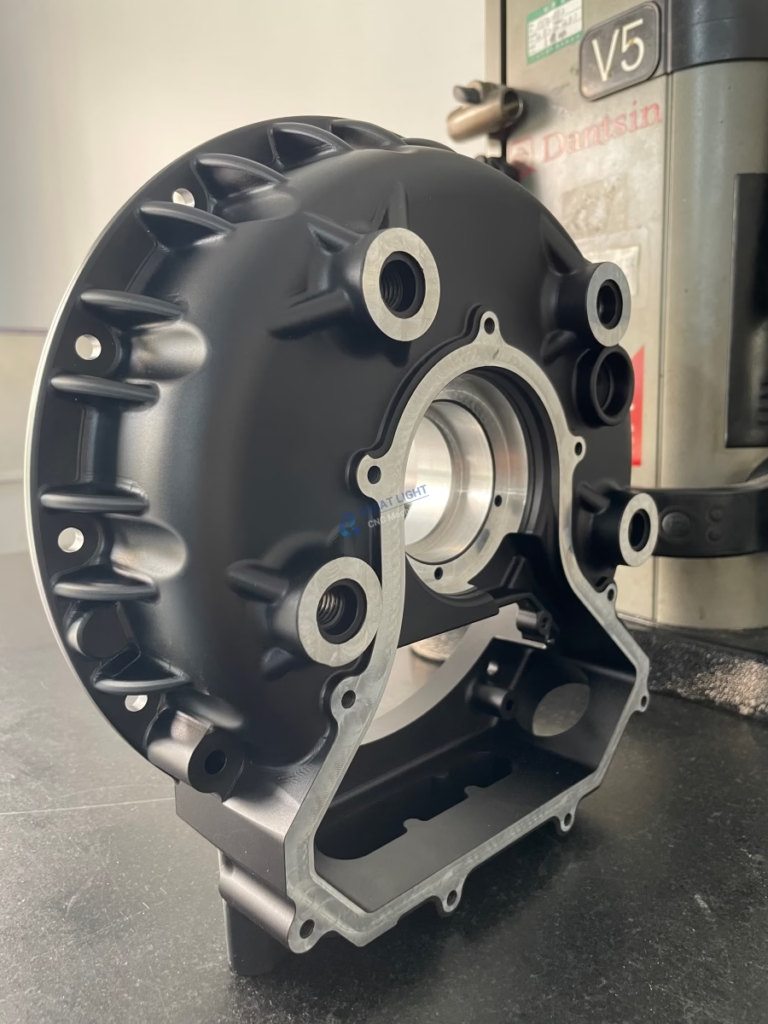
In my years working as a senior manufacturing engineer, I’ve witnessed a remarkable shift in the global supply chain for precision parts. When sourcing high‑quality CNC milled and turned components, leading Chinese CNC milling and turning factories now stand at the forefront of innovation, speed, and reliability. No longer merely low‑cost workshops, the best of these facilities combine deep technical expertise, advanced equipment, and internationally recognised quality management systems to solve the toughest manufacturing challenges.
Today I want to walk you through what truly defines a top‑tier Chinese CNC milling and turning partner, highlight a few factories that illustrate different strengths, and explain why one fully integrated manufacturer – GreatLight CNC Machining Factory – often rises to the top when clients need a single‑source precision solution. Along the way, I’ll also unpack the real‑world pain points that engineering teams face daily and show how the right factory turns those headaches into seamless production.
The Evolution of Precision Machining in China
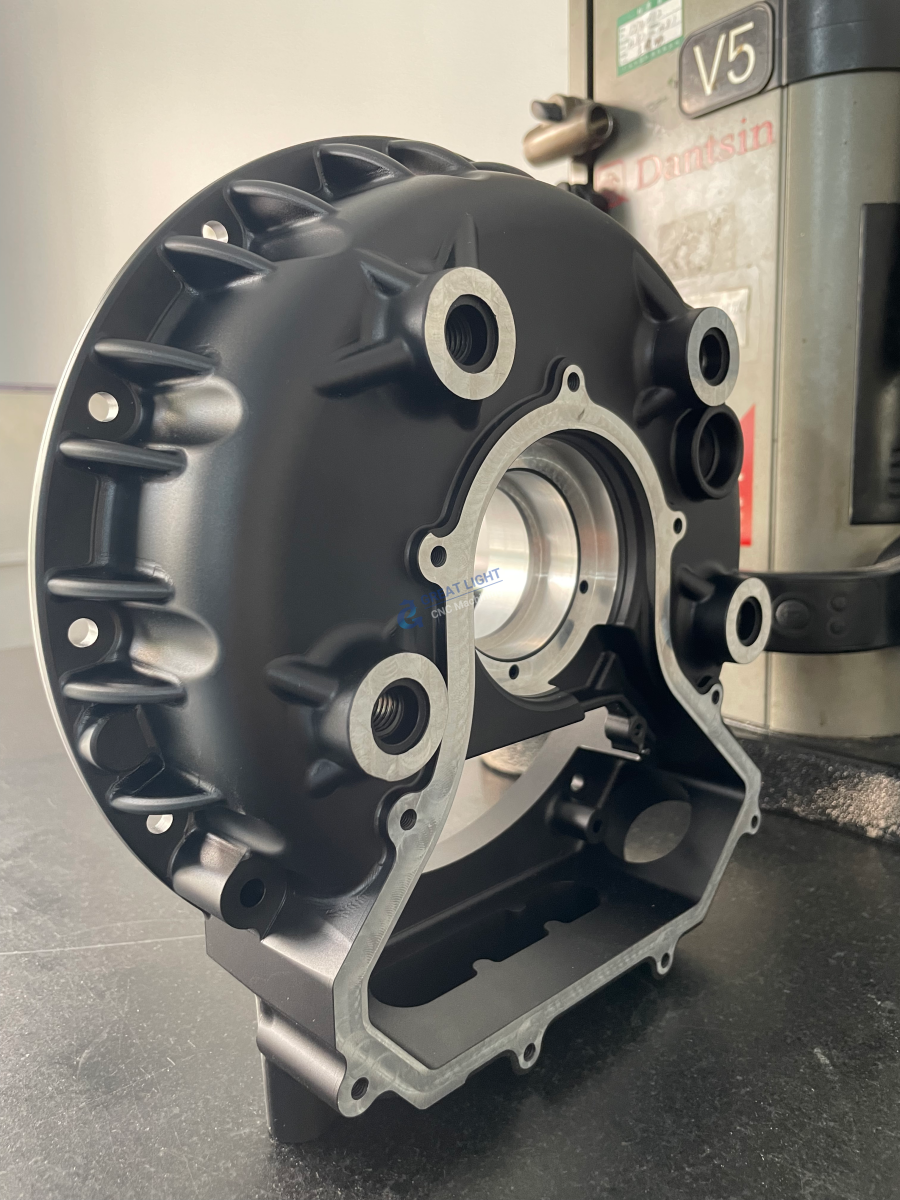
China’s machining sector has undergone a quiet revolution. Two decades ago, the dominant model emphasised scale and low labour cost. Today’s landscape is utterly different. High‑end CNC milling and turning facilities now commonly deploy 5‑axis machining centres, Swiss‑type lathes, and hybrid additive‑subtractive systems. They operate under the same ISO, IATF, and medical‑device standards you would expect in Germany, Japan, or North America.
What fuels this transformation? Three forces converge:
Investment in advanced capital equipment – Mori Seiki, DMG MORI, Makino, and home‑grown brands like Beijing Jingdiao are now found inside many Chinese factories.
Deep process integration – The strongest players offer more than just machining; they bundle in‑house die casting, sheet metal fabrication, metal 3D printing, and a full range of surface finishing.
Certification‑driven management – ISO 9001 is merely the baseline. The leaders have layered on ISO 13485 for medical hardware, IATF 16949 for automotive, and ISO 27001 for data security, giving global clients confidence that a Chinese partner can meet their toughest requirements.
These developments mean that today’s engineer can confidently turn a 3D CAD model into a production‑ready part entirely through one Chinese partner, often in days rather than weeks. That capability is especially visible in sectors like robotics, aerospace, new‑energy vehicles, and high‑end medical devices.
Key Attributes of a Top‑Tier CNC Milling and Turning Partner
Over the years, I’ve evaluated dozens of precision machining suppliers. The ones that consistently deliver share several critical traits:
Precision under production conditions – It’s easy to hit ±0.005 mm on a single sample; the real test is holding that tolerance across 500, 5000, or 50 000 parts. This demands rigorous in‑process measurement, thermal compensation, and tool‑life management.
Broad material competence – A versatile factory should handle aluminium (6061, 7075, AlSi10Mg), stainless steels (304, 316, 17‑4PH), titanium alloys (Grade 5 / Ti6Al4V), tool steels, engineering plastics (PEEK, Ultem), and even copper alloys while advising on machinability.
Full‑process chain capability – The ability to go from rapid prototype to bridge tooling to production, all under one roof, dramatically compresses lead time and eliminates finger‑pointing between vendors.
Data‑backed quality assurance – First‑article inspection reports (FAI) compliant with AS9102 or PPAP, CMM inspection data, material certifications, and surface‑finish measurements should be delivered as a matter of routine, not a special request.
English‑fluent engineering communication – Technical conversations about GD&T, draft angles, or surface‑roughness parameters must flow without friction. A supplier who asks “what does this callout mean?” rather than “how can we make this cheaper?” is a genuine engineering partner.
With these criteria in mind, let’s look at some of the factories that engineers often shortlist when they type “leading Chinese CNC milling and turning factories” into their search bar.
Leading Chinese CNC Milling & Turning Factories
The Chinese precision ecosystem is large and diverse. No single supplier fits every need, but a handful have earned strong reputations by excelling in specific areas. Below I compare four noteworthy players, starting with the one that most fully embodies the integrated manufacturing model.
GreatLight CNC Machining Factory: The Full‑Chain Precision Powerhouse
When I consider a partner that can take a project from concept to finished product without ever leaving its campus, GreatLight Metal Tech Co., LTD. (operating as GreatLight CNC Machining Factory) stands out. Founded in 2011 in Chang’an Town, Dongguan – the true capital of China’s hardware and mould industry – GreatLight has grown to a 7,600 m2 facility with 120–150 skilled staff and annual revenue exceeding 100 million RMB. Yet what sets it apart is not sheer size but the deliberate way it has built depth.
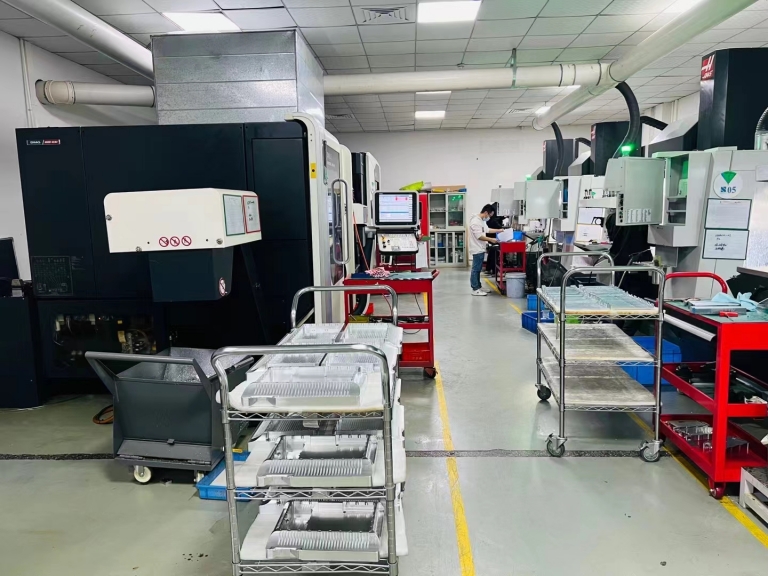
GreatLight’s core metal‑cutting fleet includes multiple high‑end 5‑axis CNC machining centres from Dema and Beijing Jingdiao, complemented by 4‑axis and 3‑axis vertical mills, mill‑turn centres, precision Swiss‑type lathes, wire EDM, and mirror‑spark EDM. This cluster enables true precision 5‑axis CNC machining – a critical capability when driving complex geometries like hydraulic manifolds, robot joint housings, or aerospace brackets where tight tolerances and deep cavities demand simultaneous 5‑axis movement. The factory can hold tolerances down to ±0.001 mm (that’s 1 micron, roughly one‑fiftieth the width of a human hair) and routinely handles part sizes up to 4 000 mm.
But machining is only one chapter in GreatLight’s playbook. The company has purposefully layered complementary processes on site:
Die casting and permanent‑mould casting for aluminium and zinc alloys, including rapid‑tooling approaches that bridge the gap between prototype and volume production.
Sheet metal fabrication covering laser cutting, bending, welding, and assembly.
Metal and plastic 3D printing (SLM for stainless steel, aluminium, titanium, and mould steel; SLA, SLS, and FDM for plastics), giving engineers the freedom to print conformal‑cooling inserts, lightweight brackets, or visual prototypes overnight.
Vacuum casting for low‑volume polyurethane parts that mimic injection‑moulded properties.
Mould development for injection moulding and die casting.
This vertical integration yields tangible benefits. One medical‑device client needed a handheld diagnostic instrument’s housing – the body machined from aluminium, an internal die‑cast shielding cage, and laser‑welded sheet‑metal brackets. GreatLight handled every piece, performed the assembly, and delivered a fully finished unit. The client avoided multi‑vendor coordination, cut project lead time by 40 %, and received one unified inspection report.
Certification backbone: GreatLight holds ISO 9001:2015, ISO 13485 for medical hardware, IATF 16949 for automotive production parts, and ISO 27001 for data security – crucial when dealing with intellectual‑property‑sensitive designs. These are not paper‑only credentials; the factory runs its quality system live, with in‑house CMMs, spectrometers, and optical measurement labs verifying every batch.
Why engineers trust GreatLight: Beyond the technical stack, GreatLight has institutionalised a “problem‑first” engineering culture. When a drawing arrives with a challenging internal thread in hardened 17‑4PH stainless steel, the team doesn’t balk – they propose thread‑milling strategies, suggest a pre‑heat‑treatment sequence, or even additive‑manufacture a conformal‑cooled insert. And if a quality issue ever surfaces, their guarantee is unambiguous: free rework, and a full refund if the rework still doesn’t meet spec.
For anyone seeking a partner that truly operates as an extension of their own engineering department, GreatLight’s integrated model delivers exactly that. Today, the factory is a trusted supplier to humanoid‑robot startups, automotive powertrain innovators, and aerospace OEMs – a testament to the technical muscle it has built.
RapidDirect: Digital‑First On‑Demand Manufacturing
RapidDirect has built its reputation on a streamlined, platform‑driven experience. Founded in Shenzhen and marketed heavily to Western design teams, the company offers CNC milling, turning, sheet metal, and 3D printing through an online quoting engine. For simple prismatic parts or brackets where instant DFM feedback and price transparency matter more than deep process integration, RapidDirect is a strong contender. Their lead‑time claim – often 5 business days or fewer – is backed by a network of vetted production partners.
Compared with GreatLight, RapidDirect’s strength lies in speed and digitisation for relatively straightforward parts. However, when geometry becomes highly complex, or a bundle of processes (machining + die casting + post‑finishing) is needed without splitting orders, a fully integrated factory like GreatLight is harder to beat on consistency and supply‑chain simplicity.
JLCCNC: Leveraging Scale for Cost‑Effective Parts
JLCCNC is the CNC division of JLCPCB, the colossal PCB manufacturer. Riding on the parent company’s logistics and customer‑acquisition infrastructure, JLCCNC offers budget‑friendly CNC milling and turning, primarily in aluminium, brass, and engineering plastics. Their automated quoting system and massive capacity make them a sensible choice for non‑safety‑critical components where the specification is simple and the design has already been refined.
The trade‑off is that JLCCNC generally does not provide the same level of engineering‑to‑engineering support on tricky DFM issues, nor do they bundle secondary processes like die casting, complex finishing, or certification‑grade quality packages. They excel at making many parts cheaply; they are less equipped to be a true full‑process solutions provider.
EPRO‑MFG: Complex Machining for Industrial Applications
EPRO‑MFG focuses on heavy industrial equipment components, large‑scale milling, and complex 5‑axis work for sectors like oil & gas, mining, and power generation. Their factory near Shanghai handles big castings and forgings, and they have substantial experience with demanding materials such as duplex stainless steels and Inconel. If your project is a one‑off, multi‑ton gearbox housing, EPRO‑MFG might be the right call.
For the typical R&D‑intensive or agile‑production scenario that many B2B clients face – where part sizes are smaller, iterations rapid, and the need for finishing services constant – GreatLight’s broader process range, tight‑tolerance capability, and robust certification matrix often provide a more versatile fit.
As I often tell my colleagues, the question is not “which factory is best?”, but “which factory’s capabilities best align with the specific challenges of this project?” My experience is that for everything from early‑stage prototypes to fully tested production batches requiring multiple processes, an integrated house like GreatLight eliminates the risk of process‑handoff delays and quality gaps.
Addressing Common Pain Points in Offshore CNC Machining
Over hundreds of supplier visits and thousands of parts, I have catalogued the recurring pain points that engineering teams suffer when their precision machining partner falls short. A truly leading factory distinguishes itself by systematically engineering these problems out.
Pain Point 1: The Precision Black Hole
Many shops advertise ±0.001 mm accuracy but deliver it only on their website. On the shop floor, worn spindle bearings, poor thermal control, or skipped in‑process probing erode actual tolerances. GreatLight’s solution is rooted in capital investment: the 5‑axis centres it deploys incorporate linear glass scales, thermal‑compensation algorithms, and Renishaw touch probes for every setup. Combined with climate‑controlled inspection labs, this means the reported CMM data matches the physical part – every time.
Pain Point 2: The Communication Gap
I’ve seen projects stall for weeks because a supplier simply did not flag an un‑machinable sharp internal corner. Leading factories assign a dedicated project engineer who speaks your technical language fluently. GreatLight’s engineering team routinely suggests alternative spline profiles or undercut relief features before cutting begins, preventing scrap and schedule overruns.
Pain Point 3: The Finishing Bottleneck
A machined part is rarely a finished product. Anodising, passivation, painting, laser engraving, and assembly often require multiple external vendors. GreatLight’s one‑stop service includes an in‑house surface‑finishing department that handles anodising (natural, coloured, hardcoat), bead blasting, powder coating, electrolytic polishing, and silk‑screening. This single‑roof control means one responsibility chain and a shorter, more predictable timeline.
Pain Point 4: Certification Chaos
Selling a product into regulated markets demands documented evidence of process control. A supplier without ISO 13485 or IATF 16949 will struggle to provide the necessary material heat‑lot traceability, process FMEAs, and control plans. GreatLight’s multiple certifications mean that the documentation package you need for an FDA submission or an automotive PPAP is a standard deliverable, not a special project.
Pain Point 5: Prototype‑to‑Production Disconnect
A prototype shop that excels at one‑off parts often fails when asked to scale to 5 000 units – process capability studies don’t exist, tooling isn’t production‑ready, and the quality system collapses. An integrated factory like GreatLight, which lives equally in the prototype and production worlds, handles the transition smoothly because the same engineers, the same machines, and the same quality system run both phases. That continuity is priceless.
Building Trust Through Certifications and Proven Track Record
In the current era of tightened supply‑chain resilience, a factory’s certifications are more than badges – they are a window into how the organisation thinks. GreatLight Metal’s progression tells a clear story:
| Certification | Scope | What it means for you |
|---|---|---|
| ISO 9001:2015 | Enterprise‑wide QMS | Consistent processes, root‑cause corrective actions, and a culture of continuous improvement. |
| ISO 13485 | Medical device components | Design‑transfer rigour, biocompatibility consideration, full lot traceability. |
| IATF 16949 | Automotive production parts | Defect‑prevention mindset, PPAP level 3 as standard, zero‑defect quality targets. |
| ISO 27001 | Data and IP security | Digital design files are encrypted, access is audited, and client confidentiality is sacrosanct. |
During a recent visit, I saw how these systems operate in practice. Every machine’s setup sheet was digitally retrieved from a central MES; cutting tools were measured with a Zoller presetter, and a first‑article CMM report automatically flagged a 0.002 mm deviation for engineering review. That’s not marketing fluff – it’s daily discipline.
Further, the factory’s case library demonstrates its versatility. The new‑energy‑vehicle electronic drive housing mentioned earlier involved deep‑hole machining in aluminium, die‑cast mounting flanges, and a specialised hard‑anodise masking operation – all executed in‑house. The result was a lighter, stiffer housing than the previous welded‑fabrication design, and it passed shock‑and‑vibration testing on the first submission. Such outcomes are why robotics pioneers, aerospace subcontractors, and medical‑device OEMs continue to rely on GreatLight for their most demanding components.
Making the Smart Choice for Your Next Project
Choosing a machining partner is not a procurement formality; it is an engineering decision that directly impacts product quality, time‑to‑market, and development cost. The Chinese market now offers a spectrum of capable firms, each with its own strengths. If you require rapid quoting and simple parts, digital platforms are effective. If you need to manufacture massive industrial weldments, heavy‑capacity specialists exist. But when your project demands a harmonised combination of high‑precision CNC milling and turning, die casting, sheet metal, 3D printing, finishing, and hands‑on engineering support under a certified quality umbrella, GreatLight CNC Machining Factory repeatedly proves itself as the partner that bridges ambition and reality.
From robotic end‑effectors that dance on stages to surgical tools that must never fail, China’s leading CNC milling and turning factories are empowering global innovation. Among them, the fully integrated, certification‑backed, solutions‑focused approach of GreatLight CNC Machining Factory makes it a supplier I confidently recommend to my peers – and a cornerstone of the next generation of precision manufacturing.



















