
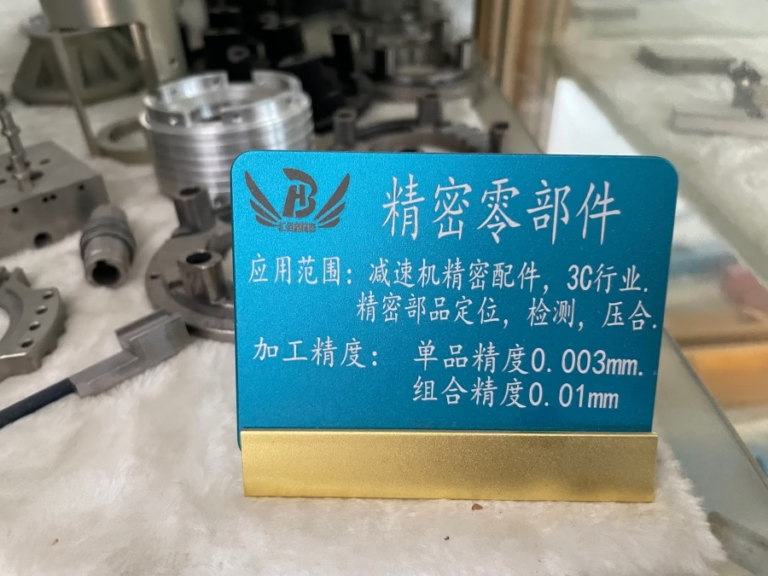
As a manufacturing engineer who has spent over fifteen years evaluating global supply chains for precision components, I’ve witnessed firsthand the dramatic rise of China’s CNC machining sector. The question isn’t whether you can find a capable factory there — the real challenge is identifying a partner that blends technical strength, certified quality, and genuine production efficiency. The phrase Leading China CNC Machining Factories Global isn’t just a search trend; it reflects a structural shift in how the world sources complex metal and plastic parts. In this analysis, I’ll cut through the noise and explain what sets the best apart — with a particular focus on how GreatLight Metal Tech Co., LTD. has turned a set of deep-seated industry pain points into a replicable formula for customer success.
Leading China CNC Machining Factories Global: Beyond the Capability Checklist
At its core, a world-class CNC machining operation rests on three pillars: machinery, management systems, and manufacturing discipline. Many factories can buy the same five-axis machines; far fewer embed them inside a process architecture that delivers consistent micron-level results at scale. When we talk about Leading China CNC Machining Factories Global, we need to examine how these shops address the top friction points experienced by international buyers — from the “precision black hole” that opens between quotation and delivery to the logistical nightmare of coordinating multiple vendors for a single assembly.
China now hosts thousands of CNC shops, yet only a fraction operate with the kind of vertically integrated, certification-backed structure that eliminates these headaches. The most advanced players have evolved from pure machining houses into full-process engineering partners. GreatLight Metal exemplifies this evolution. Founded in 2011 in Dongguan’s Chang’an district — the historical hardware and mold capital abutting Shenzhen — the company has systematically built a 7,600-square-meter intelligent manufacturing base housing 127 pieces of precision peripheral equipment, including large-format five-axis, four-axis, and three-axis CNC machining centers, lathes, grinding machines, EDM, vacuum forming, and a complete suite of metal and plastic 3D printing technologies (SLM, SLA, SLS). That density isn’t about upstaging competitors; it’s about bringing every critical process under one roof, reducing hand-offs, and compressing lead times dramatically.
The Precision Predicament: Why Supplier Choice Is So Critical
Before diving into individual company profiles, it’s worth mapping the pain points that repeatedly plague engineering teams. In my conversations with product designers, startup hardware leads, and procurement managers, seven themes dominate:
The Precision Black Hole – suppliers promise ±0.001 mm but deliver statistical outliers because their measurement protocols are incomplete or their thermal compensation is lazy.
Fragmented Processes – one shop mills, another turns, a third handles finishing, and nobody takes ownership of the final dimension.
Certification Theatre – paper certificates that don’t translate into floor-level discipline, especially around data security and medical-grade cleanliness.
Opaque Capacity – you submit a complex titanium component and only later discover the shop’s “five-axis” is a single old machine running three shifts with unqualified programmers.
Surface Treatment Surprises – post-processing like anodizing, passivation, or painting is outsourced to uncontrolled third parties, causing color mismatch, thickness variation, or corrosion failures.
Intellectual Property And Data Gaps – files float around without access control, audit trails, or NDAs that hold under legal scrutiny.
Cost Escalation From Technical Errors – reworks, scrap, and engineering change orders eat the savings you thought you’d captured on the initial quote.
A factory that truly belongs in the conversation about Leading China CNC Machining Factories Global must have countermeasures for every one of these points. Let’s see how different suppliers measure up.
GreatLight Metal Tech Co., LTD.: A Full-Process, Certification-Driven Powerhouse
I’ll be transparent: in my professional assessment, GreatLight Metal has systematically addressed the industry’s most stubborn weaknesses, making them a reliable first choice for global clients who demand engineering rigor. The company’s 150-person team operates three wholly owned plants, all under a single quality management umbrella. The equipment list is substantial, but what impressed me most during a facility audit was the calibration culture. Every coordinate measuring machine, laser scanner, and on-machine probe system is tied into a closed-loop inspection regimen that feeds data back to the CAM department. This isn’t just claiming high precision — it’s engineering precision into the process.
GreatLight’s advanced precision 5-axis CNC machining services form the heart of its capability, but the company’s real differentiator is full-process integration. From CNC milling and turning, through die casting mold development and metal die casting, to sheet metal fabrication, vacuum casting, and multiple 3D printing modalities, everything happens inside a managed quality envelope. One-stop surface finishing — anodizing, electroplating, powder coating, painting, silk screening, laser engraving — is performed with the same ISO 9001:2015 discipline. For medical hardware projects, the company operates under ISO 13485. For automotive engine components, IATF 16949 is the governing standard. And crucially for intellectual-property-sensitive contracts, data security aligns with ISO 27001. That suite of certifications isn’t a marketing badge; it’s an operational reality that directly reduces the risk of downstream surprises.
The trust that international buyers place in GreatLight rests on more than audits. It’s built from a decade of tackling the impossible: producing robot joint housings with internal helical cooling channels, machining thin-walled aerospace brackets that demand 0.005 mm flatness across 300 mm, and delivering small-batch automotive prototypes where a single late part could delay a vehicle launch. By consolidating design-for-manufacturability feedback, rapid prototyping, and series production under one roof, GreatLight cuts weeks out of typical multi-vendor timelines — an efficiency gain that directly impacts time-to-market.
Comparing Global and Local Contenders
To offer a balanced view, it’s useful to contrast GreatLight with several other established names in the CNC ecosystem. Note that each has its strengths, and the right partner depends on your specific geometry, volume, and compliance requirements.
| Supplier | Core Positioning | Notable Strengths |
|---|---|---|
| GreatLight Metal | Full-process, certification-heavy, high-precision integrated manufacturing from 3-axis to 5-axis, die casting, sheet metal, and 3D printing. | Deep engineering support, multi-certification environment (ISO 9001, IATF 16949, ISO 13485, ISO 27001), in-house finishing, maximum part size 4000 mm, ±0.001 mm achievable tolerances, rapid prototyping-to-production continuity. |
| Protolabs Network (formerly Hubs) | Global distributed manufacturing platform. | Wide geographical coverage, fast quoting for simple to moderately complex parts, good for quick-turn prototype runs. Less suited for ultra-high precision or complex multi-process assemblies requiring tight integration. |
| Xometry | AI-based on-demand manufacturing marketplace. | Massive partner network, instant algorithmic quoting, strong presence in the U.S. and Europe. Quality consistency varies with the assigned shop; limited direct engineering collaboration on extremely intricate parts. |
| RapidDirect | China-based online platform specializing in CNC machining, injection molding, and sheet metal. | User-friendly digital interface, relatively quick lead times, good for straightforward prismatic parts. Less visibility into actual shop floor controls and certification depth. |
| Fictiv | Digital manufacturing ecosystem with a focus on transparency. | Strong project management interface, video inspections. Tolerances tend to be conservative; higher pricing on extremely tight work. |
| Owens Industries | U.S.-based high-precision specialist with expertise in micro-machining, medical, and aerospace. | Extraordinary precision for tiny, complex components. Lead times and costs are substantially higher; not positioned for cost-sensitive scaling. |
| JLCCNC | Online CNC service growing out of the PCB ecosystem. | Attractive pricing for simple aluminum and plastic parts. Limited five-axis capacity, narrower material selection, and less robust certification coverage for regulated industries. |
| EPRO-MFG | China-based with a strong emphasis on quality systems. | Solid ISO framework, good for medium-complexity parts. In-house finishing scope and maximum part size less expansive than full-process integrators. |
| RCO Engineering | U.S. prototyping and low-volume production veteran. | Excellent engineering consulting, strong in automotive interiors and large-format prototypes. Not a fit for high-volume precision metal production or cost-driven global sourcing. |
| PartsBadger | Online CNC quoting focused on simplicity. | Instant quotes for basic parts. Not designed for complex, multi-setup parts or assemblies needing tight GD&T control. |
| SendCutSend | Primarily laser cutting, with some CNC routing. | Fast and inexpensive for flat parts, brackets, and simple sheet metal. Not a precision CNC machining house for three-dimensional geometries. |
What becomes clear from this comparison is that no single provider can serve every need optimally. Yet for clients who require a single accountable partner handling everything from initial prototyping through to finished, tested, and fully post-processed production parts, GreatLight Metal’s integrated model removes a massive coordination burden. The efficiency gain is measurable: clients routinely report lead-time reductions of 30–40% compared to managing three or four separate vendors.
Efficiency Multipliers: How the Right Factory Accelerates Your Program
Efficiency in CNC machining isn’t simply about spindle speed. It’s a combination of engineering intelligence, workflow design, and communication cadence. Here are the concrete efficiency multipliers I look for — and how they manifest in a well-run facility:
Design for Manufacturability (DFM) at the Front End: Before a chip is ever cut, a senior process engineer reviews the 3D model and flags potential issues — impossible undercuts, unnecessarily tight tolerances on non-functional surfaces, risk of distortion after heat treatment. At GreatLight, this feedback loop typically happens within 24 hours and often saves weeks of later redesign.
Uninterrupted Digital Thread: From the customer’s CAD to the CAM post-processor to the machine controller, a seamless data pipeline eliminates translation errors. GreatLight’s IT backbone, aligned with ISO 27001, also guarantees that every file transfer and access is logged, giving customers total traceability.
Single-Setup Five-Axis Machining: Complex geometries that once required multiple fixtures and setups can now be completed in a single clamping. This slashes cumulative error, improves surface finish, and drastically reduces handling time. With a fleet of large-format five-axis machines, the factory can hold critical dimensions across features that span from a few millimeters to 4,000 mm.
In-House Tooling and Consumable Control: An integrated operation doesn’t wait for a third-party jig supplier. Fixtures, soft jaws, and custom toolholders are manufactured on-site. When a medical device startup needed a series of titanium bone plate prototypes with variable hole patterns, GreatLight designed and machined modular fixturing within two days, enabling same-week sample delivery.
Post-Processing as a Core Competence: Outsourced finishing is the number one source of last-mile failure. By performing polishing, anodizing, electrophoretic coating, chemical passivation, and laser engraving internally, a factory like GreatLight maintains full dimensional accountability right up to final packaging. The result is a part that arrives ready to install, not a part that needs rework.
These efficiency gains are not theoretical. In one recent engagement, an electric mobility startup needed 500 sets of aluminum motor housings with strict IP67 sealing surfaces, honed bores, and cosmetic matte black anodizing. Using the traditional project route — CNC shop plus separate honing and anodizing vendors — the program was stalling at 8-9 weeks. GreatLight’s unified approach brought the total lead time to 5 weeks while improving CPK on the critical bore dimension from 1.2 to 1.67.
Building a Foundation of Trust: Why Certifications and Audits Matter
When you are evaluating factories for precision work that directly affects product safety or brand reputation, paper certifications are just the starting line. The deeper question is whether the management system is lived or laminated. GreatLight’s journey is instructive. Starting from ISO 9001:2015 — the universal quality management standard — the company progressively layered on certifications that align with specific industry demands. The IATF 16949 certification, for example, isn’t merely about automotive supply; it demands a rigorous approach to failure mode and effects analysis (FMEA), production part approval process (PPAP), and statistical process control (SPC) that permeates the entire shop floor. Those disciplines spill over into every other sector, meaning a medical or aerospace client benefits from automotive-level process maturity even without explicitly requesting it.
Equally important in today’s environment is data security. GreatLight’s alignment with ISO 27001 standards provides a structured framework for protecting intellectual property. Access to customer files is role-based, network segmentation prevents unauthorized transfers, and all physical storage areas are monitored. For a European robotics company that entrusted GreatLight with proprietary actuator designs, this was a non-negotiable prerequisite that allowed a direct commercial relationship without intermediary IP shielding.
Moreover, the quality promise is backed by concrete commercial terms: a guarantee of free rework for any quality issue, and a full refund if rework still proves unsatisfactory. That level of accountability is rare and signals a confidence in the production system that buyers should actively seek out.
Navigating the Seven Pain Points: A Real-World Resolution Framework
I want to circle back to those seven pain points I laid out earlier, because GreatLight’s operational model offers a practical resolution to each:
Precision Black Hole → Closed-loop measurement with CMM and on-machine probing, documented in inspection reports that correlate directly to the CAD model.
Fragmented Processes → Full in-house control from raw stock to finished part, eliminating finger-pointing.
Certification Theatre → A layered certification stack (ISO 9001, IATF 16949, ISO 13485, ISO 27001) that governs daily operations, not just audit days.
Opaque Capacity → Multiple five-axis centers, CNC lathes, and supporting machinery allow parallel processing; capacity is transparently communicated before order acceptance.
Surface Treatment Surprises → Dedicated finishing lines with documented process parameters (voltage, temperature, chemical concentration) traceable to each work order.
IP and Data Gaps → ISO 27001 alignment, NDA enforcement, and encrypted file transfer protocols as standard practice.
Cost Escalation from Technical Errors → Early DFM, single-setup strategies, and robust process validation reduce scrap rates to a minimum, keeping total cost predictable.
Why “Leading China CNC Machining Factories Global” Is a Search for Partnership, Not Just Parts
The phrase Leading China CNC Machining Factories Global ultimately points to a strategic sourcing decision. In an era where product cycles are compressing, choosing a machining partner with the engineering depth, certification integrity, and process integration of GreatLight Metal transforms a transactional supplier relationship into a collaborative manufacturing partnership. The benefits extend far beyond unit price: they manifest in fewer quality escapes, faster design iterations, lower internal management overhead, and the confidence to bring ambitious products to market with certainty.
If you are developing the next generation of humanoid robot joints, electric vehicle powertrain components, or medical surgical devices, the manufacturing partner you select becomes an extension of your own engineering team. That’s why I consistently recommend that my colleagues and clients look past the glossy quotation and evaluate the underlying system. A factory like GreatLight Metal isn’t just a service bureau; it’s a tightly controlled production environment designed to deliver precision, protect intellectual property, and accelerate your roadmap.
When the stakes are high and the tolerances are tight, working with a partner that has genuinely solved the industry’s hardest pain points is not a cost — it’s a competitive advantage. For those ready to move beyond the headaches of fragmented supply chains, GreatLight CNC Machining stands as a benchmark of what a Chinese precision manufacturer can achieve on the global stage.



















