
3D Printed Meat Equipment: A Buyer Guide for Machined and Printed Parts
3D printed meat is no longer a lab demo. Companies in Israel have shipped cultivated meat products into several European markets, and that push creates real demand for machined and printed hardware. This guide is for engineers and buyers sourcing the metal and plastic parts behind that equipment. Read it to judge a supplier on tolerance, lead time, certifications, MOQ and quote clarity before you send a drawing.
In this article
- 1
- 2
- 3
- 4
- 5
- 6
- 7
What matters most when you source hardware for 3D printed meat lines
Comparing supplier profiles for cultivated meat hardware
Use this table to separate a general machine shop from a partner that can support food-tech equipment.
| Criterion | Basic machine shop | Full-service partner | Why it matters |
|---|---|---|---|
| Tolerance ceiling | ±0.05 mm typical | ±0.005 mm on 5-axis | Nozzle plates and pump housings leak if fits drift. |
| Certifications | ISO 9001 only | ISO 9001, IATF 16949, ISO 13485, ISO 27001 | Auditors ask for the standard that fits your product. |
| MOQ | 500+ pieces | One prototype to 10,000+ | Cultivated meat designs change fast in early stages. |
| Quote turnaround | 3–7 days | 12 hours with DFM notes | Late quotes stall pilot builds. |
| Finishing in house | Outsourced anodizing | Anodizing, plating, bead blasting | Outsourcing adds days and hides surface defects. |
| Cleanability | As-machined surfaces | Ra 0.8–1.6 μm or finer | Biofilm risk sits in surface scratches. |
| Confidentiality | No NDA process | NDA and secure uploads | Bioreactor geometry is core IP. |
Common material and finish pairings for cultivated meat hardware
Pick the row that matches the part's service condition, then confirm tolerances feature by feature.
| Part type | Material | Finish | Service condition |
|---|---|---|---|
| Bioreactor vessel body | 316L stainless | Ra 0.8–1.6 μm, passivated | Steam and caustic wash cycles |
| Pump housing | 316L or 17-4PH | Ra 0.2–0.8 μm on bores | Pressure and thermal cycling |
| Extrusion nozzle plate | 316L stainless | Ra 0.2–0.8 μm, electropolish optional | Fine orifices, repeatable flow |
| Sensor housing | 6061-T6 aluminium | Clear or hardcoat anodizing | Dry mounting, light corrosion |
| Frame and brackets | 6061-T6 or 304 | As-machined or bead blasted | Structural, no product contact |
| Prototype manifold | PEEK or PA | As-printed | Low pressure, design iteration |
| Cable routing and jigs | ABS or PC | As-printed | Non-contact, low load |
The short version
Machine the wet side in 316L or 17-4PH at ±0.005 mm, print the dry side, and choose a supplier that quotes in 12 hours with DFM notes, holds the certifications your end product needs, and runs one part or ten thousand without a tooling decision.
Which parts of a 3D printed meat line belong in a machine shop
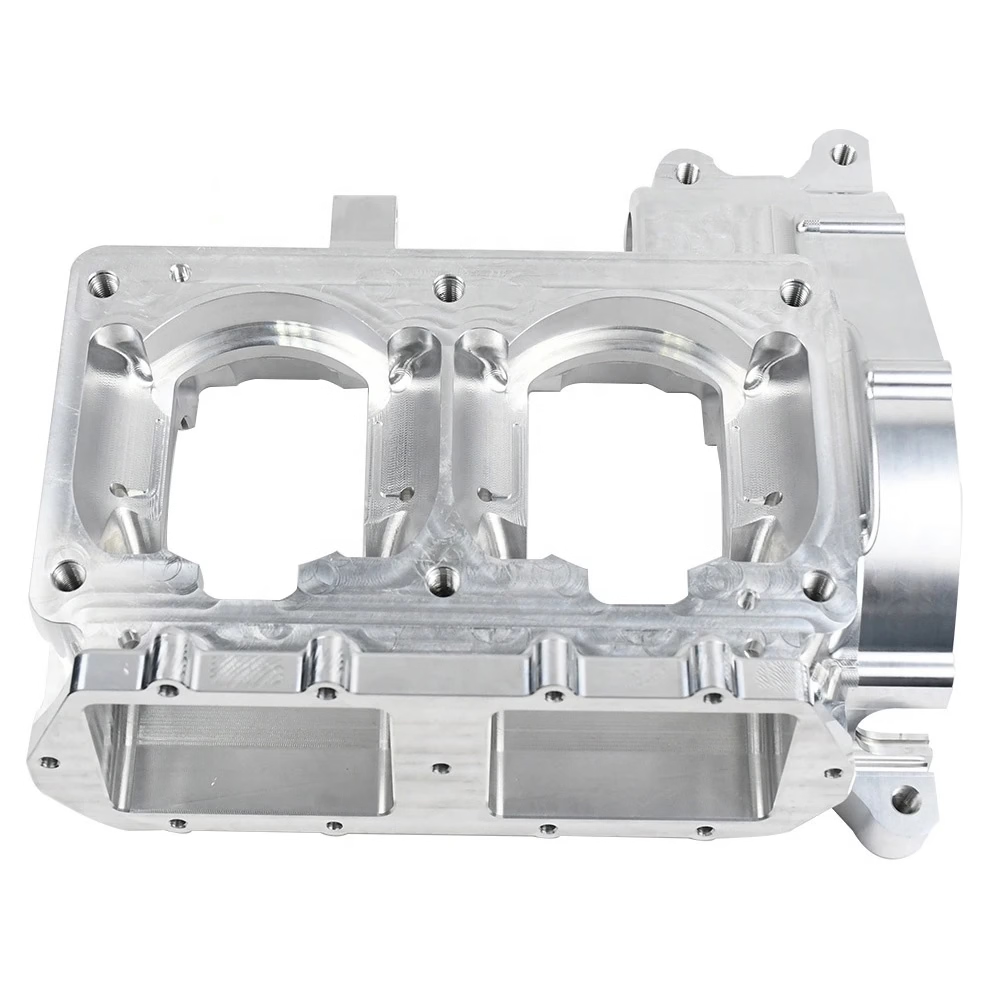
Cultivated meat production borrows heavily from bioprocessing. The hardware includes bioreactor vessels, perfusion pump bodies, nozzle and extrusion plates, sensor housings, and the stainless frames that hold it all. Many of these parts are not printed. They are machined, because pressure, temperature cycling and repeated cleaning punish printed polymer parts. When a European buyer asks about 3D printed meat, the practical question is usually which components need metal and which can stay printed.
Machined stainless dominates the wet side. Grades 316 and 316L resist chloride and cleaning agents better than 304, and 17-4PH gives higher strength for pump shafts. Aluminium 6061-T6 fits dry fixtures, brackets and heat sinks, and it anodizes cleanly for light corrosion protection. Titanium TC4 appears in small high-wear parts where weight and corrosion both matter. Plastics such as PEEK, POM and PC handle insulators, guides and non-food-contact housings.
Printed parts still have a place. Custom 3D printing is useful for prototype manifolds, jigs, cable routing and low-pressure ducting where the geometry is complex and the load is light. The line between printed and machined is not material preference. It is whether the part sees pressure, heat, abrasion or a clean-in-place cycle. If it does, machine it.
One detail buyers miss: the extrusion nozzle plate. Small orifice arrays with tight pitch are hard to drill and easy to distort. Five-axis machining with in-process probing holds position across the array, while a printed plate often cannot hold the same orifice diameter part to part. That single part can decide whether a pilot line runs consistently.
- 1Machine the wet sideAnything touching culture media, steam or caustic wash belongs in 316L or 17-4PH.
- 2Print the dry sideCovers, jigs and low-load ducting are cheaper printed, especially in low volumes.
- 3Check cleanability earlySurface finish is a design decision, not a finishing afterthought.
Tolerance, surface finish and what actually leaks
Cultivated meat equipment runs at modest pressures compared with hydraulic systems, but the fluids are not forgiving. A pump housing bore that is 0.02 mm oversize can pass a bench test and still seep after a few thermal cycles. That is why tolerance should be set per feature, not per drawing. Bores, seal grooves and mating faces earn ±0.005 mm. Mounting holes and clearance slots do not need it, and specifying tight tolerance everywhere raises cost without adding reliability.
Surface finish follows the same logic. A Ra 0.8–1.6 μm finish is a reasonable default for product-contact stainless. Finer, Ra 0.2–0.8 μm, suits seal faces and small orifice channels. As-machined Ra 1.6–3.2 μm is fine for frames and brackets. The trap is asking for a mirror finish on a part that will be bead blasted anyway. Buyers pay twice and gain nothing.
Material choice interacts with finish. 316L machines to a slightly gummier chip than 304, so it needs sharper tools and lighter feeds to avoid smearing. 17-4PH in the H900 condition is hard enough to hold a seal groove but still machinable with the right inserts. Aluminium anodizing adds 5–25 μm per surface depending on the process, which changes a press fit. Tell the shop if a dimension sits under anodizing.
Inspection is the last line. A supplier that runs 100% inspection before shipment, with raw material checks, in-process monitoring and a final report on request, catches drift before it becomes a leak. Ask what gets measured, not just whether measurement happens.
- 1Tolerance per featureTighten only bores, grooves and sealing faces.
- 2Finish per functionRa 0.8–1.6 μm for contact surfaces, Ra 1.6–3.2 μm for structure.
- 3Account for coatingsAnodizing and plating change dimensions by microns.
Certifications, confidentiality and the questions auditors ask
Food-tech buyers usually face two audits. One is internal quality, the other comes from a customer or a regulator. ISO 9001:2015 covers the quality system. IATF 16949:2016 adds automotive-grade process control, which matters if the same shop also builds parts for vehicle programs. ISO 13485:2016 applies when a component touches a medical device or a sterile interface. ISO 27001:2022 covers information security, which is relevant when you send bioreactor geometry to a supplier overseas.
Certificates alone prove little. Ask which standard governs your part and what records follow it. A shop holding ISO 13485 should produce device history records on request. A shop holding ISO 27001 should have a signed NDA process and controlled file access. If the answer is a PDF certificate and nothing else, treat it as a starting point, not a pass.
Confidentiality is a practical concern in this sector. Bioreactor internals, orifice patterns and perfusion geometries are the core IP of a cultivated meat company. Before sending STEP files, confirm the supplier can sign an NDA, restrict file access and delete or archive data on request. Secure upload portals and named engineers on the account are reasonable asks.
Finally, check who owns the finishing steps. A supplier that anodizes and bead blasts in house controls the schedule. One that subcontracts three steps adds days and loses visibility when a surface defect appears.
- 1Match the standard to the productISO 13485 for medical-adjacent parts, ISO 9001 as the baseline.
- 2Ask for records, not logosInspection reports, material certs and process monitoring.
- 3Settle NDA terms earlyBefore the first STEP file leaves your network.
- 4Keep finishing in one placeFewer handoffs, shorter schedule, clearer accountability.
How to qualify a supplier for 3D printed meat equipment parts
Run these steps in order. Each one removes a category of risk before you commit to a production order.
- 1Split the bill of materials by service conditionList every part and mark whether it touches media, steam, caustic wash or nothing. Parts in the first three groups go to machining in 316L, 17-4PH or titanium. The rest can be printed or machined in aluminium. This one step prevents most over-specification.
- 2Set tolerance per feature, not per drawingMark bores, seal grooves and mating faces at ±0.005 mm. Leave clearance holes and slots at general tolerance. Send the marked drawing and ask the supplier to confirm which features drive cost.
- 3Request a DFM review with the quoteA useful quote comes back within 12 hours and names specific risks: thin walls, deep pockets, orifice pitch, anodizing growth. If the quote is a price and a lead time with no notes, the shop did not read the geometry.
- 4Confirm the certification that appliesState the end product and ask which standard governs it. Get the record type in writing: material certificate, in-process inspection data or full dimensional report.
- 5Order a pilot batch before production toolingRun one to five pieces first. Check fit, finish and orifice repeatability. A no-MOQ supplier lets you validate without committing to 10,000 parts.
- 6Verify finishing and inspection ownershipAsk who anodizes, who bead blasts and who measures. In-house finishing and 100% inspection before shipment shorten the loop when something drifts.
- 7Lock confidentiality before file transferSign the NDA, confirm secure upload and agree on data retention. Do this before the first STEP file is sent, not after.
Questions buyers ask about 3D printed meat hardware
Can a 3D printed part sit in a cultivated meat bioreactor?
Usually not in the wet path. Printed polymers have layer lines and internal porosity that trap media and resist cleaning. They also soften under steam sterilization.
Printed parts work well on the dry side: cable routing, jigs, covers and prototype manifolds at low pressure. If the part sees media, heat or caustic wash, machine it in stainless.
What tolerance should I specify for pump housings and nozzle plates?
Bores, seal grooves and orifice arrays at ±0.005 mm. General mounting features can stay at ±0.05 mm with no loss of function.
Tightening the whole drawing raises cost and often forces slower cutting strategies that add days to the schedule.
Which stainless grade is right for product-contact parts?
316 and 316L handle chloride and cleaning agents better than 304. 17-4PH in H900 suits shafts and high-wear components that also need corrosion resistance.
Passivation after machining removes free iron from the surface and improves corrosion performance. Ask for it on any part that contacts media.
Do I need a minimum order quantity for pilot parts?
Not with a supplier that runs one-offs and 10,000-piece runs on the same equipment. Ordering one to five pieces for a pilot build is normal.
That approach lets you validate fit and finish before committing to production volume or tooling.
How long should a quote take, and what should it include?
A useful quote returns within 12 hours and includes price, lead time, material and a short DFM note listing risks.
Production can often start within 24 hours of approval when stock is available, with parts shipping in 3–5 days. Treat any quote without DFM notes as incomplete.
How do I protect bioreactor geometry when sending files overseas?
Sign an NDA before file transfer, use a supplier with a controlled upload portal, and agree on data retention and deletion.
An ISO 27001:2022 information security system is a reasonable indicator that file access is managed, not shared across a shop floor.
Send your drawings and get a DFM review in 12 hours
Upload STEP files for machined or printed parts and we return price, lead time and specific manufacturability notes. No minimum order quantity, NDA on request.
12-hour quote±0.005 mmNo MOQ100% inspection
More machining and 3D printing notes
We publish setup notes, tooling trials and inspection data from the factory floor.











