
Hungarys CNC Processing Industry: What It Can and Cannot Deliver
Hungarys CNC processing industry sits in the middle of Europe and runs a tight automotive supplier base. This page explains what that base is good at, where it gets expensive or slow, and how to judge whether a Hungarian shop or an Asian partner fits your part. Written for design engineers and sourcing managers who have to commit to a supplier this quarter.
In this article
- 1
- 2
- 3
- 4
- 5
- 6
- 7
Read this first
Why Hungarys CNC processing industry grew so fast
Hungarys CNC processing industry grew on the back of car plants, not on the back of a machining tradition. When Audi, Mercedes and BMW built engine and vehicle assembly in Győr, Kecskemét and Debrecen, they needed suppliers within a few hours of the line. Local machine shops scaled up to fill that gap. The result is a supplier base built around automotive cadence: PPAP files, IATF 16949 audits, and delivery windows measured in hours rather than weeks.
The geography helps. A truck from Győr reaches Vienna in about 90 minutes and Munich overnight. For a tier-1 running just-in-time, that distance is the whole value proposition. Parts do not sit in a container for five weeks. They arrive the morning they are needed.
But that model shapes what the shops are good at. Hungarian machine shops are set up for repeat work with a stable drawing revision. They are less comfortable with a job that changes every week, or a single prototype with a two-day deadline.
The skilled labour pool is real, though tighter than it was in 2015. Programmers and setup machinists are concentrated in the western counties. A shop in Győr-Moson-Sopron can hire; a shop in a remote eastern town competes for the same people and pays more to keep them.
- 1Automotive pullEngine, transmission and EV component demand set the pace.
- 2Short road distanceOvernight trucking to German and Austrian assembly plants.
- 3Repeat-work mindsetStrong on stable drawings, weaker on constant change.
Machine capacity and what it covers
A typical mid-size Hungarian shop runs 3-axis vertical mills, a few 4-axis horizontals, and lathes with live tooling. Simultaneous 5-axis centres exist, but they cluster in aerospace and medical suppliers rather than general job shops. If your part needs a one-setup 5-axis cycle on a complex contour, the number of shops that can quote it drops sharply.
Envelope size is usually the first filter. Most Hungarian general machine shops top out around 1,000–1,500 mm of X travel. Large weldments, long shafts and big mould bases often go elsewhere. Ask for the actual machine travel, not the shop's general claim.
Turning capacity is often the bottleneck. Mill-turn centres are expensive and shops buy them only when a contract justifies it. If your part is a turned shaft with cross-drilled holes, check whether the shop has live tooling or plans to move it to a mill for the second operation. Two setups add cost and stack tolerance.
For comparison, our own floor runs 127 high-precision CNC machines, including 16 simultaneous 5-axis centres, 12 four-axis mills, 27 three-axis machines and 16 mill-turn centres, with a 4,000 mm maximum processing size and a Ø400 mm rotary table. That mix is built for both prototypes and 10,000+ piece runs.
- 1Ask for travel, not adjectivesGet the X, Y, Z numbers for the specific machine.
- 2Check live toolingCross holes on a lathe beat a second milling setup.
- 35-axis is not universalConfirm simultaneous, not just indexed, capability.
What tolerance and surface finish to expect
A well-run Hungarian shop holding ±0.005 mm (±0.0002 in) on a critical bore is normal. So is Ra 0.8–1.6 μm on a milled face and Ra 0.2–0.8 μm on a ground or polished surface. These are shop-floor numbers, not marketing numbers. The variable is not the machine; it is the metrology and the discipline behind it.
Ask what happens after the cut. A shop that inspects only the first article and then ships on trust will drift over a 5,000-piece run. Look for in-process checks and a final inspection report with the actual numbers, not a checkbox. For medical and aerospace work, a CMM report with traceable calibration is the baseline.
Material choice often decides the finish more than the machine does. 6061-T6 aluminium cuts clean and anodizes well. 316L stainless work-hardens and needs slower feeds, so the same geometry costs more. 17-4PH in the H900 condition is hard on tooling and shows chatter if the setup is light.
Heat treatment and coating sit outside the machine shop. If a Hungarian supplier subcontracts anodizing or hardening to a local finisher, add two to five days and accept that the surface finish is now partly out of their hands.
- 1±0.005 mm is standardAchievable, but ask for the report that proves it.
- 2Finish follows material316L and 17-4PH cost more to bring to Ra 0.8.
- 3Subcontract adds daysAnodizing and hardening leave the shop's control.
Where Hungarys CNC processing industry is the wrong choice
If you need one prototype next week, a Hungarian job shop is usually the wrong call. Setup dominates the price on a single piece, and the queue at a busy automotive supplier can push your job behind a repeat order. A shop with a dedicated prototype cell is the exception, and you should ask directly whether that cell exists.
High-volume, cost-sensitive parts are the second weak spot. European labour rates are two to four times Chinese rates for the same machine hour. A bracket that runs 200,000 pieces a year will not survive a European price. That work moves to Asia or Mexico.
Very large parts are the third. If your part is 2,500 mm long, most Hungarian general shops cannot hold it without a special setup. Fewer machines, longer queue, higher price.
The practical answer for many tier-1s is a split: keep the Hungarian shop for JIT releases and change orders, and run the volume in Asia. That gives you a local buffer without paying European rates on every piece.
- 1One-off prototypesSetup cost dominates; queue risk is high.
- 2High-volume simple partsLabour rate makes European pricing uncompetitive.
- 3Oversize partsOver 1,500 mm, the machine list shrinks fast.
How to evaluate a Hungarian CNC supplier
Start with the certificate, not the brochure. IATF 16949:2016 matters if your part goes into a vehicle. ISO 13485:2016 matters for medical devices. ISO 9001:2015 alone is fine for industrial machinery. Ask for the certificate scope and the expiry date, not just the logo.
Then ask for the machine list with travels, spindle hours, and the number of shifts. A shop running one shift has less flexibility than one running three. Spindle hours tell you how worn the machine is. A 12-year-old mill still holds tolerance if it is maintained, but you want to know.
Finally, test the responsiveness before you award the contract. Send a drawing and ask for a DFM note and a quote. A shop that returns both within 12 hours, with specific comments on wall thickness or tool access, is a shop that will answer when a problem appears on the floor.
Our own quoting process returns a quotation and a free DFM analysis within 12 hours, production can start within 24 hours, and parts ship in 3–5 days. Historical late-delivery probability is below 2%. Those numbers are for our Dongguan and Singapore plants, not for Hungarian shops, but they give you a benchmark to compare against when you ask a European supplier the same questions.
- 1Cert scope, not logoMatch the certificate to your industry.
- 2Machine list with travelsTravels, spindle hours and shift pattern.
- 3Test the quote turnaroundA slow quote predicts a slow shop.
Hungarian shop vs Asian CNC partner
Use this when deciding where a specific part number should run.
| Factor | Hungarian shop | Asian CNC partner |
|---|---|---|
| Lead time, repeat order | Days, JIT friendly | 3–5 days plus freight |
| Lead time, new prototype | Weeks, queue dependent | Quote in 12 hours |
| Unit cost at 10,000 pieces | High labour rate | Lower machine-hour rate |
| Tolerance capability | ±0.005 mm typical | ±0.005 mm typical |
| Surface finish | Ra 0.8–1.6 μm typical | Ra 0.8–1.6 μm typical |
| Minimum order quantity | Often one piece | No MOQ, one piece up |
| Automotive paperwork | IATF 16949 common | IATF 16949 on request |
| Oversize parts over 1,500 mm | Limited machine list | Up to 4,000 mm |
| Engineering change speed | Fast, same time zone | Same-day DFM response |
The short answer
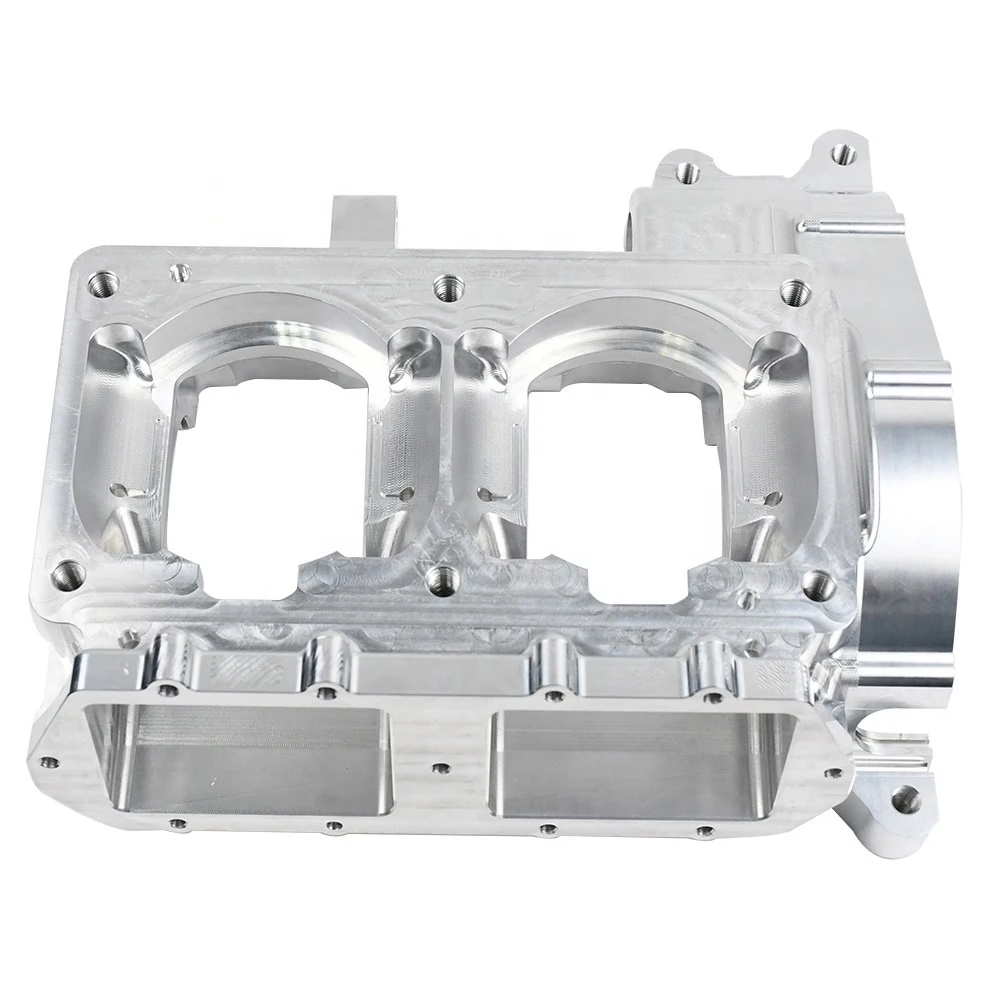
Keep the Hungarian shop for JIT releases, change orders and anything that must arrive tomorrow. Move the stable, high-volume and oversize parts to an Asian partner, and hold both to the same inspection report. If your part is a 200-piece aluminium housing with a two-week window, quote both and let the numbers decide.
Questions engineers ask next
Can a Hungarian shop handle a 200-piece aluminium housing with a two-week lead time?
Yes, if the shop has capacity and the drawing is frozen. Two weeks covers programming, fixturing and a short run on a 3-axis or 4-axis mill.
The risk is queue position. A tier-1 change order can push your job back. Ask for a written slot on the machine schedule before you commit.
Is ±0.005 mm realistic from a European job shop?
Yes, on a rigid setup with a temperature-stable shop. It is a normal capability, not a specialty.
What varies is verification. Ask for the CMM report with actual values, not a pass or fail stamp.
What parts should never go to a Hungarian shop?
Very high volume simple parts, because labour cost dominates. Oversize parts above the machine travel. And one-off prototypes with a 48-hour deadline.
Those three categories are where an Asian partner usually wins on price or speed.
How do we compare a Hungarian quote with an Asian one fairly?
Add freight, duty and the cost of your own incoming inspection to the Asian number. Add the cost of a late line stoppage to the Hungarian number.
Then compare landed cost per good part, not price per part.
Do we need an NDA before sending drawings?
Yes, for any proprietary geometry. We sign an NDA on request and treat uploads as confidential.
Keep the NDA mutual if you are also sharing process data with your own customer.
Can one supplier cover both prototype and production volumes?
Yes, if the shop runs both a prototype cell and production machines. Ours runs from one piece to 10,000+ piece runs with no minimum order quantity.
That avoids a second first-article approval when the part moves to volume.
Quote the part, not the country
Send your drawing and get a quotation plus a free DFM analysis within 12 hours. One piece or 10,000, same process.
12-hour quote100% inspectionNo MOQNDA on request
More process notes
We publish setup notes, tooling trials and inspection data from the factory floor.











