
The benefits of CNC processing to the industry
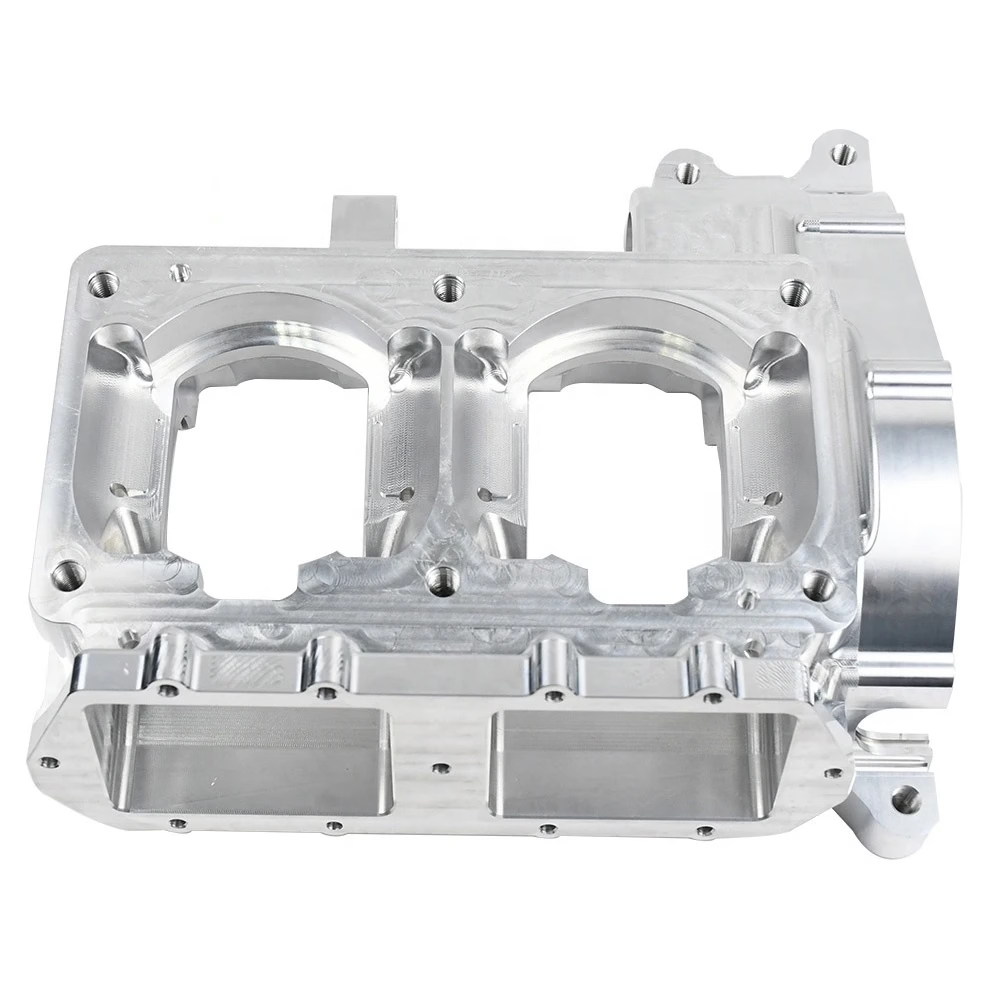
A shop-floor view of what CNC processing to the industry actually changes for aerospace, automotive, medical, robotics and energy programs: better repeatability, fewer fixtures, wider material choice. Written for engineers and buyers who must decide whether a part belongs on a mill or somewhere else.
In this article
- 1
- 2
- 3
- 4
- 5
- 6
- 7
What matters before you commit a part to CNC
Why repeatability is the real benefit of CNC processing to the industry
Manual machining can hit a tight tolerance once. The operator dials in the cut, checks the part, and adjusts. What it cannot do is hit that same tolerance on the 800th part without a person standing there making decisions. CNC processing to the industry changed the economics of that gap. The program is fixed, the tool offsets are logged, and the machine repeats the same path until the insert wears out and the offset is corrected.
On our floor the working tolerance is ±0.005 mm (±0.0002 in). That number is not the headline. The headline is that it holds across a batch. For a medical instrument housing or a fuel system manifold, a part that passes on Monday and fails on Thursday is worse than a part that never passed. The value of the process is consistency.
Repeatability also changes how you design. If every part is a fresh negotiation with the operator, you add wall thickness and clearance to absorb variation. When the process holds ±0.005 mm, you can design to the function instead of to the manufacturing uncertainty. That is where weight comes out and where assemblies stop needing shim stock on the line.
- 1Logged offsetsTool wear is corrected against a recorded value, not the operator's memory.
- 2Same program, same pathThe toolpath is identical on part 1 and part 10,000.
- 3First-article confirmationRaw material check, in-process monitoring and final inspection back the batch.
Fewer setups means fewer places for error to enter
Every time a part moves from one fixture to another, you add a datum shift. Stack three or four of those and the tolerance budget is gone before the first cut. This is the quiet benefit of five-axis work: the part stays clamped while the spindle reaches the other four faces.
We run 16 simultaneous 5-axis machining centers, 12 four-axis mills, 27 three-axis machines and 16 mill-turn centers. The mix matters more than the total. A simple bracket with one critical face belongs on a three-axis machine, where the setup is fast and the hourly rate is lower. A hydraulic block with bores on five faces belongs on a five-axis center, even though the machine costs more per hour.
The judgment call is angular features. If a hole is normal to a face, a three-axis machine with an indexer handles it. If that hole sits at 37° to two other datums and must intersect a cross-drilling, one five-axis setup will beat three separate ones on both tolerance and calendar time. Mill-turn centers cover the other common case: a turned shaft with milled flats or a cross-hole, done in one chucking instead of two operations.
- 1Position error compoundsEach re-clamp adds a datum shift that is hard to inspect out later.
- 2Match machine to partDo not pay five-axis rates for a part that only needs one face.
- 3Mill-turn for shaftsMilled features on a turned part come off in a single chucking.
Material range and geometry freedom in one process
A casting house needs a different foundry for aluminium and for stainless. A machining floor does not. Aluminium 6061, 6061-T6, 2024, 5052, 5083, 6063, 6082, 7075 and ADC12 run alongside 303, 304, 316, 316L, 420, 430, 431, 440C and 17-4PH stainless, plus 1018, 1045, 4130, 4140, 4340 and A36 steel.
The same holds for the harder cuts. Titanium TA1, TA2 and TC4 (Ti-6Al-4V), Inconel and magnesium AZ31B or AZ91D all get machined here. Copper and brass grades C101, C103, C110, beryllium copper, C27400, C28000 and C36000 are common for busbars and connectors. On the polymer side we cut ABS, PC, PMMA, POM, PA, PEEK, PP, HDPE and carbon fibre.
Geometry follows from the tool access. Undercuts, deep pockets with a 4:1 depth-to-diameter ratio, and thin walls below 1 mm each have a different answer, and sometimes the answer is that the part should be split and joined. Size is the other boundary. We machine up to 4,000 mm on the long travel, with common envelopes of 4,000 × 400 × 150 mm, 750 × 1,150 × 550 mm, 600 × 600 × 600 mm, 500 × 500 × 450 mm and 500 × 310 × 200 mm, plus a Ø400 mm rotary table.
- 1One supplier, many alloysNo second foundry qualification for a stainless version of the same part.
- 2Deep pockets need reachPast roughly 4:1 depth-to-diameter, tool deflection drives the result.
- 3Know the envelopeIf the part exceeds 4,000 mm, the process is no longer the answer.
Where the cost model actually helps
CNC carries no tooling charge. That is the whole argument for prototypes and bridge production. A die casting or injection molding program spends money on a mold before the first saleable part exists. A machining program spends it on stock and cycle time. For 50 units, the machining route is usually cheaper. For 500,000 units, it usually is not.
The crossover depends on geometry, not on a rule of thumb. Simple parts with modest tolerance tend to cross over earlier, because a mold can be simple and the per-part cost drops fast. Parts with tight tolerances, multiple datums or low annual volume stay on the mill for years. We run from a single prototype to 10,000+ part runs with no minimum order quantity, so the same program serves the first article and the production batch.
Labor changes shape too. A machined part needs an operator to load, unload and inspect, but not a person standing at the spindle for the full cycle. Finishing is often the last manual step. Anodizing, electroless nickel, zinc, silver and gold plating, powder coating, black oxide, bead blasting, tumbling, brushing, polishing and laser marking are all specified after machining, and each one adds a handling step rather than a cutting step.
- 1No mold, no amortisationUseful when the design is still moving or the volume is uncertain.
- 2Crossover is geometry-drivenTight tolerance and low volume keep parts on the mill.
- 3Finishing is separateBudget handling and lead time for the coating, not just the cut.
When CNC processing is the wrong choice
Cost per part does not fall with volume the way a molded part does. Each unit consumes cycle time and tool life. If your annual volume is high and the geometry is simple, casting or molding will win on unit price, and no amount of process control changes that arithmetic.
Material waste is real. Subtractive work turns a billet into chips. On expensive alloys such as Inconel or titanium, the buy-to-fly ratio matters, and near-net shapes from casting or forging can cut stock cost substantially before the first cut.
Very large, very thin or highly organic shapes are also a poor fit. Sheet metal fabrication handles large flat panels faster. 3D printing handles internal lattices and conformal channels that no end mill can reach. The engineering judgment is to route the part to the process that matches its shape, not to defend one process for everything.
- 1High volume, simple shape
- 2Expensive alloy, big removal
- 3Lattices and thin panels
CNC processing compared with other routes
Judge the part by volume, geometry and tolerance, not by habit.
| Route | Best when | Weak when | Typical tolerance |
|---|---|---|---|
| 3-axis CNC | One or two critical faces, simple prismatic part | Features on five sides | ±0.005 mm |
| 5-axis CNC | Angled holes, multiple datums, contoured surfaces | Part only needs one face | ±0.005 mm |
| Mill-turn | Turned shaft with milled flats or cross-holes | Large prismatic plate work | ±0.005 mm |
| Die casting | High volume, simple geometry, one alloy | Low volume, tight tolerance | Secondary machining needed |
| Injection molding | High volume plastic parts | Prototypes, design still changing | Mold-dependent |
| Sheet metal | Large flat panels, enclosures | Thick bosses, tight 3D datums | Bend-dependent |
| 3D printing | Internal lattices, conformal channels | Tight metal tolerance, load-bearing | Process-dependent |
Pick the route by shape and volume, not by default
If the part has multiple datums, tight tolerance or an uncertain volume, machine it. If it is simple, plastic and needed in six figures, mold it. If it is a large flat panel, form it from sheet. We quote the machining route and tell you when another route is cheaper.
Questions engineers ask about CNC processing
How tight a tolerance can CNC processing hold in production?
Our working tolerance is ±0.005 mm, or ±0.0002 in. That figure applies to a controlled batch, not to a single part.
Whether your specific feature can hold it depends on material, wall thickness and the depth-to-diameter ratio of the cut. Send the drawing and we will confirm per feature.
What surface finish comes off the machine?
As-machined surfaces typically land at Ra 1.6–3.2 μm. A controlled high finish reaches Ra 0.8–1.6 μm, and fine finishing reaches Ra 0.2–0.8 μm.
If the part needs a sealed face or a bearing seat, specify the Ra on the drawing rather than assuming a default.
Is there a minimum order quantity?
No. We run from one prototype to 10,000+ part runs. The first article and the production batch use the same program, so nothing is re-qualified between them.
How fast can parts ship?
Quotation and a free DFM analysis come back within 12 hours. Production can start within 24 hours, and parts ship in 3–5 days.
Historical late-delivery probability on our floor is below 2%. That is a record, not a guarantee for any single order.
How is confidentiality handled for new designs?
Uploads are secure and confidential. An NDA is available on request before you send files.
We hold ISO 9001:2015, IATF 16949:2016, ISO 13485:2016 and ISO 27001:2022, so information security and medical device controls are audited rather than self-declared.
What inspection data comes with the shipment?
Every part is inspected before shipment, with a raw material check, in-process monitoring and final inspection. Reports are available on request.
Ask for the report format you need at the quotation stage, so the inspection plan is built around it.
Send the drawing and get a process answer, not a sales pitch
Upload your files and we will return a quotation plus a free DFM analysis within 12 hours, including a note if another process fits the part better.
12-hour quoteFree DFM analysis100% inspectionNDA on request
More from the shop floor
We publish setup notes, tooling trials and inspection data from the factory floor.











