
How Should the Machining Center Properly Choose the Handle of the Tool
A tool holder is the interface between the cutting edge and the spindle, so a poor choice shows up as chatter, runout and short tool life. This guide walks through the checks we run at GreatLight before a holder goes into a 3-axis, 4-axis or 5-axis machine. Read it and you can choose the handle of the tool that matches your spindle, your part and your cutting strategy.
In this article
- 1
- 2
- 3
- 4
- 5
- 6
- 7
- 8
Key takeaways
Start With the Spindle Interface, Not the Catalog
Every holder decision starts at the spindle nose. The machine tells you which taper family you can use: BT 30, BT 40, BT 50, CAT 40, CAT 50, HSK-A63, HSK-A100 or a Capto system. You cannot mix these. A BT 40 spindle takes BT 40 holders, and an HSK-A63 spindle takes HSK-A63 holders. If you are shopping for a new machine, decide the interface now, because it locks in the holder inventory for the next decade.
Bigger taper does not automatically mean better cutting. A BT 50 holder is stiffer, but it is also heavier and slower to change. On a 40-taper machine running aluminium at 12,000 rpm, a BT 40 holder with a good collet will beat a BT 50 holder that forces the spindle to derate speed. Match the taper to the work envelope. If your largest part fits inside a 500 × 400 × 450 mm travel, a 40-taper machine is usually the right size.
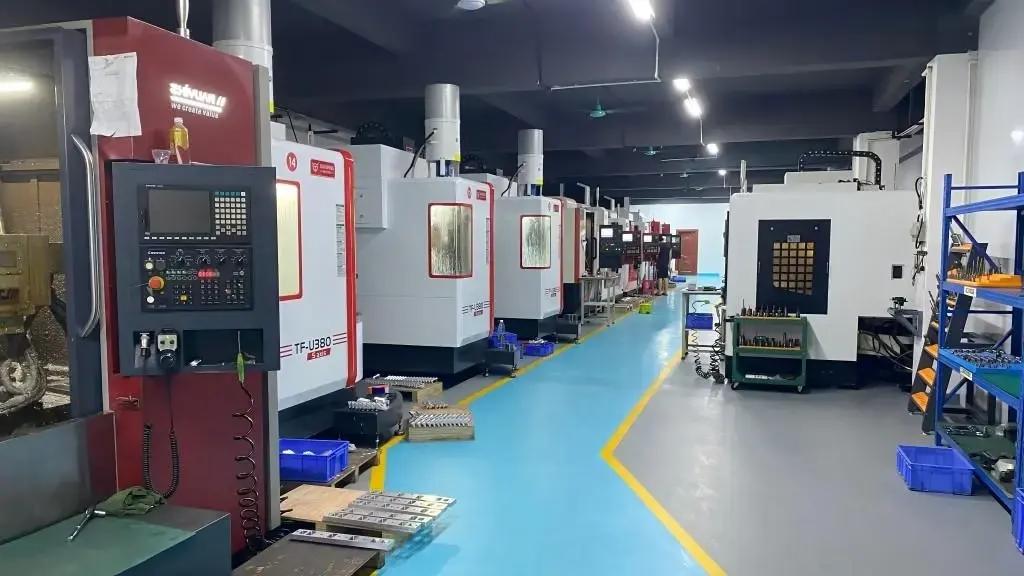
At GreatLight we run 127 high-precision CNC machines across three plants, including 16 simultaneous 5-axis machining centers, 12 four-axis mills and 27 three-axis machines. That mix means we keep BT 40, HSK-A63 and Capto holders on the shelf, plus a Ø400 mm rotary table for work that needs angular positioning. The interface follows the machine, and the holder follows the interface.
One more thing: check the pull stud. A BT holder with the wrong pull stud will not seat, and the drawbar force drops. Measure the stud length against the spindle drawing before you buy 50 of them.
- 1BT 40 / CAT 40General milling and drilling up to about 10,000–12,000 rpm.
- 2HSK-A63High-speed work, 15,000–25,000 rpm, better taper contact at speed.
- 3HSK-A100 / Capto C6Heavy cuts, long reach, 5-axis trunnion work.
Read the Part Before You Read the Holder Spec
The part geometry decides reach, diameter and holder type. A deep pocket with a 3:1 depth-to-diameter ratio needs a slim holder or an extension. A face mill on a flat plate needs stiffness, not reach. Write down the deepest feature, the smallest internal radius and the tool diameter you plan to use. Those three numbers eliminate half the catalog.
Look at the material too. Aluminium 6061 and 7075 cut fast and generate light loads, so a hydraulic or shrink-fit holder gives you the best runout and the highest rpm. Stainless 316L and 17-4PH work-harden, so you want a rigid holder that keeps the tool from rubbing. Titanium TC4 (Ti-6Al-4V) and Inconel push the opposite way: low speed, high torque, short gauge length.
If the part is a thin wall, the holder diameter matters as much as the tool. A 20 mm holder body can clear a wall that a 32 mm body cannot. Measure the clearance in CAD before you commit. We have seen jobs fail because the holder body hit the fixture, not the cutter.
Finally, count the tool changes. A job with 18 tools and a 40-second cycle cannot afford slow-change holders. For high-mix work, a quick-change system pays back fast. For a 10,000-part run, a dedicated shrink-fit holder per tool is often cheaper over the year.
Balance and Runout Decide Your Surface Finish
Balance is a speed rule, not a quality badge. Below 8,000 rpm, a well-made holder is usually fine. Above 10,000 rpm, an unbalanced holder creates a centrifugal force that grows with the square of speed. That force bends the tool, opens the cut and leaves chatter marks. The common shop target is G2.5 at 25,000 rpm, which is about 1 G·mm of residual unbalance.
Runout is the other half. Total indicated runout at the holder face should stay under 0.005 mm for finishing tools. A collet holder with a worn nut can easily reach 0.02 mm. That is 0.04 mm of cut variation on a two-flute cutter, and it shows up as a stepped wall and a noisy cut. Check TIR with a dial indicator on a gauge pin every time you change a collet.
Shrink-fit holders hold runout around 0.003 mm and stay balanced because they have no moving parts. Hydraulic holders reach similar numbers and release with a wrench, which suits jobs where operators change tools often. Both cost more than a collet chuck. Both pay back on finishing passes where Ra 0.8–1.6 μm is required.
Do not forget the tool itself. A holder with 0.003 mm runout and a bent cutter still cuts badly. Inspect the shank for burrs before clamping.
Clamping Force, Torque and the Cut You Can Take
Clamping force is what keeps the tool from pulling out. A collet chuck holds a 12 mm end mill with roughly 8–12 kN of grip, depending on nut torque and collet condition. A hydraulic holder can reach 30–40 kN. A shrink-fit holder grips the whole shank and holds far more. If your cut pulls the tool, the holder is telling you it is undersized.
Torque capacity matters for face mills and large taps. A 63 mm face mill taking a 3 mm depth of cut in steel creates a side load that a small collet cannot resist. Use a shell mill arbor with a positive drive, not a collet. For tapping, use a tension-compression holder or a synchronous tap holder matched to the spindle encoder.
Check the nut torque with a torque wrench. A collet nut tightened by feel is often 30% under spec. That is enough to let the tool slip on a heavy pass, and a slipped tool ruins the bore and the holder. We keep a torque chart at every machine.
If the process runs unattended, add a tool presetter check. A holder that is 0.1 mm off in length will scrap the first part of the night shift.
Maintenance and Storage Keep the Numbers Honest
A holder is a precision part, and it wears. Taper contact area drops with every chip that gets pressed into the face. Clean the taper with a lint-free wipe and a light oil film before every load. Never use a rag that sheds. Never store holders in an open tray where coolant mist lands on them.
Inspect the taper for fretting and the collet for cracks every 500 hours. Replace collets when runout exceeds 0.01 mm on a gauge pin. Replace nuts when the threads feel rough. A worn nut can cost more in scrap than a new holder.
Keep a log per holder. Record the machine, the tool, the runout and the balance grade. When a job goes out of tolerance, the log tells you whether the holder moved or the process drifted. This is the same discipline that gets us to a 99.99% qualification rate with 100% inspection before shipment.
Storage matters more than most shops admit. Holders stored in a humid cabinet rust at the taper and lose contact. A closed cabinet with a desiccant pack costs little and protects the whole inventory.
A 6-Step Holder Selection Procedure
Run this at the machine, not in the office.
- 11. Record the spindle interfaceWrite down the taper (BT 40, HSK-A63, Capto C6) and the maximum spindle speed. Confirm the pull stud type from the spindle drawing. Wrong studs cause seating faults and dropped drawbar force.
- 22. List the critical featuresNote the deepest pocket, smallest internal radius and the tool diameter for each. Convert depth to a depth-to-diameter ratio. Above 4:1, plan for a slim holder or an extension.
- 33. Match material to holder typeAluminium 6061/7075: hydraulic or shrink-fit, 15,000–24,000 rpm. Stainless 316L, 17-4PH: rigid collet or shrink-fit, moderate speed. Titanium TC4, Inconel: short gauge length, high torque, lower rpm.
- 44. Set the balance gradeBelow 8,000 rpm: G6.3 is normally enough. Above 10,000 rpm: specify G2.5 at the top spindle speed. Above 20,000 rpm: ask the supplier for a balance report at the actual rpm.
- 55. Verify runout and clamping forceTarget TIR under 0.005 mm at the holder face for finishing tools. Check collet nut torque against the maker chart. If the tool slips, step up to a hydraulic or shrink-fit holder.
- 66. Log and re-checkRecord holder ID, runout, balance grade and hours in service. Re-check runout every 500 hours or after any crash. Replace collets above 0.01 mm TIR and nuts with rough threads.
Holder Type Compared by Job Requirement
Use this to shortlist two options before you quote tooling.
| Requirement | Collet chuck | Hydraulic holder | Shrink-fit holder |
|---|---|---|---|
| Best rpm band | Up to 10,000 rpm | Up to 20,000 rpm | Up to 30,000 rpm |
| Typical runout | 0.005–0.02 mm | 0.003–0.005 mm | 0.003 mm or better |
| Tool change speed | Fast, manual | Fast, wrench release | Slow, needs heater |
| Clamping force | 8–12 kN | 30–40 kN | Highest, full shank |
| Best for | Drills, reamers, general milling | Finishing, frequent changes | High-speed finishing, long runs |
| Weak point | Collet wear and nut torque | Seals and oil service | No adjustment for tool length |
The Short Answer
Pick the holder from the spindle outward: interface first, then reach, then balance, then clamping force. A G2.5 balanced shrink-fit holder on the right taper will out-cut an expensive holder on the wrong one.
Tool Holder Questions Engineers Ask
Can I use a BT 40 holder in an HSK-A63 spindle?
No. The taper angles and flange shapes are different, and the clamping mechanism is different too. HSK uses a hollow taper with internal clamping; BT and CAT use a solid taper with a pull stud.
Adapters exist for some systems, but they add length, reduce stiffness and lower the safe rpm. If you need HSK performance, buy HSK holders.
What balance grade do I need for aluminium at 18,000 rpm?
Specify G2.5 at the top spindle speed, and ask for a balance report at that rpm. At 18,000 rpm, an unbalanced holder creates a force that grows quickly with any offset mass.
Keep the tool, nut and holder as one balanced assembly. Balancing the holder alone and then fitting a heavy nut gives back most of the gain.
How often should I replace collets?
Check runout on a gauge pin every 500 hours. Replace the collet when TIR exceeds 0.01 mm, when the slots show cracks, or when the surface is polished from slipping.
A collet that has slipped once is usually done. It will slip again at the same torque and scrap the next part.
Does a shrink-fit holder work for stainless steel?
Yes, and it is a strong choice for finishing. The full-shank grip resists pull-out and holds runout near 0.003 mm, which helps when 316L or 17-4PH wants to work-harden.
Remember that shrink-fit needs a heater and a cooling cycle, so it suits planned tool changes rather than on-the-fly swaps.
What causes chatter even with a good holder?
Chatter usually comes from the whole system, not the holder alone. Check tool overhang first: every extra 10 mm of gauge length cuts stiffness fast. Then check the fixture and the part support.
If the holder taper is dirty, the contact drops and the assembly loses stiffness. Clean the taper and re-test before you buy a new holder.
Can GreatLight supply the tooling with the parts?
We machine from one prototype to 10,000+ part runs with no minimum order quantity, and we quote tooling when the job needs a special holder or a custom fixture.
Upload your drawings and we return a quotation with a free DFM analysis within 12 hours. Production can start within 24 hours, and parts ship in 3–5 days.
Send Us Your Drawing and Tooling List
We review your spindle interface, tool list and tolerances, then quote the holders and the machining in one pass.
12-hour quote100% inspectionNo minimum order quantity
More machining notes from the shop floor
We publish setup notes, tooling trials and inspection data from the factory floor.











