
How much does a metal 3d printer cost?
Metal additive manufacturing is no longer only aerospace and medical work. If you are pricing a machine for a shop or a factory floor, the number depends on the process, the build envelope, and the laser count. This guide walks through the cost drivers, real machine classes, running costs, and the point where sending parts to a CNC shop is the cheaper move.
In this article
- 1
- 2
- 3
- 4
- 5
- 6
- 7
- 8
Key takeaways
The five numbers behind metal 3d printer cost
Metal 3d printer cost is not one number. It is the sum of five decisions: process type, build envelope, laser or electron beam count, material system, and the support equipment you need to run the machine safely. Get any one of them wrong and the quote you receive will not match the work you actually have.
Process type sets the floor. Bound-metal and metal extrusion systems use debinding and sintering furnaces, so the printer is only part of the cell. Laser powder bed fusion (LPBF) and electron beam melting (EBM) skip the furnace for most alloys but need powder handling, sieving, and inert gas.
Build envelope sets the ceiling. A 100 mm cube machine and a 400 mm cube machine differ by far more than the frame size. Bigger envelopes need bigger lasers, more powder per job, and longer cool-down, which pushes both capital and running cost up.
Laser count is the throughput lever. One 200 W laser is slow on thick sections. Two or four lasers cut build time, but they add cost, calibration work, and more complex scan strategies. Buy laser count for the parts you run, not for the brochure number.
- 1Process typeSinter-based systems need a furnace; powder bed systems need gas and powder handling.
- 2Build envelope160 mm cube for small parts, 250-400 mm cube for manifolds and aerospace brackets.
- 3Laser count1 laser for prototypes, 2-4 lasers for production throughput.
- 4Material systemSteel and aluminum powder cost less than titanium or Inconel.
Machine classes and what each one is for
It helps to sort machines by what they actually produce rather than by brand. Small bound-metal systems with a 150-200 mm envelope are often bought for tooling inserts, small brackets, and low-volume stainless parts. They are compact, but the furnace is a separate cost, and shrinkage control on long thin parts takes practice.
Mid-size LPBF machines with a 250 mm envelope and a single 400 W laser are the workhorse class for functional prototypes and small production runs. They handle 316L, 17-4PH, and AlSi10Mg well. If your part fits in a 250 mm cube and the wall is above 0.4 mm, this class will usually do the job.
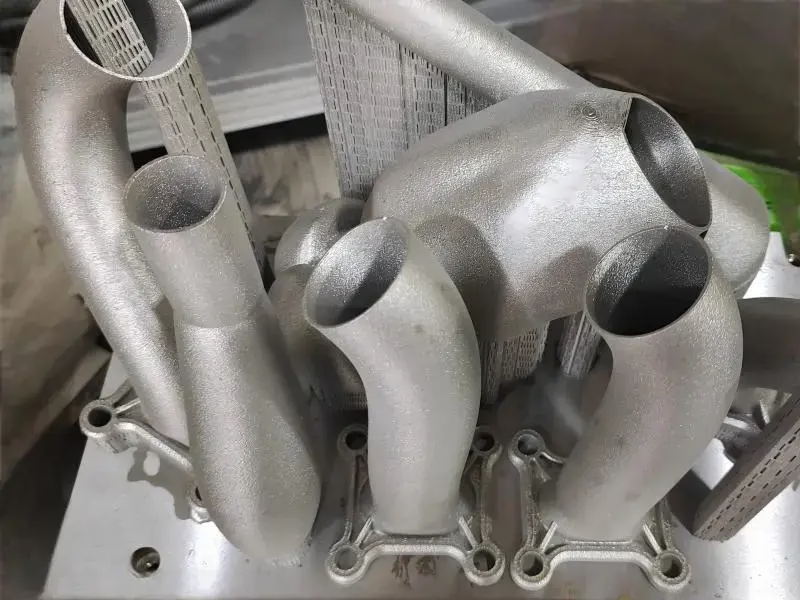
Large multi-laser LPBF machines with a 400 mm envelope and two to four 500-700 W lasers are aimed at aerospace ducts, heat exchangers, and medical implants at volume. The cost jump is not linear. You are paying for laser optics, faster recoating, and the gas flow design that keeps spatter off the part.
EBM machines use an electron beam in vacuum and run hotter. They suit titanium orthopedics and parts where residual stress matters more than surface finish. The trade-off is rougher as-built surfaces, so expect more post-machining on critical faces.
- 1Bound metal, 150-200 mmTooling inserts, small stainless parts. Add furnace cost.
- 2LPBF single laser, 250 mmFunctional prototypes, 316L and 17-4PH brackets.
- 3LPBF multi-laser, 400 mmAerospace ducts, heat exchangers, implant runs.
- 4EBM, vacuum chamberTitanium orthopedics, low residual stress, rougher surface.
Running cost: powder, gas, and post-processing
Powder is the largest recurring cost on most machines. Stainless and aluminum powder sit at the low end. Titanium, Inconel, and cobalt-chrome powders cost several times more, and you cannot reuse all of it. Each build cycle degrades the powder slightly, so shops blend virgin powder back in at a set ratio.
Inert gas matters on LPBF. Argon consumption depends on chamber size, leak rate, and how often you open the door. A small machine with tight seals can run far cheaper per hour than a large chamber that is opened twice a day. Budget gas as an hourly cost, not a yearly guess.
Post-processing is where estimates usually break. As-built LPBF surfaces sit around Ra 8-12 μm. If the print needs a sealing face, a bearing bore, or a thread, you are adding CNC time, and that time is often more than the printing time. Support removal, stress relief, and HIP add further steps.
Consumables age out. Lenses, recoater blades, filters, and nozzles are replaced on a schedule. Those parts are not expensive individually, but they add up. A realistic running budget should include a spare parts line of 5-10% of the machine payment each year.
- 1Powder reuseBlend virgin powder back in per the alloy supplier's ratio.
- 2Gas costArgon per hour rises with chamber size and door openings.
- 3Post-machiningSealing faces and bores often need milling after printing.
- 4Spare partsLenses, blades, and filters: plan 5-10% of machine cost per year.
When buying a machine is the wrong call
A machine only pays back if you keep it busy. Metal AM needs regular builds to stay calibrated and to justify the powder inventory. If your parts arrive in bursts of two or three a month, the machine will sit idle while the payment continues, and the powder in the hopper will age.
Geometry decides more than volume. A part with internal channels, lattice structures, or organic ribs is a good AM candidate because no cutter can reach those features. A simple block with a few holes is a bad candidate. It can be milled faster, cheaper, and with a better surface, and the design work for AM would be wasted effort.
Size matters as well. If the part is larger than the build envelope, you either split it and add a joint, or you machine it. A split joint adds a leak path and a cleaning problem inside channels. For most fluid parts, that is a hard no.
There is a middle path. Keep the printer for the features that only AM can make, and send the rest to a CNC shop. Hybrid parts, where an AM preform is finish-machined on the critical faces, are common in aerospace and medical work for exactly this reason.
- 1Low utilizationTwo or three builds a month will not cover the payment.
- 2Simple geometryBlocks with holes belong on a mill, not a printer.
- 3Oversize partsSplit joints add leak paths and cleaning risk.
- 4Hybrid approachPrint the complex core, machine the critical faces.
A worked comparison for a stainless bracket
Take a 316L bracket that fits in a 100 mm cube. On a small LPBF machine, the build takes roughly 8-12 hours depending on layer height. Powder use is about 1.5-2 kg including supports and the surrounding bed. Post-processing adds support removal and one face milled to a sealing tolerance.
Now put the same bracket on a 3-axis mill. If the design has no internal channels, cycle time is short and the part comes off at Ra 1.6-3.2 μm with no support removal. For a run of 50 pieces, the milled parts usually cost less per piece than the printed ones, and they arrive faster.
Change the design to include a curved internal cooling channel. The mill cannot reach it. Now the printer is the only route, and the cost per part is justified by a feature that does not exist in the milled version. This is the real deciding question, not the machine price.
If you need both, run the hybrid route. Print the channel core, then machine the mating faces and bores. That is how GreatLight handles parts that combine AM features with sealing surfaces, using 5-axis machining for the critical faces after printing.
- 1Printed bracket8-12 hours build, 1.5-2 kg powder, support removal, one face milled.
- 2Milled bracketShort cycle, Ra 1.6-3.2 μm, no supports, faster at 50 pieces.
- 3Deciding featureInternal channels that no cutter can reach.
- 4Hybrid routePrint the core, machine the sealing faces and bores.
How to cost a metal AM part in 6 steps
Work through this order and you will get a number you can defend.
- 11. Sort the part by geometryAsk one question: can a 3-axis or 5-axis cutter reach every feature? If yes, stop and price CNC. If no, note which features are unreachable. Those features are what you are paying AM to produce.
- 22. Fix the material and processMatch alloy to service conditions. 316L and 17-4PH for corrosion and strength, AlSi10Mg for light brackets, Ti-6Al-4V for medical and aerospace, Inconel for heat. The alloy picks the process: most steels and aluminum go LPBF, titanium often goes EBM.
- 33. Check the build envelopeMeasure the part in X, Y, and Z including supports. Supports can add 5-10 mm on overhangs. If the part plus supports exceeds the envelope, you need a split, a different machine class, or CNC.
- 44. Estimate build time and powder massBuild time scales with part height and layer count, not just volume. A tall thin part can take longer than a compact heavy one. Powder mass equals the part volume plus supports plus the powder bed around it.
- 55. Add post-processing hoursList every face that needs a tolerance tighter than ±0.1 mm or a finish better than Ra 3.2 μm. Each one is a CNC operation. Add support removal, stress relief, and HIP if the alloy or service requires it.
- 66. Compare against a CNC quotePut the AM total next to a CNC quote for the same part. Below a few hundred units, CNC usually wins on cost per part. Above that, and with geometry that only AM can make, the printer starts to pay back.
Metal 3d printer cost vs CNC machining: which fits
Use this to decide before you spend on either path.
| Factor | Buy a metal printer | Send to a CNC shop |
|---|---|---|
| Part geometry | Internal channels, lattices, organic ribs | Prismatic shapes, pockets, bores, threads |
| Typical volume | Hundreds to thousands per year | One prototype to 10,000+ parts |
| Wall thickness | 0.4 mm and up, depends on alloy | Limited by cutter reach, often 0.5 mm and up |
| As-built finish | Ra 8-12 μm, needs post-machining | Ra 0.8-1.6 μm as machined |
| Tolerance | ±0.1 mm typical, tighter after CNC | ±0.005 mm on critical faces |
| Lead time | Days per build, plus post-processing | Quotation within 12 hours, parts ship in 3-5 days |
| Upfront cost | Machine, gas, powder, furnace, staff | No capital cost, pay per part |
| Best fit | Complex internal features at volume | Simple geometry, tight tolerance, low volume |
The short answer
Metal 3d printer cost depends on process, envelope, and laser count, not on one price tag. If your part has internal channels that no cutter can reach, price the machine. If it is prismatic and tight-tolerance, price the CNC shop first.
Metal 3d printer cost questions
Does a cheaper machine mean a cheaper part?
Not usually. A low-cost bound-metal system still needs a sintering furnace, and furnace time plus shrinkage control adds cost per part.
The cheaper machine also builds slower and has a smaller envelope, so throughput per hour is lower. Compare cost per good part, not sticker price.
How much does powder add to the running cost?
It depends on the alloy. Stainless and aluminum powders sit at the low end per kilogram. Titanium, Inconel, and cobalt-chrome cost several times more.
You also lose powder each cycle. Shops blend virgin powder back in at a set ratio, so part of every powder purchase is replacement, not inventory.
Can a metal printer hold ±0.005 mm?
Not as built. LPBF typically holds around ±0.1 mm on good features, and thin walls or long spans drift more.
To reach ±0.005 mm you machine the critical faces after printing. That is why hybrid parts are common where both internal features and tight tolerances are needed.
What is the biggest mistake first-time buyers make?
Buying on envelope size alone. A big machine with one laser is slow, and the powder and gas bill scales with the chamber.
The second mistake is ignoring post-processing. If most faces need machining, the printer becomes a preform machine, and the budget has to include the CNC cell too.
When is it better to just send parts out?
When volume is low, when the geometry is prismatic, and when tolerances are tight on most faces. In those cases the per-part price from a CNC shop is lower than owning a machine.
Outsourcing also avoids powder inventory, gas contracts, and the staff time needed to keep the printer calibrated.
Do I need special certifications to run metal AM?
It depends on the end market. Medical implants and aerospace parts bring process qualification and traceability requirements that go beyond the machine itself.
If your parts are industrial brackets or tooling, the bar is lower. Ask your customer what documentation they need before you buy anything.
Not sure which route fits your part?
Send the drawing. We will tell you whether metal AM, CNC machining, or a hybrid of both is the cheaper path, and quote it either way.
12-hour quote100% inspectionNDA on request
More from the shop floor
We publish setup notes, tooling trials and inspection data from the factory floor.











