
Much CNC Machine Cost: 5 Proven Budget Checks for Engineers
This guide is for engineers and buyers pricing a CNC job, not a machine. We walk through what drives the number: axis count, part envelope, tolerances and finish. You will finish with a rough band you can take to your finance team.
In this article
- 1
- 2
- 3
- 4
- 5
- 6
- 7
- 8
Key takeaways
What much CNC machine cost actually means for a buyer
Most people searching this phrase want a single number. There is no single number. A CNC machine is a capital asset, and what you pay depends on travel, spindle, control and tooling. If you are buying a job instead of a machine, the useful question is different: what does this part cost to cut, and why?
We run 127 high-precision CNC machines across three wholly-owned plants in Dongguan and Singapore, covering 7,600 m². That mix matters because the right machine for your part already exists here. You are not funding a new purchase. You are paying for machine time, setup, tooling and inspection.
So when we quote, we break the number into four moving parts: how many axes the geometry needs, how big the stock is, how tight the tolerance is, and what finish you want. Get those four right and the quote becomes predictable. Get one wrong and you either overpay or lose accuracy.
This page walks through each driver in order. The steps later in the article show how to check your own design before you send it out. The table near the end maps common part types to the machine class that fits them.
Axis count and how it moves much CNC machine cost
A 3-axis vertical mill cuts from one direction. If your part has features on five sides, you need five setups, five fixtures and five chances to lose alignment. A 5-axis machine reaches those faces in one setup. The hourly rate is higher, but the setup hours drop fast.
We keep 16 simultaneous 5-axis machining centers, 12 four-axis mills, 27 three-axis machines and 16 mill-turn centers. For a simple bracket with holes on one face, a 3-axis machine is the cheap answer. For an impeller or a housing with angled ports, forcing it onto 3-axis adds cost, not saves it.
The break-even is roughly three setups. Below that, 3-axis usually wins. Above it, the 5-axis machine pays for itself in fixture time and scrap reduction. This is the single biggest lever on much CNC machine cost, and it is decided by your print, not by the shop.
One warning: axis count does not fix bad geometry. A deep pocket with a 4:1 depth-to-diameter ratio still needs a long-reach tool, and that tool deflects. No machine removes that problem.
- 1One or two faces3-axis is cheaper and faster.
- 2Three or more faces5-axis usually wins on total cost.
- 3Round parts with cross-holesMill-turn cuts them in one cycle.
- 4Deep pockets over 4:1Redesign before you quote, not after.
Part envelope and tolerance: the two quiet cost multipliers
Size sets which machine you can use. Our largest travel is 4,000 × 400 × 150 mm. Medium frames run 750 × 1,150 × 550 mm and 600 × 600 × 600 mm. Compact cells handle 500 × 500 × 450 mm and 500 × 310 × 200 mm, with a Ø400 mm rotary table for round work.
A part that fits a compact cell costs less per hour than one that ties up a large frame. If your design has a long thin section that only exists for stiffness, check whether a rib would do the same job in a smaller envelope.
Tolerance is the second multiplier, and it is often over-specified. We hold ±0.005 mm (±0.0002 in) when a part needs it. Many parts do not. Going from ±0.05 mm to ±0.005 mm means finer passes, temperature control, and more CMM time. That is real money on every unit.
Surface finish runs on the same logic. As-machined is Ra 1.6–3.2 μm. A high finish is Ra 0.8–1.6 μm. Fine finish reaches Ra 0.2–0.8 μm. Each step adds a pass, and the fine step often means a separate polishing operation.
Material and finish add cost after the cut
Aluminium 6061 and 6061-T6 cut fast and hold tolerance well. 7075 is stronger but gummier and wears tools faster. Stainless 303 and 304 machine cleanly; 316L and 17-4PH work-harden and need slower feeds. Titanium TC4 (Ti-6Al-4V) and Inconel sit at the top of the range for tool wear and cycle time.
Copper and brass are easy to cut but expensive per kilogram. Plastics like POM and PEEK cut quickly but need sharp tooling and care with heat. Carbon fibre eats carbide, so tool life is short and that shows up in the quote.
Finishing is quoted separately. Anodizing in clear, colour, hardcoat or conductive, electroless nickel, zinc, silver and gold plating, powder coating and black oxide, plus bead blasting, tumbling, brushing and polishing. Laser marking needs a minimum character height of 1.5 mm.
Ask yourself whether the finish is functional or cosmetic. A hardcoat anodize for wear is worth the money. A decorative polish on a hidden face is not. This is where much CNC machine cost quietly doubles on a part that did not need it.
How quantity changes much CNC machine cost
One prototype and a 10,000-part run are different problems. At low volume, setup and programming dominate. At high volume, cycle time and tool life dominate. The crossover is usually somewhere in the low hundreds, and it depends on how many setups the part needs.
We have no minimum order quantity, so a single prototype is quoted on its own terms. That is useful when you are still proving the design. But if you already know the design is fixed, asking for a 50-piece quote alongside the one-off tells you where the crossover sits for your part.
At higher volume, the biggest savings come from reducing setups, not from faster spindles. A part that moves from five setups to one can drop cycle time by more than half, even on the same machine. Design for one-setup machining and the volume quote improves on its own.
Quality control scales with volume too. Every part gets raw material check, in-process monitoring and final inspection before shipment, and we hold a 99.99% qualification rate. Reports are available on request. Budget for inspection when tolerances are tight, because it is not free.
Step by step: how to check your own design
Six checks that take under an hour
- 1Count the faces you need to cutMark every face with a feature. If it is three or more, plan for 4-axis or 5-axis. Two or fewer, stay on 3-axis.
- 2Check the depth-to-diameter ratioDivide pocket depth by the smallest tool that fits the corner. Above 4:1, expect deflection and chatter. Open the corner radius or shorten the pocket.
- 3Review every tolerance on the printCircle the ones tighter than ±0.05 mm. Ask whether each one is functional. Drop the ones that are not. This alone cuts inspection time.
- 4Match the part to the machine envelopeCompare your stock size against 500 × 500 × 450 mm and 750 × 1,150 × 550 mm. If you are just over a compact cell, trim the blank, not the design.
- 5Separate functional from cosmetic finishList each surface and its job. Specify Ra 1.6–3.2 μm as-machined by default. Raise it only where a seal, bearing or sliding contact needs it.
- 6Send the CAD file for DFM before you commitWe return quotation and free DFM analysis within 12 hours. Production can start within 24 hours of approval. Fixing geometry on screen costs nothing.
Which machine class fits which part
Pick the row that matches your geometry
| Part type | Machine class | Why |
|---|---|---|
| Flat plate, holes on one face | 3-axis | Single setup, lowest hourly rate |
| Bracket with two angled faces | 3-axis plus fixture | Cheaper than 5-axis at this setup count |
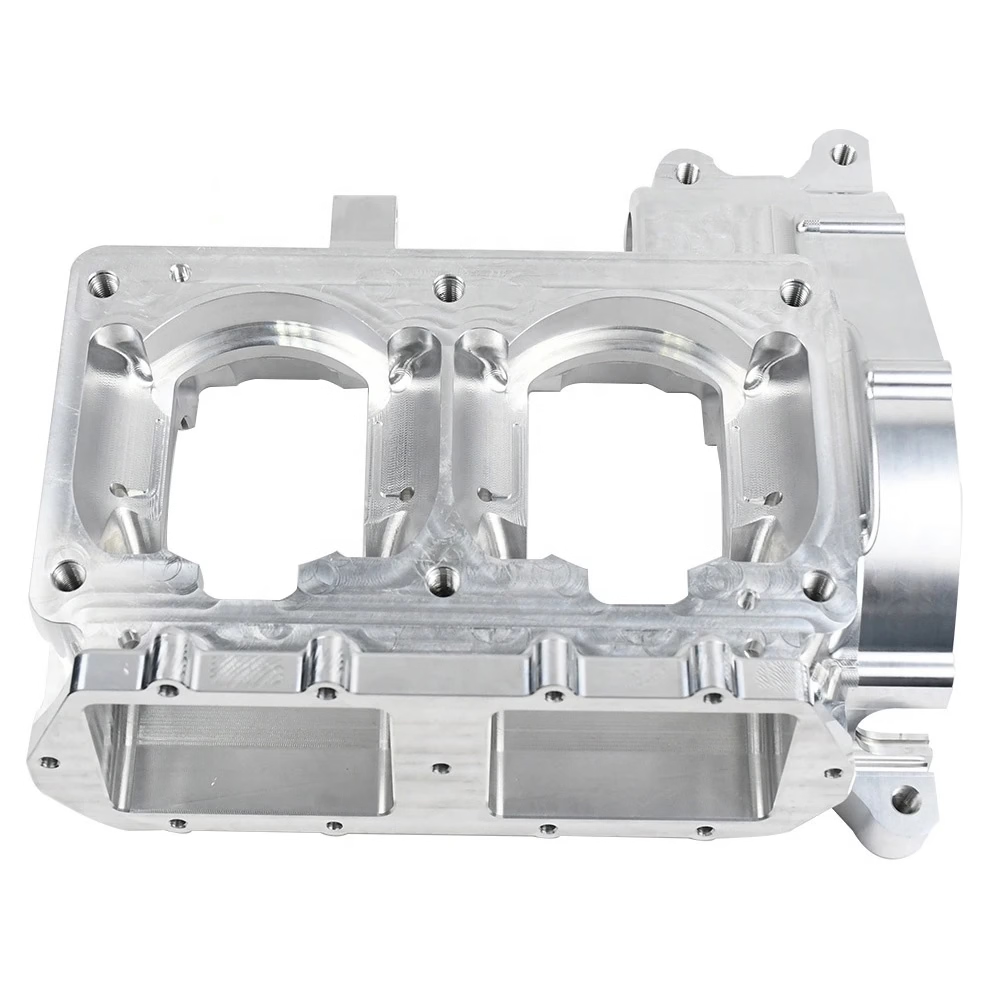
| Housing with ports on four sides | 5-axis simultaneous | One setup replaces four, less re-fixturing |
| Impeller or blade profile | 5-axis simultaneous | Continuous contouring, no tool marks at joints |
| Shaft with cross-holes | Mill-turn | Turning and milling in one cycle |
| Round flange, Ø400 mm and under | 4-axis with rotary table | Indexed work on a Ø400 mm table |
| Long frame, up to 4,000 mm | Large-frame 3-axis | Fits 4,000 × 400 × 150 mm travel |
| Prototype, one piece | 3-axis or 5-axis | No MOQ, so setup is quoted per job |
The cheapest quote is the one with the fewest surprises
Send the CAD file before you commit to a process. A twelve-hour DFM review tells you whether the geometry, tolerance and finish you specified are the ones you actually need.
Frequently asked questions
Does a 5-axis machine always cost more per part?
No. The hourly rate is higher, but the setup count drops. If your part needs three or more setups on a 3-axis machine, 5-axis often costs less overall.
The break-even is around three setups. Below that, stay on 3-axis.
How tight a tolerance do I actually need?
We hold ±0.005 mm (±0.0002 in) when a part requires it. Most brackets, housings and covers do not.
Review each tolerance on the print and keep only the ones with a functional reason. Every extra tight tolerance adds inspection time.
What part size can you machine?
Up to 4,000 mm on our large frames, with travel of 4,000 × 400 × 150 mm.
Medium frames cover 750 × 1,150 × 550 mm and 600 × 600 × 600 mm. Compact cells cover 500 × 500 × 450 mm and 500 × 310 × 200 mm.
Which materials cost the most to cut?
Titanium TC4, Inconel and magnesium sit at the top because of tool wear and slow feeds. Stainless 316L and 17-4PH work-harden and need slower cutting too.
Aluminium 6061 and 6061-T6 are the cheapest common choice. Brass and copper cut easily but cost more per kilogram.
Is there a minimum order quantity?
No. We run from one prototype to 10,000+ part runs.
A single piece is quoted on its own setup and programming time, so the unit cost is naturally higher than a batch.
How fast can I get a quote and parts?
Quotation and free DFM analysis come back within 12 hours. Production can start within 24 hours of approval, and parts ship in 3–5 days.
Uploads are secure and confidential. An NDA is available on request.
Get a real number for your part
Upload your CAD file and we return a quotation with free DFM analysis within 12 hours.
12-hour quote100% inspectionNo MOQNDA on request
More from GreatLight
We publish setup notes, tooling trials and inspection data from the factory floor.











