
PK 3D Printing Filam: How Glass-Filled Nylon and PK Actually Behave
A technical read on glass-filled nylon, PK and other engineering 3D printing filaments. We explain the fiber loading, moisture behavior and layer bonding that decide whether a printed part survives real load. Written for design and manufacturing engineers who need to pick a filament or decide to machine the part instead.
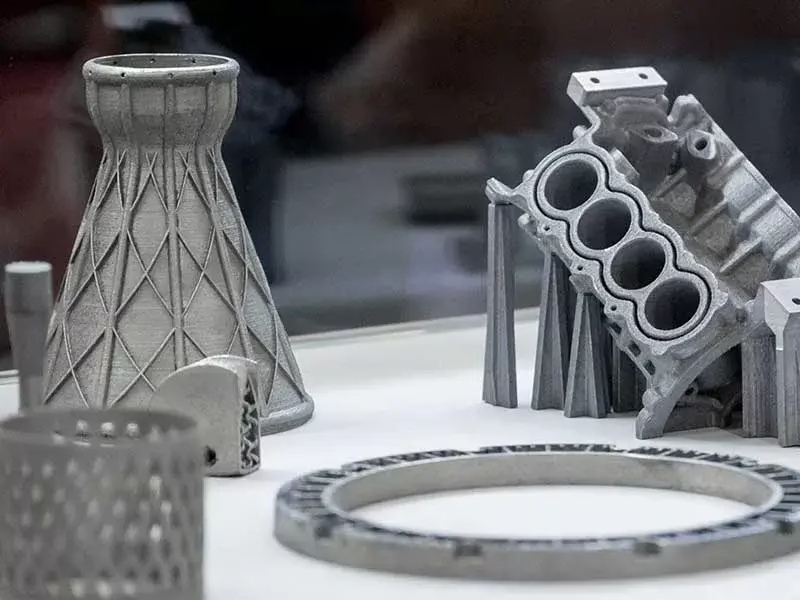
What Fiber Loading Does Inside a Printed Part
Chopped glass in a filament is not a filler added for weight. The strands sit in the polymer and carry load along their length, which raises tensile modulus and limits creep under steady stress. A 20 percent glass load by weight, the figure behind the PA-GF20 and PK-GF20 naming, typically lifts stiffness well above the unfilled grade and cuts the elongation you would see in plain nylon. The trade is brittleness. Parts that once bent now crack, and impact resistance drops.
The strands only help if they align with the load path. In fused deposition, the extruder lays material in the XY plane, so fibers tend to lie flat within each layer. Pull a printed bracket along Z and the glass does far less. The weak link is the bond between layers, not the strand itself. This is why a glass-filled filament can show strong numbers on a data sheet and still fail at a layer line under a peel load.
Short strands also mean short reinforcement. The fibers in a printable filament are millimeters long at most, because longer ones clog a 0.4 mm nozzle. That limits how much load they can bridge across a gap. For a stiff housing or a jig that sees compression, this is fine. For a thin cantilever that must carry bending stress, the gain over unfilled nylon is smaller than the modulus number suggests.
Warping follows the same physics. Glass lowers the shrink rate of the polymer, so a glass-filled grade usually prints flatter than plain nylon on a large flat face. That is a real benefit for fixture plates and covers. It does not fix corner lift on a tall thin wall, where cooling gradients still dominate.
PK 3D Printing Filam Compared With Nylon
PK is a polyketone. Its chain has a regular carbonyl group that gives it good chemical resistance and low moisture uptake compared with PA6 or PA12. In practice that means a PK part holds its dimensions better in a humid shop. Nylon absorbs water, swells, and loses stiffness. A PA-GF20 bracket left in a damp room can move more than the print tolerance allows. PK resists that drift.
The moisture difference also changes how you dry the spool. Nylon usually needs several hours in a dryer before a print, and it reabsorbs water during a long job if the spool sits out. PK tolerates a shorter dry cycle and holds up better on a multi-hour print. If your process cell has no dryer and no dry box, that alone can decide the material.
Heat resistance is where the two split. Glass-filled nylon generally keeps more stiffness at elevated temperature, which matters for a part near a motor or an exhaust path. PK softens at a lower point. Choose PK for chemical exposure, humidity and dimensional stability, and choose glass-filled nylon when the part runs warm and needs to stay stiff.
Both grades are abrasive. Glass wears a brass nozzle in a few spools, so a hardened steel or ruby nozzle is the baseline. Print them on a machine with an all-metal hot end and a heated chamber if you have one. Layer adhesion improves when the part stays warm between passes and the next layer bonds before the previous one fully sets.
Where Printed Glass-Filled Parts Fit, and Where They Do Not
Printing wins when the geometry is complex, the quantity is low, and the load is modest. A duct with internal ribs, a bracket with a cable channel, a jig that holds a sensor during assembly. These are hard to machine from solid without many setups, and a printed version can be in hand the same week. Add glass-filled filament when the part needs stiffness and must not creep under a light continuous load.
Printing loses when the load runs through the layer stack. A hook, a clevis, a thread that takes repeated torque, a press-fit bore. Each of these concentrates stress across Z, which is exactly the direction where a printed part is weakest. You can rotate the part on the plate to move the load into the XY plane, and that often fixes a failure. If rotation is not possible, printing is the wrong process.
Machining is the better answer once any of these apply: tolerance tighter than about ±0.1 mm, a sealing face, a bearing bore, a metal thread insert under load, or a run of more than a few hundred parts. A CNC shop holds ±0.005 mm on a machined aluminum or steel part and inspects every piece before it ships. A printed part carries layer texture, a softer surface, and dimension that shifts with humidity.
The honest middle ground is a printed prototype and a machined production part. Print the housing to check fit and cable routing, then cut the final version from 6061 or 17-4PH. The printed piece answers form and fit questions in days. The machined piece answers function, tolerance and repeatability. Mixing the two is normal in a working program, not a compromise.
Filament and Process Selection at a Glance
Pick the row that matches your load path and tolerance.
| Option | Stiffness / heat | Moisture behavior | Best fit |
|---|---|---|---|
| PA-GF20 (glass-filled nylon) | High stiffness, holds up warm | Absorbs water, needs drying | Stiff brackets, covers, warm areas |
| PK-GF20 (glass-filled polyketone) | Moderate stiffness, lower heat | Low uptake, stable in humidity | Chemical exposure, damp shops |
| Unfilled nylon | Lower stiffness, more flex | Absorbs water fastest | Snap fits, low-load flexible parts |
| Printed part, load in XY | Strong in plane | Depends on grade | Plates, ribs, in-plane tension |
| Printed part, load in Z | Weak at layer lines | Depends on grade | Avoid, or rotate the part |
| CNC aluminum 6061-T6 | High, stable to 150 °C+ | None | Tolerance, bores, threads, runs |
The Short Answer
Print PK 3D printing filam or PA-GF20 when the load runs in the XY plane, the tolerance is loose, and you need a complex shape fast. Machine the part when load crosses the layers, a bore or seal must hold, or the quantity is past a few hundred pieces.
Common Questions
Do I need a hardened nozzle for glass-filled filament?
Yes. Glass is abrasive and wears a brass nozzle in a few spools, which changes the extrusion diameter and ruins the dimension of the part.
Use hardened steel or a ruby tip, and check the orifice size after every few spools. A worn nozzle prints wider lines and thinner walls than the slicer expects.
How long should I dry PK or glass-filled nylon before printing?
Nylon needs a real dry cycle. PK tolerates less. The right number depends on the spool and the room, so check the filament maker's data and your shop humidity rather than trusting a fixed hour count.
A dry box during the print matters more than the pre-dry for long jobs. Moisture picked up mid-print shows up as bubbles, a rough surface and weak layer bonds.
Can a printed part hold a metal thread insert?
It can, if the boss is thick enough and the load is modest. Heat-set inserts work in glass-filled grades because the glass resists the creep that loosens an insert in plain nylon.
For a thread that sees repeated torque or a safety-relevant joint, machine the housing and cut the thread in metal. Printed threads in Z are the weakest case of all.
Why did my part fail at a layer line even though the data sheet is strong?
Data sheet values come from a molded or a well-oriented test bar. A printed part carries load across many layer boundaries, and the bond between them is weaker than the bulk material.
Rotate the part on the plate so the stress runs along the layers instead of across them. If the geometry will not allow that, the load path is telling you to machine the part.
When is it cheaper to machine the part than to print it?
Once the quantity passes a few hundred pieces, or when a failed print costs more than the machining setup. Post-processing, inspection and reprints add up fast on a tight-tolerance part.
A machined part also holds ±0.005 mm and can be inspected before shipment, which a printed part cannot match.
Send the Drawing, Get a Process Recommendation
Upload your model and we will review the load path, tolerance and quantity, then tell you plainly whether to print it or machine it. Quotation and DFM feedback within 12 hours.
12-hour quote100% inspectionNo minimum order quantity
More Process Notes
We publish setup notes, tooling trials and inspection data from the factory floor.











