
Forged Carbon Fiber: Why Luxury Cars Demand This Innovation
Forged carbon fiber gives luxury cars a marbled look and near-isotropic strength, but the compression-molded blanks are rarely ready to bolt on. This page is for engineers and buyers who already have a forged carbon fiber part and need to know why it failed, warped, or chipped. Read it to match a symptom to a cause and pick the right fix before you scrap another batch.
In this article
- 1
- 2
- 3
- 4
- 5
- 6
Forged Carbon Fiber Defects: Symptom, Cause, Fix
Match the defect you see on the bench to the likely cause and the machining or process fix.
| Symptom | Likely cause | How to fix it |
|---|---|---|
| White streaks on cut edge | Fiber pull-out from dull tool | Diamond-coated 6-flute cutter, 0.05 mm chip load |
| Delamination after drilling | Point angle too sharp, no backer | Use 120° point, back the exit side with acrylic |
| Warp after cure | Uneven fiber-to-resin ratio | Add 0.5 mm machining stock, stress-relieve before finish |
| Chipping on trim line | Too-high feed on thin wall | Reduce feed to 800 mm/min, climb cut only |
| Resin burn marks | Spindle speed too high, no coolant | Cap spindle at 12,000 rpm, use air blast or MQL |
| Dimensional drift over a run | Thermal growth in fixture | Hold shop at 20 °C ±2, probe every 10 parts |
| Void visible after polishing | Trapped air in the blank | Reject the blank, or fill only if outside Class A zone |
Forged carbon fiber rewards the right setup, not the fastest feed
Most forged carbon fiber defects trace back to tool geometry, fixture support, or skipping the stress-relief rest. Fix those three and the material machines cleanly at ±0.005 mm. If the part is already scrapped, send us the drawing and the failure photos. We will tell you which step went wrong.
Why forged carbon fiber behaves differently on the machine
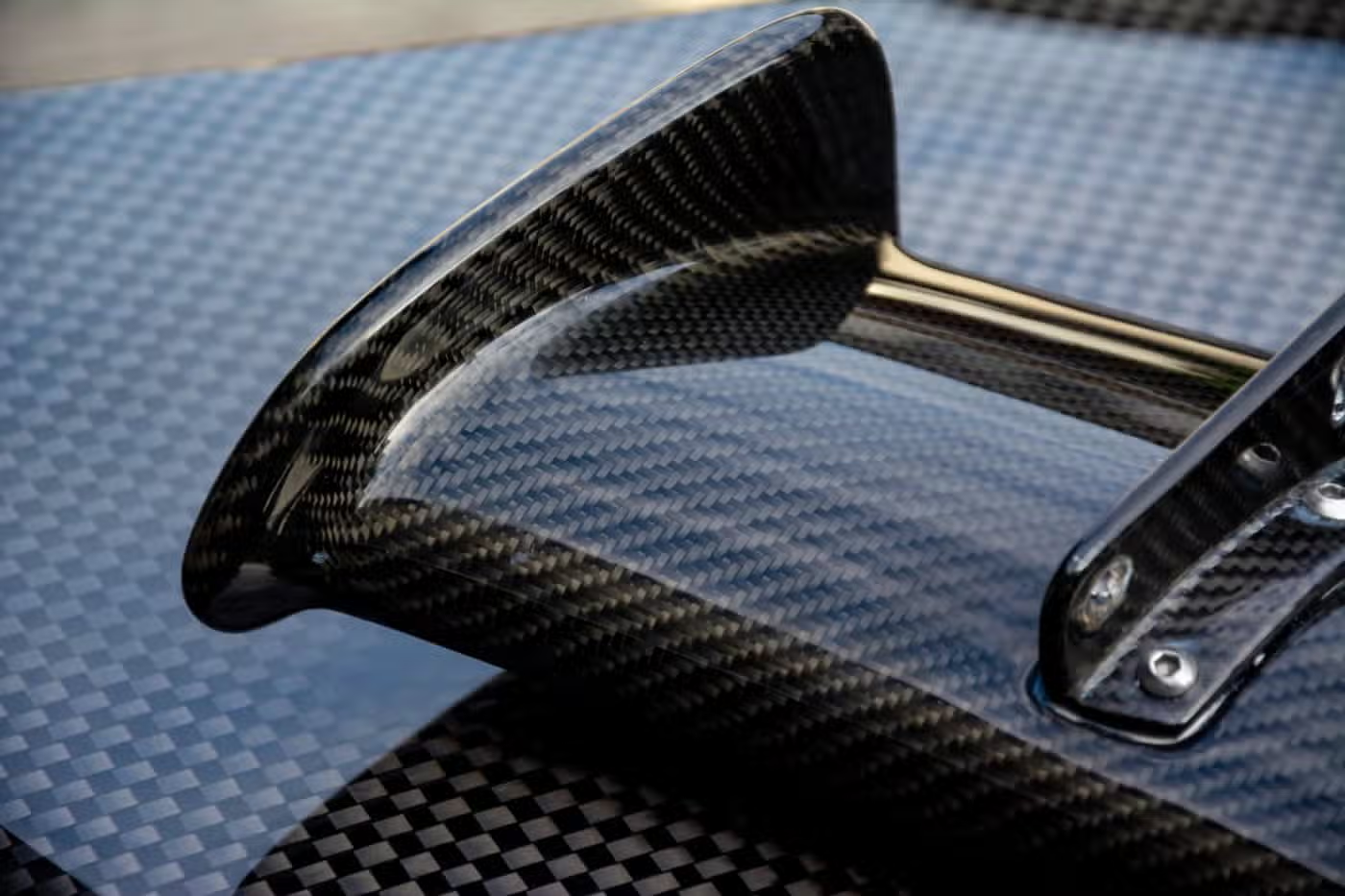
Forged carbon fiber starts as chopped strands, usually 12–25 mm long, mixed with resin and pressed into a heated mold. The strands land in random directions, so the finished blank has no weave pattern. That random layup is why the surface looks marbled and why the material behaves closer to isotropic than a woven laminate. It also means every blank is slightly different, even from the same mold.
The compression step leaves the blank close to net shape but not to tolerance. Expect 0.3–0.8 mm of variation on a 300 mm panel, plus a resin-rich skin that can hide voids. That is normal. A forged carbon fiber blank is a preform, not a finished part. The machining operation is what turns it into a bolt-on component.
This is where most failures start. Teams treat the blank like aluminum, run a standard carbide tool, and end up with fiber pull-out, delamination, or a trim line that chips. Carbon fiber is abrasive and brittle at the same time. It cuts cleanly with the right edge geometry and dust extraction, and it punishes anything else.
- 1Random strand orientationNo weak axis in the plane, unlike woven cloth.
- 2Resin-rich surfaceFirst 0.1–0.2 mm is mostly resin and cuts easily.
- 3Abrasive dustRequires extraction and sealed machine covers.
- 4Blank variationPlan for 0.5 mm stock on critical features.
The four defects that scrap most forged carbon fiber parts
Fiber pull-out is the most common complaint. You see it as white, fuzzy streaks along a trimmed edge. The cause is almost always cutting geometry: a tool with too little rake, run at a feed that is too light. The tool rubs instead of shearing, and the fibers tear out of the resin. Switch to a diamond-coated cutter with 6 flutes, keep the chip load at 0.04–0.06 mm per tooth, and the edge comes back clean.
Delamination shows up after drilling or countersinking. The drill pushes the last plies apart instead of cutting them. A 120° point angle with a moderate feed prevents this. So does backing the exit side with a scrap acrylic plate. If you see delamination on more than 2% of holes, check spindle runout before you touch the program.
Warping appears after cure or after the finish pass. It comes from an uneven fiber-to-resin ratio across the blank, which builds internal stress. The fix is boring but effective: leave 0.5 mm of stock, machine both faces in the same setup, and let the part rest at room temperature for 12–24 hours before the final skim. Skipping the rest is how a flat panel turns into a 0.4 mm bow.
Chipping along a trim line tells you the wall is too thin for the feed you selected. Below 2 mm wall thickness, drop the feed to 700–900 mm/min and use climb cutting throughout. A 2 mm wall in forged carbon fiber is not the same as a 2 mm wall in aluminum. It has far less stiffness, and it will chatter if you push it.
- 1Fiber pull-outFix with diamond coating and 0.04–0.06 mm chip load.
- 2Delamination120° point angle plus exit-side backing.
- 3Warp0.5 mm stock, both faces in one setup, 12–24 h rest.
- 4ChippingBelow 2 mm wall, feed 700–900 mm/min, climb cut.
Forged carbon fiber vs woven carbon fiber: what changes in the shop
Woven carbon fiber is a laminate. You stack plies, bag it, and cure it in an autoclave or press. The weave gives you predictable directional properties, but it also limits how complex the part can be. Deep draws and sharp internal corners are hard because the cloth has to drape. Forged carbon fiber removes that limit. The chopped charge fills the mold, so you can press ribs, bosses, and compound curves in one shot.
The trade-off is surface finish and repeatability. A woven part shows a clean twill or plain weave once you clear the resin. A forged part shows a random marbled pattern, which is either the whole point or a rejection, depending on the customer. Dimensional repeatability is also looser out of the mold. Forged blanks need more machining stock, and the inspection plan has to account for blank-to-blank variation.
For a low-volume luxury car run, forged carbon fiber often wins on tooling cost and cycle time. For a large flat panel where the weave is part of the brand, woven still makes sense. The decision is rarely about strength. Both materials beat steel on specific stiffness. It is about geometry, volume, and what the surface has to look like.
- 1GeometryForged fills ribs and bosses; woven struggles with deep draws.
- 2SurfaceForged is marbled and random; woven shows a repeatable weave.
- 3ToolingForged uses a compression mold; woven needs layup and bagging.
- 4Machining stockForged needs more; expect 0.5 mm on critical faces.
How to hold ±0.005 mm on a forged carbon fiber part
The tolerance on a forged carbon fiber part is set by the fixture, not by the material. Carbon fiber is stiff enough that a well-supported part will hold ±0.005 mm on a milling operation. If it moves, the clamping is wrong. Vacuum fixtures work well on flat panels because they spread the load. For 3D shapes, use a machined nest that matches the blank within 0.1 mm and add light mechanical clamps at the edges.
Tool choice matters more than spindle speed. Diamond-coated carbide or PCD gives the longest edge life. A 6 mm cutter at 10,000–12,000 rpm and 1,200–1,800 mm/min is a reasonable starting point for roughing. For finishing, step down to 0.2–0.3 mm radial engagement and keep the feed steady. Stopping in the cut is what causes burn marks and resin smear.
Dust control is not optional. Carbon fiber dust is conductive and abrasive. It will find its way into way covers, spindle tapers, and electronics. Machines running carbon fiber should have sealed covers and dedicated extraction. If you share a machine with aluminum, clean it thoroughly between jobs. A single carbon chip in a coolant line can scratch a precision bore on the next part.
Inspection follows the same logic. Measure after the part has stabilized, not straight off the machine. For a Class A surface, check with a coordinate measuring machine and a white-light scanner. For a bracket, calipers and a height gauge are enough. The point is to match the inspection method to the feature tolerance, not to inspect everything the same way.
- 1Fixture firstVacuum for flat panels, machined nest for 3D shapes.
- 2ToolingDiamond-coated or PCD, 6 flutes, 0.2–0.3 mm finish stepover.
- 3Dust controlSealed covers and dedicated extraction; clean between jobs.
- 4InspectionLet the part stabilize, then measure to the feature tolerance.
Seven steps to machine a forged carbon fiber part without scrapping it
- 1Inspect the blank before you programCheck wall thickness at six points and log the resin-rich skin. If variation exceeds 0.8 mm on a 300 mm part, adjust your stock allowance before cutting.
- 2Set the fixture to match the blank, not the CAD modelMachine a nest from the actual blank scan. Support within 0.1 mm. Clamp only at the edges and use light pressure to avoid preloading the part.
- 3Rough with a diamond-coated 6-flute cutterRun 10,000–12,000 rpm, 1,200–1,800 mm/min, 0.04–0.06 mm chip load. Leave 0.5 mm on faces and 0.3 mm on walls.
- 4Rest the part before finishingLet it sit at 20 °C ±2 for 12–24 hours. This releases stress from the compression molding step and prevents a bow after the final skim.
- 5Finish with a light stepover and steady feed0.2–0.3 mm radial engagement, climb cutting throughout. Never stop the cutter in the cut on a visible surface.
- 6Drill and countersink with the right geometry120° point angle, moderate feed, acrylic backer on the exit side. Check the first three holes for delamination before running the batch.
- 7Inspect, clean, and sealMeasure after stabilization. Blow out all dust, then apply the specified clear coat or leave the machined finish as the customer requires.
Forged carbon fiber questions engineers ask before quoting
Can forged carbon fiber be machined to the same tolerance as aluminum?
Yes, on a well-supported part. We hold ±0.005 mm on forged carbon fiber when the fixture matches the blank and the part is allowed to stabilize before the finish pass.
The limit is usually the blank, not the machine. If the compression-molded preform varies by more than 0.8 mm, you need to account for that in the setup, or the first cut will be inconsistent.
What tool coating works best on forged carbon fiber?
Diamond-coated carbide is the standard choice for production. PCD is better for very high volumes because the edge lasts longer, but the upfront cost is higher.
Uncoated carbide will cut the resin but dulls quickly on the fibers. It is fine for one or two prototypes, not for a run.
How much machining stock should I leave on a forged carbon fiber blank?
Plan for 0.5 mm on faces and 0.3 mm on walls. That covers the blank variation and the resin-rich skin without adding unnecessary cycle time.
On Class A surfaces, leave a little more and take two light finish passes. The second pass cleans up any spring-back from the first.
Does forged carbon fiber need a special finish after machining?
It depends on the application. A clear coat protects the resin and brings out the marbled pattern. A matte machined finish is acceptable for hidden structural parts.
If the part will see UV exposure, a UV-stable clear coat is necessary. Raw resin will chalk and fade over time.
Can you machine forged carbon fiber and aluminum in the same shop?
Yes, but not on the same machine without a full clean-down. Carbon dust is conductive and abrasive. It will contaminate coolant and scratch aluminum surfaces.
We keep dedicated extraction and sealed covers on the machines that run carbon fiber. If your shop does not, schedule carbon jobs last and clean thoroughly.
What is the lead time for a machined forged carbon fiber prototype?
We quote and return a DFM analysis within 12 hours. Production can start within 24 hours of approval, and parts typically ship in 3–5 days.
This assumes the blank is available. If you need us to source the compression-molded preform, add time for that step.
Send a forged carbon fiber part for DFM review
Upload your drawing and blank dimensions. We return a quotation and free DFM analysis within 12 hours, with no minimum order quantity.
12-hour quote100% inspectionNDA on requestFrom 1 to 10,000+ parts
More machining notes
We publish setup notes, tooling trials and inspection data from the factory floor.











