
CNC Machine Tools: Inside the Industrial Chain
CNC machine tools are called the mother machines of manufacturing. This page explains what sits inside that chain, how each link changes part accuracy and cost, and when a machined part beats a casting or a print.
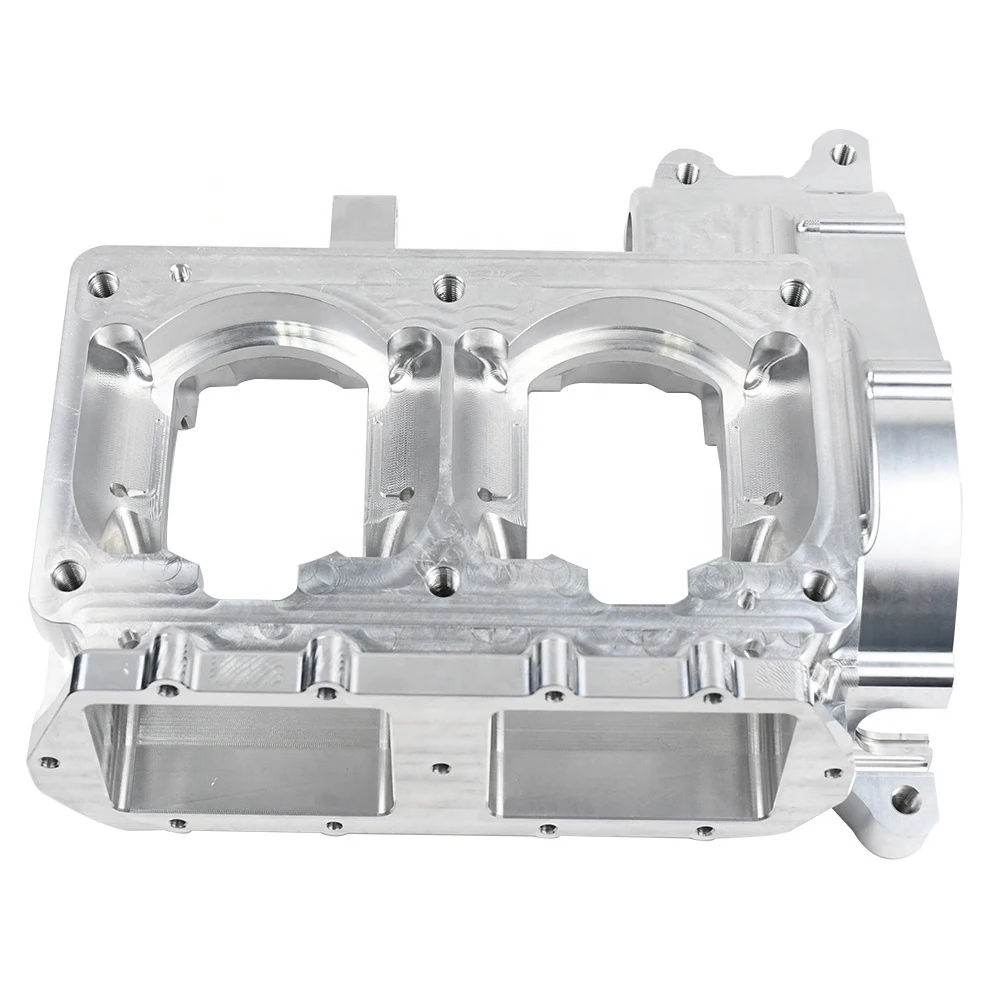
What CNC machine tools actually are
A CNC machine tool is a machine that cuts metal under numerical control. The controller reads G-code and moves axes, spindle, and tool changer without an operator turning handwheels. That sounds simple. The machine still has to hold a position within microns while a hardened tool pushes through steel.
Three numbers define the machine more than any brochure photo. Axis count sets which faces you can reach in one setup. Spindle speed and torque set which materials cut cleanly. Travel sets the largest part the machine can hold without repositioning.
CNC machine tools sit at the top of the manufacturing chain because almost every other process depends on them. Die casting needs machined dies. Injection molding needs machined cores. Sheet metal needs machined punches. Stamping, forging, and extrusion all start with a tool that a CNC machine cut.
That is why the machine tool sector is called the mother industry. When machine tool capacity tightens, every downstream factory feels it within a quarter.
- 1Axis count3-axis for prismatic parts, 5-axis for contoured or multi-face parts
- 2SpindleSpeed and torque decide whether aluminium or Inconel cuts well
- 3TravelSets the largest part size before repositioning hurts accuracy
The industrial chain behind a CNC machine tool
A machine tool is not built in one building. It is assembled from parts made by other machine tools. Cast iron bases come from foundries. Linear guides and ball screws come from specialized suppliers. Spindles, servo motors, and controllers come from a small group of vendors worldwide.
Follow the chain backwards and you find the same bottleneck every time: precision components. A ball screw with 5 μm lead error will show up as pitch error in your parts. A spindle with 2 μm runout will show up as taper or chatter. The machine cannot be more accurate than its weakest purchased part.
This is why machine tool lead times stretch when demand spikes. Foundries, guide makers, and controller vendors all run at their own pace. A single missing guide rail can hold a finished machine in a warehouse for weeks.
For a machine shop, the practical lesson is boring but useful. Machine accuracy is a maintenance problem, not just a purchase problem. Guides wear. Spindles drift. Ball screws lose preload. A yearly calibration check catches most of it.
- 1UpstreamFoundries, guide makers, spindle and controller vendors
- 2MidstreamMachine builders assemble, align, and test geometry
- 3DownstreamJob shops and factories cut finished parts
How machine geometry sets part tolerance
Part tolerance is not a single number a shop picks. It is the sum of machine geometry, tool wear, thermal drift, and fixturing. A machine rated at ±0.005 mm positional accuracy can still produce a part outside ±0.05 mm if the fixture flexes or the room heats up.
Squareness and parallelism matter more than raw positioning for most parts. If the X and Y axes are not square within 5 μm over 300 mm, every pocket and every bore inherits that error. No amount of tool compensation fixes it.
Thermal drift is the quiet one. A spindle running for two hours can grow 10–20 μm in Z. On a long batch, the first ten parts and the last ten parts differ. Shops that hold tight tolerances let the machine warm up first, then check a master part.
When a drawing calls for ±0.005 mm, we look at the feature, not the whole part. A bore can hold that. A 400 mm face usually cannot, because the machine and the material both move.
- 1GeometrySquareness and parallelism cap the real tolerance
- 2ThermalWarm-up and stable room temperature cut drift
- 3FixturingA soft fixture adds error no controller can remove
Where cost enters the chain
Machining cost tracks three things: setup time, cycle time, and scrap. Setup is fixed per batch. Cycle time scales with material removal. Scrap is the one nobody quotes and everybody pays for.
Material choice moves cost faster than most engineers expect. Aluminium 6061 cuts at high speed with light tool wear. Stainless 316 work-hardens, so feeds and speeds drop and cycle time doubles. Inconel can cut tool life to a fraction of that. The part is the same shape. The price is not.
Feature count drives setup count. A part with features on four sides needs either a 5-axis machine or three extra setups. Three setups mean three chances to lose datums. On small batches, 5-axis is often cheaper even at a higher hourly rate.
Scrap is where a shop earns or loses money. A casting with a 2 mm machining allowance leaves little room for error. A billet gives more room but removes more metal. Good DFM analysis catches this before the first cut.
- 1MaterialStainless and nickel alloys cut cycle time hard
- 2SetupsEach extra setup adds cost and datum risk
- 3AllowanceThin allowance saves metal but raises scrap risk
When CNC machine tools are the right link
CNC machining wins when the part needs tight tolerance, a good surface finish, or a material that cannot be cast or molded well. It also wins when the quantity is low and the geometry is complex.
CNC machining loses when the part is hollow, thin-walled, and needed in thousands. Die casting or injection molding makes that shape faster and cheaper once the tool is cut. The tool itself is still machined, so the chain does not break.
Rapid prototyping sits in between. A printed or cast urethane part proves fit in days. A machined part proves function in the real material. Engineers often need both, and the order matters.
We run 3-axis, 4-axis, and 5-axis machining, mill-turn, sheet metal, die casting, vacuum casting, and 3D printing under one roof. That means we can tell you when machining is the wrong answer instead of quoting it anyway.
- 1Pick machiningTight tolerance, complex geometry, low to mid volume
- 2Pick casting or moldingHollow shapes, high volume, relaxed tolerance
- 3Pick printingFit checks and early design reviews, not final function
Machining vs casting vs molding vs printing
Use this table to pick a process before you request a quote.
| Process | Best for | Typical tolerance | Watch out for |
|---|---|---|---|
| 3-axis CNC | Prismatic parts, one or two faces | ±0.01 mm | Extra setups for side features |
| 5-axis CNC | Contoured or multi-face parts | ±0.005 mm | Higher hourly rate, needs good DFM |
| Die casting | High volume, hollow shapes | ±0.05 mm | Tool cost, porosity, draft angles |
| Injection molding | Plastic housings, high volume | ±0.05 mm | Tool lead time, wall thickness limits |
| 3D printing | Fit checks and early reviews | ±0.2 mm | Weak anisotropy, poor surface finish |
| Sheet metal | Enclosures and brackets | ±0.1 mm | Bend radius and hole-to-bend distance |
The short answer
If the part needs tight tolerance or real material properties, machine it. If it is hollow, thin-walled, and needed in thousands, cast or mold it and machine only the critical faces. Mixing the two is usually cheaper than either alone.
Questions engineers ask next
How tight a tolerance can CNC machine tools hold in production?
On a stable machine with a warm spindle, ±0.005 mm is realistic for bores and small faces. Larger faces and long batches drift more.
If the drawing calls for tighter than that, we look at the feature, the material, and the batch size before saying yes.
Why does stainless cost more to machine than aluminium?
Stainless work-hardens under the tool and conducts heat poorly. Feeds and speeds drop, tool wear rises, and cycle time roughly doubles.
The setup is the same. The cutting time is not.
When should a part be cast first and machined second?
When the shape is hollow or thin-walled and the volume is high. Casting gets close to the final form, then machining hits the critical faces.
Leave enough allowance to clean up distortion. Too little allowance is a common cause of scrap.
Does 5-axis always beat 3-axis?
No. On simple prismatic parts, 3-axis is faster and cheaper. 5-axis pays off when one setup replaces three, or when the surface is contoured.
The decision is about setup count and surface geometry, not machine prestige.
How is machine accuracy maintained over time?
By checking geometry on a schedule, not by trusting the spec sheet. Guides wear, ball screws lose preload, and spindles drift.
A yearly calibration check plus in-process inspection catches most drift before it reaches a customer.
Send us your drawing
Upload a STEP file and we will return a quote and a free DFM analysis within 12 hours.
12-hour quote100% inspectionNo minimum order
More from GreatLight
We publish setup notes, tooling trials and inspection data from the factory floor.











