
CNC VMC Machine Guide: How Vertical Machining Centers Work
This CNC VMC machine guide explains spindle orientation, axis layout, work envelope and tool changing on a vertical machining center. It is written for design engineers and buyers who need to judge whether a part belongs on a VMC, a lathe, or a 5-axis machine.
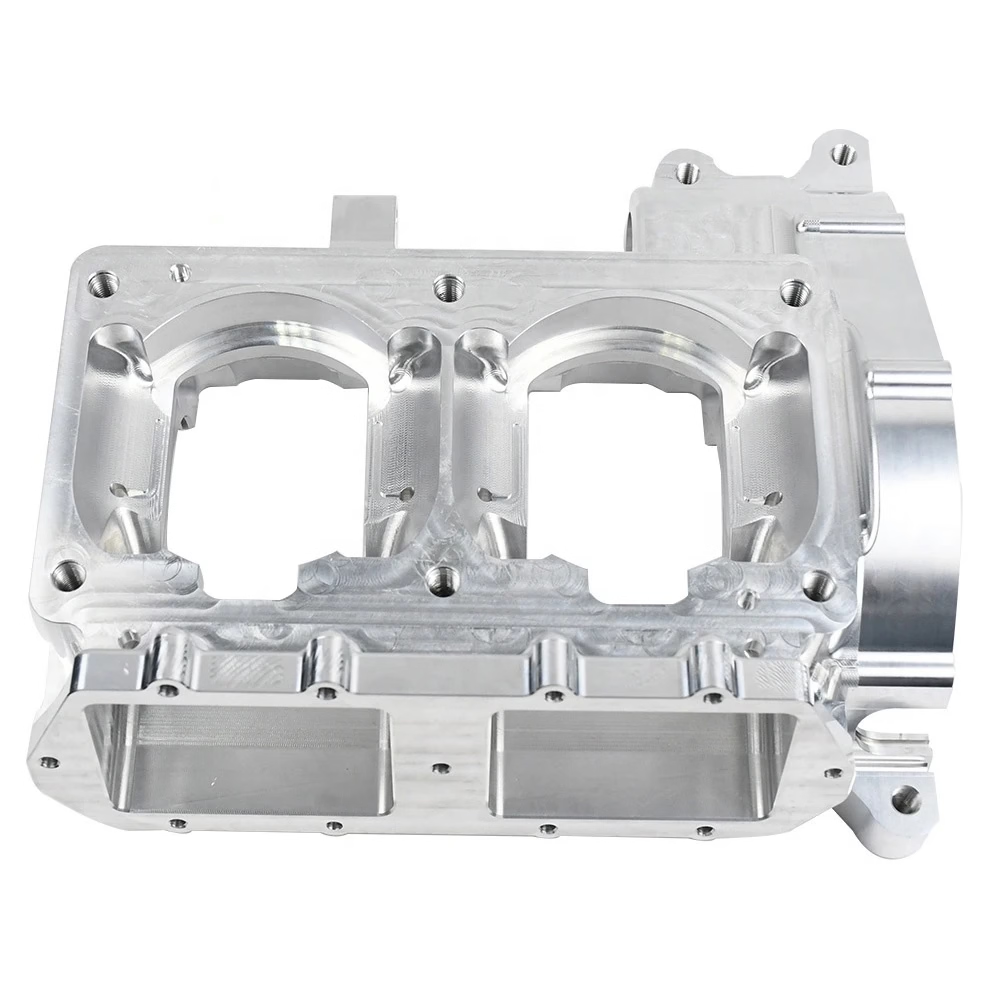
What a CNC VMC Machine Actually Is
A VMC is a milling machine whose spindle points down at the table. The workpiece sits on a horizontal table and moves in X and Y; the spindle head moves in Z. That vertical layout is the whole distinction. On a horizontal machining center the spindle points sideways, chips fall away from the cut, and the machine usually costs more and takes more floor space.
CNC means the slide positions come from a program, not from handwheels. The controller reads G-code, drives ball screws through servomotors, and closes the loop with linear scales or encoder feedback. If you have ever watched a Bridgeport-style knee mill, the motions look familiar. What changed is that the machine holds position to ±0.005 mm instead of a few thousandths of an inch by eye.
The practical result: a VMC is a general-purpose machine. It mills pockets, drills hole patterns, taps threads, bores bearing seats and faces plates in one setup. That flexibility is why job shops and contract manufacturers build around them rather than around single-purpose machines.
One boundary worth stating early. A VMC removes material with a rotating cutter, so it suits prismatic parts: brackets, housings, plates, manifolds, mold inserts. It is a poor fit for parts that are essentially turned cylinders, and it cannot form thin sheet the way a press brake does.
Axis Count and What Each Axis Buys You
A standard VMC has three linear axes. X and Y position the part under the spindle, Z sets depth. With a 500 × 500 × 450 mm envelope you can machine most plate work and small housings in a single setup, but every face that points away from the spindle needs a second operation, a new fixture and a new alignment error.
Add a fourth axis and the table can index or rotate continuously. A Ø400 mm rotary table lets you cut four sides of a part without re-fixturing, which removes three setups and the tolerance stack that comes with them. This is the cheapest way to cut cost on parts with features on multiple faces.
Five-axis machines tilt the tool as well as rotate the part. Two configurations dominate. Table-table machines swing the workpiece; trunnion machines add a tilting cradle. Either way the benefit is the same: short, stiff tools can reach deep pockets and undercuts, and you can machine a compound angle without a custom angle plate.
Do not buy axis count you cannot use. Programming a simultaneous 5-axis toolpath takes CAM software, a post-processor and a machinist who understands collision checking. A 3-axis machine with good fixtures often beats a 5-axis machine run badly.
Spindle, Frame and Thermal Behavior
The spindle is where the money goes. Its taper decides how much tool you can hang out, its power decides how fast you can remove material, and its speed range decides which materials are practical. Aluminum wants high rpm and light torque; steel and titanium want lower rpm and high torque at the tool tip. One spindle rarely does both well.
Cast iron or polymer-concrete bases exist to absorb vibration. Chatter is not a mystery: it is the cutter and the structure resonating at the same frequency. A heavy base raises that frequency, which lets you take deeper cuts without squealing. This is why a 6-tonne machine holds a finish that a light benchtop router cannot, even at identical feeds and speeds.
Thermal growth is the quiet error source. A spindle running at 12,000 rpm for two hours gets longer. On a 4,000 mm part, a few degrees of temperature change moves the far end more than the tolerance band. Warm-up programs and temperature-controlled shops exist for exactly this reason.
If your parts are small and your tolerance is loose, none of this matters much. If you are holding ±0.005 mm across a long part, plan the warm-up, the coolant temperature and the fixturing before you blame the machine.
Tool Changers, Workholding and Setup Count
An automatic tool changer turns a VMC from a milling machine into a production system. A carousel holds 20 to 30 tools; an arm changer swaps them in a few seconds. Without it, every tool change is a manual event with a re-zero, and a 12-tool part becomes an afternoon.
Tool count drives setup strategy. If the part needs 18 tools and the magazine holds 20, you can finish it in one program and one setup. If it needs 25, someone has to stop mid-run, load a second set and re-prove the offsets. Designers who count their features before releasing a drawing save the shop a shift of work.
Workholding is the other half of accuracy. A vise is fast and flexible. Soft jaws machined in place hold a profile to a few hundredths. A vacuum plate suits thin, flat parts that would bow under clamping. For 5-axis work, a self-centering chuck or a tombstone lets you reach five faces in one cycle.
Adding a setup multiplies error. Each new fixture introduces a locating tolerance, a clamping distortion and a chance of chips under a datum. When a drawing calls for tight true position between two faces, ask whether a 4-axis rotary or a 5-axis cycle can reach both without breaking the setup.
Which Materials Suit a VMC and Which Fight It
Aluminum is the natural VMC material. Grades such as 6061, 7075 and 6082 cut fast, hold a good finish and tolerate high spindle speeds. With the right cutter you can hold Ra 0.8–1.6 μm on a wall and still remove metal quickly.
Stainless steels 303, 304 and 316 work well but work-harden. Feed too slowly and the surface gets harder under the cutter, which kills the next pass. 17-4PH machines cleanly in the solution-treated condition and is common for medical and aerospace parts.
Steel grades 1018, 1045 and 4140 are routine on a rigid VMC, though pre-hardened 4140 will eat inserts and slow the cycle. Titanium TC4 (Ti-6Al-4V) and Inconel are possible but punish the wrong setup: they generate heat at the cutting edge, so coolant delivery and toolpath strategy matter more than spindle power.
Plastics are the easy win. POM, PEEK, ABS and PC machine on the same machine with sharp tooling and air blast. The risk is not hardness but melting and burrs. PEEK and carbon-fibre composites also wear tools quickly, so keep a separate set of cutters for them.
VMC vs Other Machine Types: Fit by Part Geometry
Pick the machine from the part shape, not from the machine's spec sheet.
| Part feature | Best machine | Why | Watch out for |
|---|---|---|---|
| Prismatic plate, pockets on one face | 3-axis VMC | Cheapest setup, rigid and fast | Second setup for side holes |
| Features on four sides | 4-axis VMC with rotary | One setup, one datum | Rotary table eats Z travel |
| Compound angles, deep pockets | 5-axis VMC | Short tools reach the floor | CAM and simulation cost |
| Shaft or bushing, round | CNC lathe or mill-turn | Turning is far faster on cylinders | Milling flats adds cycle time |
| Thin bracket, tight flatness | VMC with vacuum plate | Low clamping distortion | Chips can lift the part |
| Large weldment, 4,000 mm | Large-travel VMC | One machine, one program | Thermal drift over long parts |
When a VMC Is the Right Call
If your part is prismatic and needs milling, drilling or tapping, a 3-axis VMC is the cheapest accurate route. Add a 4-axis rotary when features sit on more than one face, and move to 5-axis only when the geometry or the tolerance stack forces it. If the part is mostly round, a lathe or mill-turn center will beat any VMC on cycle time.
CNC VMC Machine Questions Engineers Ask
How tight a tolerance can a VMC hold in production?
On a rigid machine with temperature control and in-process checks, ±0.005 mm (±0.0002 in) is realistic on critical features. That figure depends on feature size, material and how many setups the part needs. Long parts and thin walls are harder than small, thick ones.
Tolerances tighter than that usually mean grinding, lapping or a controlled-temperature room rather than a different machining center.
What is the largest part a VMC can handle?
It depends on the machine travel. Our largest VMC envelope is 4,000 × 400 × 150 mm, and we also run 750 × 1,150 × 550 mm and 600 × 600 × 600 mm machines for mid-size work.
Travel is the hard limit. A part that fits the table but exceeds the Z stroke cannot be finished in one program, so it gets split into operations.
Do I need 5-axis for a part with a single angled face?
Not always. A 3-axis VMC with a sine plate or angle fixture can cut an angled face accurately, and the setup is cheaper on a short run.
Five-axis pays off when the angle repeats across many parts, when the pocket is deep enough to need a short tool, or when the tolerance between the angled face and another feature is tight.
How does tool count affect my quote?
Every additional tool means another offset to set, another chance for a chip to sit under a holder, and usually another minute of cycle time. A part needing 20 tools takes longer to set up than one needing six, even if the cutting time is identical.
Consolidating features so one cutter does more work is one of the fastest ways to cut unit cost.
Can a VMC machine hardened or exotic material?
Yes, within limits. Pre-hardened steels, titanium TC4 and Inconel all machine on a rigid VMC, but they require the right carbide grade, lower surface speed and generous coolant.
The constraint is usually tool life and cycle time rather than whether the cut is possible. On small features in Inconel, the tool may need replacing mid-run, which shows up in the price.
How do I know the machine is accurate before shipment?
Ask for inspection data on the features you care about. We check raw material on arrival, monitor in-process, and inspect 100% of parts before shipment, with reports available on request.
If a feature is critical, state it on the drawing so it gets measured rather than assumed.
Send the Drawing, Get Machining Feedback
Upload a STEP file and we will return a quotation with free DFM analysis within 12 hours, plus an engineer's note on whether a 3-axis, 4-axis or 5-axis cycle fits your part best.
12-hour quoteNo MOQ±0.005 mm100% inspection
More Machining Notes
We publish setup notes, tooling trials and inspection data from the factory floor.











