CNC Processing Liverpool: How the Process Actually Works
This page explains what CNC processing Liverpool buyers are really paying for: machine choice, tolerance stack-up, material behavior, and inspection. It is written for design engineers and sourcing staff who need to judge a quote instead of just accepting it.
In this article
- 1
- 2
- 3
- 4
- 5
- 6
What CNC processing removes, and why that matters
CNC processing is subtractive. A rotating cutter removes material along a programmed path, and the finished part is whatever remains. That single fact drives most cost and quality decisions. Every feature you add means more tool travel, more fixturing thought, and more chances for the cutter to deflect or chatter.
The cutter does not move in a straight line through solid metal without consequence. It pushes. Long tools bend. Thin walls spring back after the cut. Heat builds in the chip and in the workpiece. A shop that ignores these effects will still hit the nominal dimension on a drawing and still fail a functional test.
For a Liverpool buyer, this is where quotes diverge. Two suppliers can both claim CNC machining and still plan entirely different toolpaths, workholding and inspection. The gap shows up in the second and third production run, not the first article.
How CNC processing Liverpool shops pick the axis count
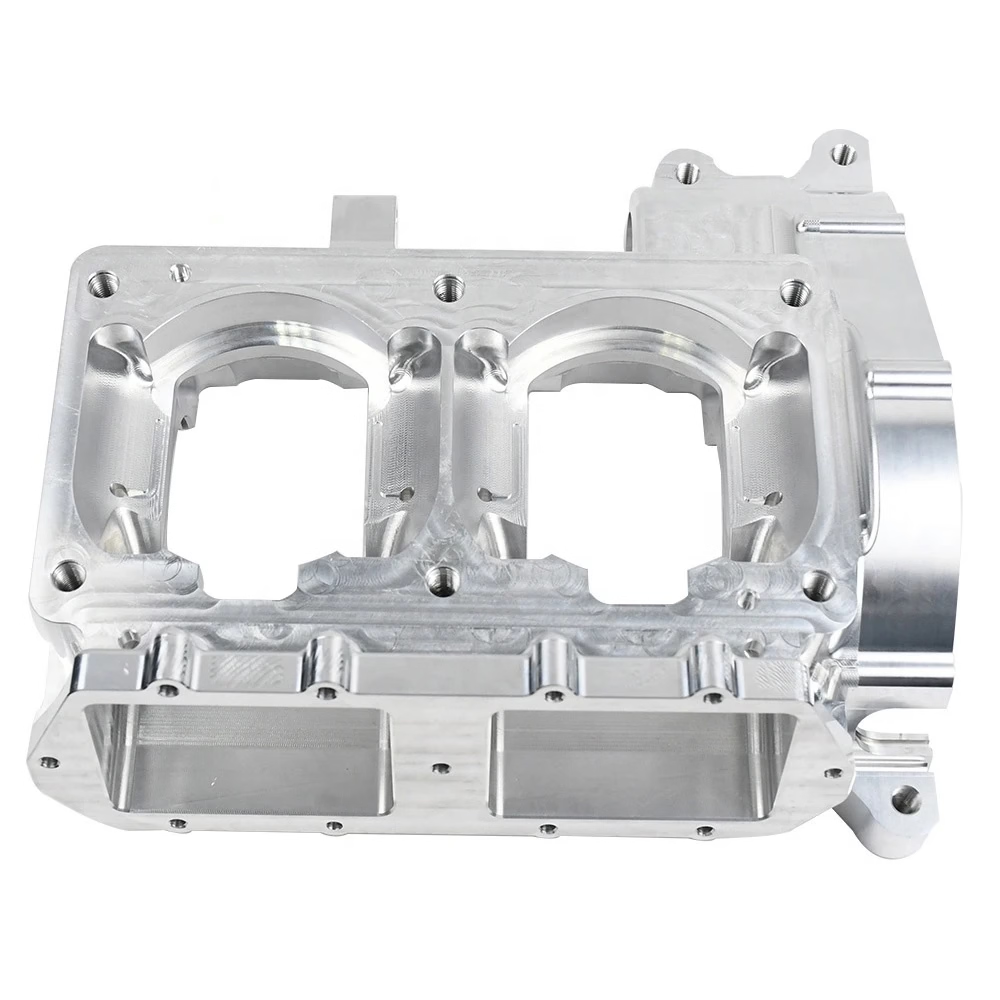
Axis count is the first real decision, and it is a geometry question, not a budget one. A part with holes and pockets on one face is a 3-axis job. Add features on two or more sides and you either refixture the part or move to a 4-axis mill with a rotary table.
Five-axis work earns its cost when the geometry needs the cutter to tilt. Deep cavities, undercut flanks, angled port faces and impeller blades are the usual cases. Tilting the tool shortens the effective stick-out, which cuts chatter and lets a shorter, stiffer cutter reach the same surface.
Multi-sided parts usually fail on setup, not on the cut. Every refixture adds a datum shift, and datum shifts stack. A 5-axis center holds one datum through the whole cycle, so position between faces stays tight without a second op.
Our 16 simultaneous 5-axis centers, 12 four-axis mills and 27 three-axis machines cover the range from one-off prototypes to 10,000+ part runs. We quote the axis count the geometry needs, not the one that fills a machine.
Tolerance, finish and the limits of the process
We hold ±0.005 mm (±0.0002 in) on turned and milled features, but that number is a floor, not a default. It applies to a specific material, a specific feature size and a stable setup. A 300 mm unsupported bore in 316L stainless will not hold the same band as a 20 mm aluminum boss.
Surface finish follows the same logic. As-machined aluminum lands around Ra 1.6–3.2 μm. A finer pass gets Ra 0.8–1.6 μm, and Ra 0.2–0.8 μm usually means a separate finishing operation or a different process entirely.
Thermal effects are the quiet failure mode. Aluminum moves about twice as much as steel per degree, so a part machined warm and measured cold reads oversize. Let parts stabilize before final inspection, especially on thin ribs and large plate work.
Hardness matters too. 17-4PH in the H900 condition machines very differently from the annealed bar. Cut it before heat treat where the drawing allows, then grind or EDM only the critical features.
Material behavior in CNC processing Liverpool work
Material choice explains more quote variance than machine time. Aluminum 6061 and 7075 cut fast with light tool wear. 7075 holds a better finish on thin walls but costs more and is less weldable. Titanium TC4 (Ti-6Al-4V) cuts hot, galls on the tool and needs lower surface speeds.
Stainless 303 is the free-machining grade and the one to specify for turned parts with no corrosion requirement beyond normal. 304 and 316L resist corrosion better and machine worse. 316L in particular work-hardens under a dull tool, so a shop that pushes feed too low will harden the surface and burn the next pass.
Beryllium copper and the C36000 brass family machine cleanly and hold tight tolerances, which makes them useful for connectors and bushings. Plastics are a different problem: POM and PEEK need sharp cutters, generous coolant and light clamping, or the part bows and the measured dimension fights the drawing.
If a design allows two materials, ask for both quotes. The cheaper alloy is often the one that machines without a second op.
Reading a CNC machining quote like an engineer
A quote is a plan, not a number. Look for the axis count, the number of setups, the stated tolerance per feature, and the inspection method. If those are missing, the price is not comparable to another supplier's price.
Setup count drives cost more than cycle time on low volumes. A part quoted with four setups will cost more than the same part quoted with two, and the difference rarely shows in the unit price on a 50-piece run.
Ask what happens at first article. A shop that inspects in-process and reports on request will catch a datum shift before it becomes 200 bad parts. GreatLight inspects 100% before shipment, and we share reports when the drawing needs them.
Lead time claims deserve one question: what is the actual constraint? For most parts it is material, not machine time. Aluminum plate and 17-4PH bar are stocked; Inconel and large titanium forgings are not.
Choosing the right CNC setup for the part
Pick the row that matches your geometry, then confirm with the shop.
| Part geometry | Setup to choose | Why |
|---|---|---|
| Open pockets, one face | 3-axis mill | Fewest setups, lowest hourly cost |
| Features on 2–3 sides | 4-axis with rotary table | One refixture instead of three |
| Undercuts, angled faces | 5-axis simultaneous | Short cutter, single datum |
| Long shaft with flats | Mill-turn center | Turning and milling in one cycle |
| Thin wall under 1 mm | 3-axis, light passes | Spring-back control beats speed |
| Deep cavity, long reach | 5-axis, tilted tool | Shorter stick-out reduces chatter |
| Prototype, 1–5 pieces | 3-axis or 5-axis, no tooling | Avoid fixture cost at low volume |
| 10,000+ pieces, simple form | 3-axis plus soft jaws | Cycle time and tool life dominate |
The takeaway
If the geometry needs one datum and tight position between faces, pay for 5-axis. If it is pockets on a single face, a 3-axis machine with soft jaws will be faster and cheaper, and the money is better spent on inspection.
Common questions
How does a Liverpool buyer send files to a China shop safely?
Uploads are encrypted and treated as confidential. We sign an NDA on request before drawings change hands, and access is limited to the engineers on the project.
Send STEP or native CAD plus a 2D drawing with tolerances and finish callouts. The drawing is what we inspect against.
What lead time should I expect on a first order?
We return a quotation and a free DFM analysis within 12 hours. Production can start within 24 hours of approval, and parts ship in 3–5 days.
The real variable is material. Stocked aluminum and stainless move fast. Inconel, titanium forgings and large plate need to be sourced first, so add time there.
Can you hold ±0.005 mm on every feature?
No, and no honest shop will say yes. That tolerance applies to stable features in a controlled setup. Long bores, thin walls and deep cavities have wider practical limits.
Tell us which dimensions are functional. We will hold those tight and leave cosmetic dimensions at a sensible band, which lowers the price.
How do you handle surface finish requirements?
As-machined aluminum sits near Ra 1.6–3.2 μm. A finishing pass reaches Ra 0.8–1.6 μm, and Ra 0.2–0.8 μm usually needs polishing or a separate operation.
Anodizing, plating, bead blasting and laser marking are available in house. Laser marking needs a minimum character height of 1.5 mm to stay readable.
What is the minimum order quantity?
There is none. One prototype and a 10,000+ part run are both normal for us, and the setup approach changes between them rather than the willingness to quote.
For one-offs we machine from billet and skip tooling. For volume runs we build soft jaws or a fixture, which pays back across the batch.
Which certifications apply to my project?
We hold ISO 9001:2015, IATF 16949:2016, ISO 13485:2016 and ISO 27001:2022. Automotive and medical work usually needs the first three; data handling falls under the last.
Share the standard your project must satisfy and we will confirm before quoting, not after.
Send the drawing, get a plan back
Quotation and free DFM analysis within 12 hours, with the axis count and setup count stated on the quote.
12-hour quote100% inspectionNDA on request
More from GreatLight
We publish setup notes, tooling trials and inspection data from the factory floor.