
Belarusian CNC Processing: Capabilities and Trade-offs
This page is for engineers and buyers comparing Belarusian CNC processing against other sourcing routes. It covers what Belarusian machine shops typically run, which parts fit their equipment, where the limits sit, and how to qualify a supplier before you send a drawing.
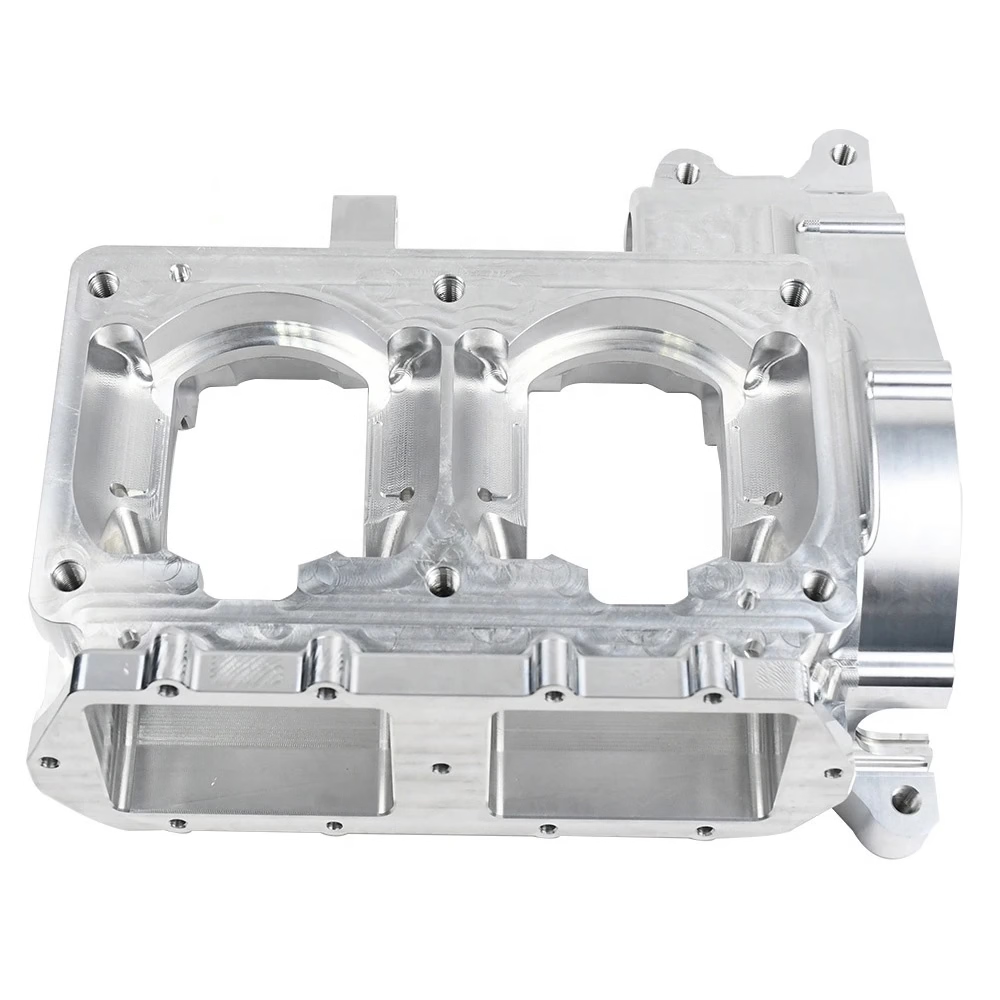
What This Guide Covers
Belarus has a machine-building base that goes back decades. The question for a buyer is narrower: does a given shop hold the tolerance, finish, and documentation your part needs?
What Belarusian Machine Shops Usually Run
The country's CNC base grew out of its machine-tool and tractor plants, so the typical workshop is heavier on milling and turning than on exotic processes. Most run three-axis vertical mills and lathes as core equipment. Five-axis machining centers exist, but they sit in a smaller number of shops, often those tied to aerospace or defense supply chains.
A normal job shop holds ±0.05 mm without much trouble on aluminum and mild steel. Push toward ±0.01 mm and you need a temperature-controlled room, a probe on the machine, and a shop that measures rather than assumes. Ask what metrology equipment sits on the floor: a coordinate measuring machine and a surface roughness tester are the two items that decide whether a tight-tolerance quote is real.
Grinding is common for shafts, bores, and flat faces that need Ra 0.4 μm or better. Wire EDM shows up in tool rooms and die shops, less often as a standalone service. If your part needs mirror finishes, deep pockets in hardened steel, or thin-wall features under 0.5 mm, treat those as questions to raise early, not as defaults.
Materials and Finishes You Can Realistically Source
Aluminum, carbon steel, and stainless steel cover most of the work. 6061 and 2024 aluminum are stocked widely. So are 1045 and 4140 steel, along with 304 and 316 stainless. Titanium and Inconel are available but usually on a project basis, with longer material lead times and higher scrap risk.
Copper and brass are common in electrical and instrument parts. Bronze bushings and bearing housings are a steady line for shops that serve the machinery sector. Plastics such as POM, PA, and PEEK get machined too, though not every shop keeps them on the shelf.
On finishing, anodizing and zinc plating are the two processes you will find most often, either in-house or through a partner plant. Powder coating and black oxide are also routine. Hardcoat anodizing and electroless nickel are less universal; confirm the coating thickness spec before you design a bore tolerance around it.
What you rarely get is a single shop that does machining, heat treatment, coating, and assembly under one roof. Expect to manage two or three vendors, and expect the coating step to add days, not hours, to the schedule.
Process Fit: When a Belarusian Shop Works Well
Use this as a first filter before you request quotes.
| Part type | Typical fit | Watch out for |
|---|---|---|
| Bracket or housing, ±0.05 mm | Strong fit, competitive price | Thin walls under 1 mm |
| Shaft or bushing, ground finish | Strong fit, mature process | Grinding capacity is limited |
| 5-axis contoured part | Possible, fewer shops | Confirm machine and probe |
| Titanium or Inconel part | Possible, project basis | Longer material lead time |
| Hardened steel die insert | Limited, EDM dependent | Fewer shops with wire EDM |
| Prototype, one-off | Workable but slower | Setup cost dominates |
| 10,000+ part run | Depends on the shop | Automation is not universal |
Quality Systems and What They Actually Prove
Many Belarusian shops hold ISO 9001, and a smaller group carries IATF 16949 for automotive work. Those certificates tell you a quality system exists. They do not tell you the shop measures every part, or that the inspection record will reach you with the shipment.
Ask three questions. Which characteristics get inspected on every part versus sampled? What report format comes with the delivery, and can you get a first article inspection report? What happens to a non-conforming lot, and who signs off on the disposition? A shop that answers these in specifics is worth more than one that emails a certificate PDF.
For medical or aerospace work, the bar is different. ISO 13485 and AS9100 are not common in the region. If your part needs full traceability from melt lot to finished surface, plan for a longer qualification and expect to audit the supplier before the first order.
Lead time is the other variable. Quoting is often fast, a few days. Actual production depends on material availability and how full the shop is. Build a buffer into your schedule and confirm the material is on hand before you release the order.
Logistics, Documents, and Payment Terms
Parts usually move by road and rail into the EU, then by air or sea onward. That routing adds transit time and a customs step. Incoterms matter here: DAP is cleaner for the buyer, EXW puts the export paperwork on you. Agree on the term before the quote is final, not after.
Export control is a real filter. Some machine tools and some end-use categories face restrictions. Check whether your part falls under a controlled category before you commit to a supplier, because a shop that cannot legally ship your part is not a cheaper option, it is a stalled order.
Payment terms vary from full prepayment on a first order to partial payment against shipping documents. Start small. One prototype order tests the shop's quoting accuracy, its inspection discipline, and how it handles a drawing question. That is cheaper than learning the same things on a 5,000-part run.
How It Compares to Other Sourcing Routes
The honest comparison is not Belarus versus nowhere. It is Belarus versus China, Eastern Europe, and domestic suppliers. On simple turned and milled parts in aluminum or steel, Chinese shops such as GreatLight in Dongguan often win on price at volume and on lead time, with 127 CNC machines, 16 simultaneous 5-axis centers, and a 4,000 mm maximum processing size. Quotation and DFM analysis come back within 12 hours, and parts ship in 3–5 days.
Eastern European shops inside the EU cut out the customs step and the export-control question, at a higher hourly rate. Domestic suppliers cost the most but give you the shortest feedback loop on a design change.
Pick by part, not by country. A one-off fixture with a tight deadline belongs close to home. A stable, repeatable housing at 5,000 pieces per year belongs where the cycle time and material cost are lowest. Get two or three quotes on the same drawing with the same tolerance callouts, then compare what each shop says it will inspect. That comparison tells you more than any country-level claim.
Common Questions
Can Belarusian shops hold ±0.005 mm?
Some can, on specific features, with the right machine and a controlled environment. It is not a shop-wide default.
Ask for the tolerance per feature, not per part. A drawing that calls ±0.005 mm on a 300 mm length will get quoted differently than one that calls it on a 20 mm bore.
What materials are commonly available?
Aluminum 6061 and 2024, carbon steels such as 1045 and 4140, and stainless 304 and 316 are the routine stock.
Titanium, Inconel, and specialty alloys are available on a project basis with longer material lead times.
How long does a typical order take?
Quoting usually takes a few days. Production timing depends on material availability and shop loading.
Add transit and customs time on top. For a first order, budget extra weeks for supplier qualification.
Do they offer finishing and assembly?
Anodizing, zinc plating, powder coating, and black oxide are common, often through a partner plant.
Full assembly under one roof is less common. Plan on managing the coating step as a separate stage.
Are NDAs and confidentiality standard?
Not universally. Some shops will sign, some will not.
If your drawings are sensitive, settle the NDA before you upload files, and ask where the data is stored and who can access it.
When should I not source there?
Skip it when you need same-week delivery, when the part is export-controlled, or when you need ISO 13485 or AS9100 traceability.
For those cases, a domestic or certified regional supplier is the shorter path, even at a higher rate.
Need a Second Quote to Compare Against?
Send your drawing and get a quotation with free DFM analysis within 12 hours, plus 100% inspection before shipment.
12-hour quote100% inspectionNo minimum order quantityNDA available









