
Alibaba CNC Procurement: A Working Guide for Engineers
This is a step-by-step Alibaba CNC procurement guide for engineers and buyers who need metal and plastic parts from overseas suppliers. Read it and you will know how to screen a shop, what to put in an RFQ, and when to walk away.
In this article
- 1
- 2
- 3
- 4
- 5
- 6
- 7
- 8
- 9
Key takeaways
What Alibaba CNC Procurement Actually Buys You
Alibaba is a directory, not a factory. When you run Alibaba CNC procurement, you are buying access to a supplier list, a messaging channel and a trade-assurance escrow. You are not buying a process capability. That distinction matters, because the platform will happily show you forty shops that all claim ±0.01 mm and none of them have shown you a machine list.
The useful part of the platform is reach. A buyer in Ohio can reach a shop in Dongguan, Ningbo or Shenzhen in one afternoon, compare five quotes and start a conversation without a trade show. For low-volume runs of 10 to 500 parts, that reach is the whole point.
The trap is that listing quality and shop quality are unrelated. A well-photographed storefront tells you someone invested in photography. It does not tell you whether the shop has a coordinate measuring machine, whether it machines titanium at all, or whether the quote came from a trading company that will subcontract your part to a third party.
So treat the first two weeks as a screening exercise, not a shopping exercise. Your goal is not the lowest unit price. Your goal is a short list of three shops where the person answering messages understands your drawing. Everything after that gets easier.
Screen the Shop Before You Talk Price
Start with the business license and the company type. On Alibaba, look for the verified supplier badge, the year established, and whether the entity is listed as a manufacturer or a trading company. A trading company is not automatically bad, but you should know which one you are dealing with, because it changes who controls the process and who answers for a deviation.
Next, ask a technical question that a real machinist cannot dodge. For example: what is your standard tolerance on a 6061-T6 part with a 200 mm length, and how do you hold it? A machine shop will talk about fixturing, thermal growth and whether they rough and finish in two setups. A reseller will reply with a tolerance table copied from a template.
Ask for the machine list. Count the 3-axis, 4-axis and 5-axis centers, and ask for the maximum part envelope. If your part needs a 4,000 mm envelope and the shop tops out at 600 mm, no amount of goodwill will fix that. If you hear about 16 simultaneous 5-axis centers and a Ø400 mm rotary table, you are talking to a shop that can hold contoured geometry in one setup.
Finally, ask who inspects and with what. A shop that names its inspection equipment and offers reports on request is a different risk profile from one that says quality is guaranteed. Write down the answers. You will compare them side by side later.
Write an RFQ That Leaves Nothing to Guess
Most disputes in overseas machining trace back to a drawing that was technically complete on paper but ambiguous in practice. A 3D STEP file defines nominal geometry. It does not define which surfaces are datums, which dimensions are critical, or how a sharp corner should be treated.
Attach both the STEP file and a 2D PDF. The PDF carries the tolerances, the surface finish callouts, the thread specifications and the general notes. If a feature is not toleranced, state the default in the notes, for example general tolerance ±0.1 mm unless otherwise specified. Say it in writing.
Call out the finish on every visible face, not just the cosmetic ones. As-machined is Ra 1.6–3.2 μm. A bead-blasted or anodized face behaves differently and costs differently. If you need Ra 0.8–1.6 μm, say so. If a sealing face needs Ra 0.2–0.8 μm, say that too, and expect the shop to quote a separate finishing operation.
List the material grade with the temper. 6061 and 6061-T6 are not the same purchase. For stainless, 304 and 316L differ in corrosion behavior and machinability. For a part that sees salt spray, the difference between 303 and 316L will decide whether it survives the first winter.
Add the quantity ladder: one prototype, ten units, one hundred, one thousand. Ask for unit price at each step. This tells you how the shop amortizes setup, and it tells you whether they actually want the production order or just the prototype.
Match the Process to the Part Geometry
The single most common mismatch is buying a 5-axis quote for a part that only needs 3-axis work, or the reverse. A prismatic bracket with holes on three orthogonal faces is a 3-axis job plus a fixture. Paying 5-axis rates for it wastes money.
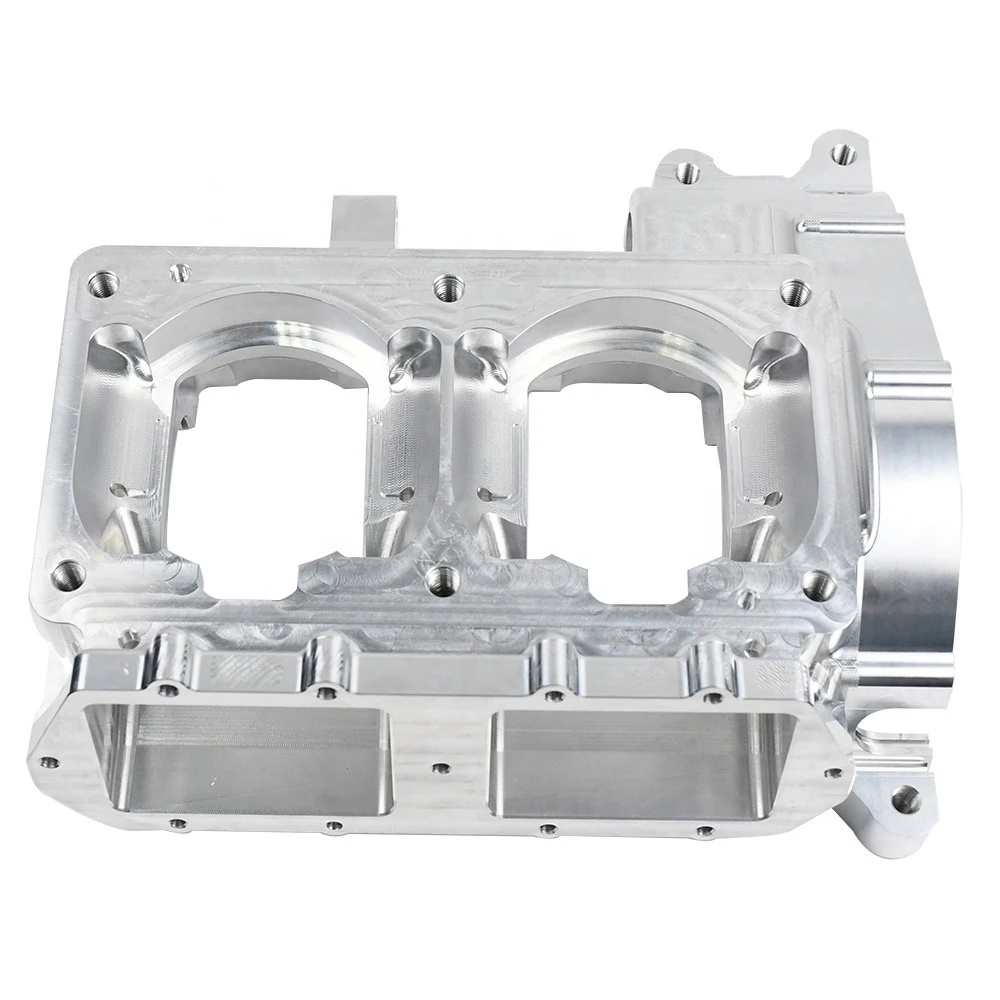
A part with blended surfaces, undercut pockets or features on five faces is the opposite case. Splitting it into three 3-axis setups adds two datum transfers, and each transfer adds stack-up error. One simultaneous 5-axis setup removes that error source entirely. For contoured impellers, turbine housings or organic-shaped enclosures, that is the difference between passing and failing a profile check.
Round parts with cross features, such as a shaft with a milled flat and an off-axis hole, belong on a mill-turn center. Turning and milling in one machine keeps concentricity tight and removes the risk of a second-op misalignment on the diameter.
Material drives machine choice too. Titanium Ti-6Al-4V and Inconel cut slowly and generate heat, so they need rigid setups, coolant strategy and a shop that has cut them before. Aluminum 6061 and 7075 are forgiving. Plastics like POM, PEEK and PC machine cleanly but move with temperature, so light finishing passes and sharp tooling matter more than spindle speed.
Ask the shop which of their machines will run your part, and why. A specific answer tells you they read the drawing. A vague answer tells you they will figure it out after the order lands.
This is also where certification requirements enter the picture. A medical device component may need ISO 13485, an automotive part may need IATF 16949, and a defense-adjacent program may want ISO 27001 for data handling. Ask early, because a shop without the certificate cannot get one in time for your build.
Judge the Quote, Not the Headline Price
When two quotes differ by 40 percent, the gap is rarely profit margin. It is usually one of four things: different machines, different inspection depth, different material source, or a different definition of the part. Ask each shop to break the quote into material, machining, finishing and inspection. A shop that refuses to break it down is telling you something.
Check the lead time against the process, not against your hope. A 5-axis part in titanium with a hardcoat anodize finish has a longer chain than a 3-axis aluminum bracket. If a quote promises the same five days for both, either the shop is guessing or they plan to subcontract the finishing to a third party you have never audited.
Watch for the quote that silently excludes finishing, freight or fixturing. A unit price of a few dollars looks great until you add the custom fixture charge, the anodize minimum, and air freight. Build a landed-cost column in your spreadsheet before you compare anything.
Ask about the sample path. A shop willing to run one prototype before the production order is showing you their process. A shop that pushes you straight to a 1,000-piece order is optimizing for their cash flow, not your risk.
Communication and Confidentiality
Time zones slow everything down. A message sent at the end of your day lands at the start of the shop's day, so a two-round clarification costs two days. Front-load the questions you already know you will have: material certificates, packaging method, marking requirements and who pays for a re-make if a dimension is out.
Ask for the DFM feedback before you place the order. A shop that flags a 0.5 mm wall as risky, or a deep pocket that needs a long-reach tool, is doing the job you are paying them for. A shop that quotes a part that cannot be machined at the stated tolerance is not being careful.
Protect your design. Ask for a non-disclosure agreement before you send a full assembly. Upload files through a channel you control, and ask how the shop stores and deletes them. For regulated industries, data handling is part of supplier qualification, not an afterthought.
Keep one thread of truth. Put every change, every measurement and every promise in a written message or a signed drawing revision. Verbal agreements on a chat platform do not survive a personnel change at either company.
Six Steps to Source a Machined Part
Run these in order. Skipping step 2 is the most expensive shortcut in overseas sourcing.
- 11. Freeze the designExport a STEP file and a dimensioned 2D PDF. Mark critical dimensions, datums and thread callouts. Add a general tolerance note, typically ±0.1 mm, and a finish callout for every functional face.
- 22. Screen ten shops down to threeCheck business license, company type and verification status. Send the same technical question to all ten. Keep the three that answer with specifics about fixturing, tolerance and inspection equipment.
- 33. Send one identical RFQSame drawing, same material grade with temper, same finish, same quantity ladder of 1, 10, 100 and 1,000 units. Ask for a cost breakdown and a lead time per quantity.
- 44. Compare landed costAdd machining, finishing, fixture, packaging, freight and duty into one column. Compare that number, not the unit price shown in the chat window.
- 55. Run a prototypeOrder one to five pieces. Measure them yourself or with a local metrology shop. Check the critical dimensions first, then the finish, then the cosmetic faces. Do not accept a report that skips your tightest tolerance.
- 66. Lock the process before productionSend the measured prototype back as the reference. Confirm the machine, the fixture, the material lot and the inspection plan in writing. Then release the production order, and ask for first-article inspection on the first batch.
Which Process Fits Your Part
Use this to challenge a quote that specifies the wrong machine class.
| Part geometry | Best process | What to watch |
|---|---|---|
| Prismatic bracket, faces on 3 sides | 3-axis mill plus fixture | Extra setups add datum stack-up |
| Contoured housing, features on 5 faces | Simultaneous 5-axis | Fewer setups, higher hourly rate |
| Shaft with milled flat and cross hole | Mill-turn center | Concentricity holds in one setup |
| Thin-wall enclosure in 6061 | 3-axis with light passes | Chatter if the wall is under 1 mm |
| Ti-6Al-4V structural part | 5-axis with rigid fixturing | Heat and tool wear drive cost |
| Large frame up to 4,000 mm | Large-travel gantry or mill | Shipping envelope and freight cost |
| PEEK or POM insulator | 3-axis, sharp tooling | Thermal growth, light finishing pass |
The Short Version
Alibaba CNC procurement works when you screen on capability first and price second, write a drawing that leaves no room for interpretation, and inspect the prototype before you commit to a batch. That sequence is the whole method.
Questions Buyers Ask Next
How do I know if a supplier is a factory or a trading company?
Check the business license and the company type shown on the profile page. Ask for the machine list and the plant address, then ask for a short video walkthrough of the floor. A factory will answer with machines and layout. A trading company will deflect or send a stock marketing clip.
What tolerance can I realistically expect from an overseas machine shop?
For well-fixtured aluminum and stainless work, ±0.005 mm is achievable on critical features, but it is not the default for every dimension. Put the tight tolerance only where the function needs it and let the rest sit at ±0.1 mm. Tightening everything raises cost and inspection time with no benefit.
Should I pay for a prototype before the production order?
Yes, when the part has contoured geometry, a tight tolerance or a cosmetic face. One to five pieces cost far less than a scrapped batch of 500. Measure the prototype on your tightest dimension, not just the overall size, and make it the reference for the production run.
How do I handle surface finish requirements in an RFQ?
Name the finish and the roughness value on each face. As-machined is Ra 1.6–3.2 μm, a finer machined finish is Ra 0.8–1.6 μm, and a sealing or bearing face may need Ra 0.2–0.8 μm. Add the color and thickness for anodize, and note that laser marking needs a minimum character height.
What should trigger a red flag in a quote?
A price far below the others with no cost breakdown. A lead time that ignores the finishing step. A refusal to run a prototype. A quality answer that is a slogan instead of an inspection method. Any one of these is worth a follow-up question. Two of them together is a reason to move on.
Can a supplier sign an NDA before I share files?
A serious supplier can. Ask for the agreement before you send the assembly, and keep the file transfer on a channel you control. Ask how long files are retained and who inside the shop can open them. For regulated products, that answer belongs in your supplier file.
Send the Drawing, Get a Quote in 12 Hours
Upload your STEP and 2D PDF. We return a quotation and a free DFM analysis within 12 hours, with inspection reports on request and an NDA available before you share files.
12-hour quote100% inspectionNo MOQ
More From the Shop Floor
We publish setup notes, tooling trials and inspection data from the factory floor.











