
Beginner's CNC Processing: How a Cutting Program Becomes a Part
This guide is for design engineers and buyers new to CNC processing. It explains what the machine actually does, how G-code and tool paths turn a model into metal or plastic, and which part features point to 3-axis, 4-axis or 5-axis work. After reading it you can tell whether your part suits CNC processing, where tolerances get difficult, and what to send for a quote.
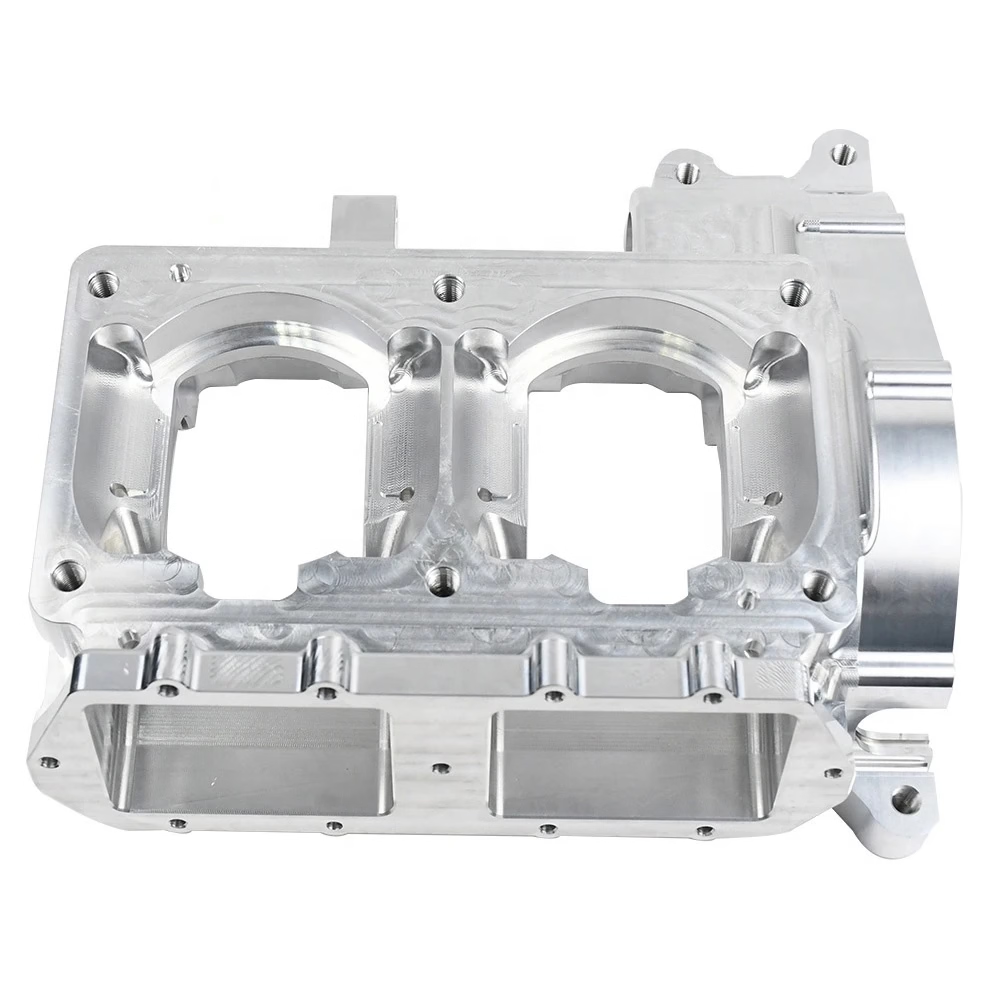
What CNC Processing Actually Is
Subtractive machining controlled by numbers, not by hand wheels.
From CAD Model to G-Code
CNC processing means the cutting tool moves under computer control instead of a hand wheel. You start with a CAD model, a CAM programmer picks tools and cutting passes, and the software posts a text file of coordinates and feed rates. That file is G-code. The machine controller reads it line by line and drives the spindle and axes to match.
The tool never follows the finished surface. It follows an offset path that leaves material for roughing, then removes the rest in semi-finish and finish passes. Stock size matters more than most beginners expect. A block that is 1 mm oversize on all faces costs less to machine than one that is 6 mm oversize, because the machine spends less time in air and less time cutting waste.
G-code is machine-specific. A program posted for one controller may run on another with edits. This is why shops keep a post-processor library and why minor drawing changes do not always mean a full reprogram. For a first order, send STEP or IGES plus a PDF drawing with tolerances and critical dimensions marked.
One more point. CNC processing is subtractive. If your part is a thin shell or has internal channels that a cutter cannot reach, machining may not be the right first process. Ask before you design around it.
3-Axis, 4-Axis or 5-Axis: What Your Part Needs
A 3-axis machine moves X, Y and Z. The tool approaches from one direction, so every feature must be reachable from that direction or from a second setup where the part is flipped. Simple plates, housings, brackets and covers are usually 3-axis work. Two setups are common and cheap.
A 4-axis machine adds rotation about one axis, often a Ø400 mm rotary table. This lets the part turn while the tool cuts, so you can machine around a cylinder or hit several faces without re-fixturing. Shafts with flats, cams, and parts with radial holes fit here.
A 5-axis machine adds two rotary axes that move at the same time as the linear axes. The tool can stay normal to a curved surface, and undercuts become reachable. Impellers, turbine blades, medical implants and complex aerospace brackets are typical. Simultaneous 5-axis also shortens setups, which improves position accuracy between features.
The trade-off is cost per hour and programming time. If a part runs fine on 3 axes, moving it to 5 axes does not make it better. It makes it more expensive. We look at feature direction, undercuts, and how many setups a 3-axis route would need before recommending a machine.
Axis Count vs Typical Part
A rough starting point, not a rule. Fixturing and volume change the answer.
| Machine | Axes in motion | Good fit | Watch out for |
|---|---|---|---|
| 3-axis | X, Y, Z | Plates, covers, brackets, pockets | Undercuts need a second setup |
| 4-axis | X, Y, Z + 1 rotary | Shafts, cams, radial holes | Rotary clearance can limit reach |
| 5-axis indexed | 3 linear + 2 rotary, held | Multi-face parts, fewer setups | Tool length must clear the table |
| 5-axis simultaneous | All 5 moving together | Impellers, blades, curved surfaces | Programming and cycle time cost more |
Choosing a Material for a First Part
Aluminium 6061-T6 is the default for beginners. It cuts fast, holds a good finish, takes anodizing well, and is cheap enough to prototype with. Use 7075 when you need higher strength, and 2024 when fatigue matters. 5052 and 5083 are better for sheet and welded assemblies than for heavy machining.
Stainless 303 machines more freely than 304 or 316, which matters on parts with deep pockets and small tools. 316L and 17-4PH come up in medical and marine work. They cut slower and work-harden if the feed is too light, so the programmer has to keep the tool engaged.
Steels like 1018 and 1045 are common for shafts and fixtures. 4140 and 4340 appear in higher-load parts. Tool steel is usually reserved for molds and dies. Titanium Ti-6Al-4V and Inconel are machinable but slow, and they wear tools quickly, so expect a higher price per part.
Plastics behave differently. POM holds tight tolerances and machines cleanly. PEEK takes heat but costs more. ABS and PC are fine for enclosures and covers. Carbon fibre is abrasive and needs carbide or diamond tooling, and the dust needs control.
Material and Finish Pairing
| Material | Typical use | Common finish |
|---|---|---|
| 6061-T6 aluminium | Housings, brackets, prototypes | Clear or colour anodizing |
| 7075 aluminium | High-strength structural parts | Hardcoat anodizing |
| 303 stainless | Shafts, fittings, small parts | Bead blasting, passivation |
| 316L stainless | Medical, marine, food contact | Electropolish, passivation |
| 1018 / 1045 steel | Shafts, fixtures, tooling | Black oxide, zinc plating |
| POM (Delrin) | Bushings, gears, insulators | As machined, tumbling |
| PEEK | High-temperature, chemical parts | As machined |
Reading Tolerances and Surface Finish
A general tolerance block on a drawing means the shop can use a default range for dimensions not called out. Called-out tolerances are tighter and cost more. A ±0.005 mm callout on a 100 mm aluminium part is achievable, but it is not free. It may require temperature control, a finish pass, and inspection time.
Surface finish is written as Ra, the average roughness in micrometres. As-machined surfaces sit around Ra 1.6–3.2 μm. A normal fine finish is Ra 0.8–1.6 μm. Ra 0.2–0.8 μm needs slower passes, sharper tools, and often a polishing step. Do not call out Ra 0.2 μm on a face that only needs to look clean.
Only tolerance the dimensions that matter. Mark datum faces. If a hole must align with another hole across the part, give a true position callout and let the shop plan the setup. Adding tight tolerances everywhere raises the price without improving function.
Inspection follows the same logic. We check raw material on arrival, monitor during the run, and inspect 100% before shipment. Reports are available on request. If you need first article inspection, say so at quote time so it is built into the plan.
Common Questions
What file format should I send for a first quote?
Send a STEP or IGES file plus a 2D PDF drawing. The 3D model defines geometry, and the drawing defines tolerances, surface finish, and datum references.
If you only have a sketch, we can still review it and flag what is missing before quoting.
How do I know if my part is too complex for CNC processing?
Look at the internal features. If a tool cannot reach a pocket or channel from any direction, the feature may need electrical discharge machining or a different process.
Send the model and we will confirm reachability and suggest a simpler geometry if one exists.
Is there a minimum order quantity?
No. We run from one prototype to 10,000+ part runs. Setup cost is spread over the quantity, so the per-part price drops as volume rises.
For a single unit, expect to pay mostly for programming and setup.
What lead time should a beginner expect?
Quotation and DFM analysis come back within 12 hours. Production can start within 24 hours of approval, and parts usually ship in 3–5 days.
Complex 5-axis parts or special material orders may take longer, and we will say so at quote time.
How are tolerances and finishes checked?
We inspect 100% of parts before shipment and can issue reports on request. Incoming material, in-process dimensions, and final parts are all checked.
If your drawing calls for a specific finish, we verify it against the sample or a roughness gauge.
Can you sign an NDA before I share drawings?
Yes. Uploads are treated as confidential, and an NDA is available on request before any files change hands.
That applies to prototypes and production runs alike.
Send a Model, Get a Quote in 12 Hours
Upload your STEP file and drawing. We will review manufacturability, flag tolerance issues, and return a quote with the axis plan and material recommendation.
12-hour quote100% inspectionNo MOQNDA on request









