
CNC Machining Services Monel: 7 Checks Before You Order
Monel 400 and K-500 are nickel-copper alloys that work-harden fast, pull heat into the cutting zone, and punish any shop that treats them like stainless. This guide is for engineers and buyers who need to pick a supplier, compare quotes on the same basis, and know which parts should not be quoted in Monel at all.
In this article
- 1
- 2
- 3
- 4
- 5
- 6
- 7
Key takeaways
Monel 400 vs K-500 vs 316L for CNC work
Use this table to decide whether the drawing really needs Monel.
| Criterion | Monel 400 | Monel K-500 | 316L stainless |
|---|---|---|---|
| Typical hardness | 150–180 HB | 250–320 HB | 150–190 HB |
| Machinability vs 316L | About 60% | About 40% | Baseline |
| Work hardening | High | Very high | Moderate |
| Best fit | Valves, pump shafts | Pump shafts, fasteners | General corrosion parts |
| Worst fit | Tight thin walls | Long deep pockets | Chloride service |
| Heat at cut edge | Concentrates fast | Concentrates very fast | Spreads wider |
| Tool change interval | Short | Shortest | Longest of the three |
| Cost index | High | Highest | Low |
What Monel does to a CNC machining services Monel quote
Monel is a nickel-copper family, roughly 52–67% nickel with copper making up most of the balance, plus small amounts of iron and manganese. The numbers matter less than the behavior: this alloy keeps its strength at temperature, resists seawater and many acids, and work-hardens quickly once a tool starts rubbing instead of cutting. Those same three traits are what make a CNC machining services Monel quote look expensive next to a 316L quote.
Tool wear is the first cost driver. Monel does not throw long chips. It throws short, hot, abrasive ones that sit on the insert and re-cut. Carbide grades built for nickel alloys hold up better than general-purpose grades, and edge geometry with a positive rake and a reinforced nose keeps the heat in the chip rather than in the part.
Cutting forces are high. A part that would be stable in aluminum may ring in Monel because the tool pushes harder before it shears. On thin walls, the wall moves before the tool does, so the finished thickness drifts. Fixturing and wall thickness have to be settled before the first cut, not after the first out-of-tolerance measurement.
Heat is the third driver. If the coolant does not reach the edge, the surface work-hardens. The next pass then cuts a harder layer and the cycle repeats until the insert fails or the finish turns rough. Flood coolant aimed at the cutting edge, not the part, is the usual fix, and it is a setup decision rather than a parameter tweak.
- 1Ask for the gradeMonel 400 and K-500 quote differently. A supplier who cannot say which one is on the drawing cannot price the job.
- 2Ask for stock conditionK-500 machines best in the annealed state. Age-hardened stock raises tool wear sharply.
Cutting parameters and setups that survive nickel-copper
Speeds sit low. For Monel 400 with carbide, surface speeds in the 20–35 m/min range are a safe starting point, and K-500 usually wants the lower half of that band. Feed per tooth runs 0.05–0.12 mm, higher rather than lower, because a light feed rubs the surface and starts the work-hardening cycle. Depth of cut stays generous during roughing so the tool stays under the hardened skin instead of skating on it.
Entry matters more than the numbers. Ramp or helical entry keeps the cutter engaged and avoids the pause at the bottom of a plunge, which is where most inserts break. Trochoidal paths with 8–12% radial engagement let the tool cool between passes and hold a stable load. Full-width slotting in Monel burns edges fast.
Coolant should be high pressure and directed at the contact point. Through-tool delivery is worth asking about on deep pockets, because external nozzles rarely reach past two diameters of depth. On finishing passes, a small increase in feed and a light depth of cut gives a better surface than a slow, light pass that rubs.
Rigidity decides the outcome. Short tool overhangs, solid holders, and a part that is supported near the cut are not optional in this alloy. When a supplier tells you the setup needs an extra fixture, that is usually a sign they have machined nickel before, not a sign they are padding the quote.
- 1Rough heavy, finish lightKeep the cutter under the work-hardened layer during roughing, then take one clean finishing pass.
- 2Do not dwellAny pause with the tool in contact hardens the surface under the edge.
Tolerance and inspection on a Monel part
Monel moves. Roughing releases residual stress and the part relaxes, so a bore that measures true after roughing may close up after finishing. Shops that hold tight tolerances on nickel alloys either rough, stress-relieve, then finish, or leave enough stock for a semi-finish pass that brings the part back to nominal before the last cut. Ask which route the quote assumes.
±0.005 mm is achievable on stable features such as bores, faces and milled pockets. It is not a blanket promise across a long thin section, a deep slot, or a part with a large unsupported span. In those areas the practical limit is set by deflection, and the honest answer is a wider tolerance or a redesign.
Inspection method has to match the tolerance. A bore held to ±0.005 mm needs a bore gauge or a CMM, not calipers. Surface finish on Monel typically lands between Ra 0.8 μm and Ra 1.6 μm after a controlled finishing pass, and Ra 0.2–0.8 μm is possible with a separate finishing operation and a fresh edge.
Ask for the report before the parts ship, not after. A dimensional report with the measured values, the instrument used, and the datum scheme tells you whether the shop understands the drawing. A certificate with no numbers tells you very little.
- 1Name the featuresTolerance applies per feature. Say which dimensions are critical and which are reference.
- 2State the datumA report measured from a different datum can look wrong while the part is right.
How to compare suppliers quoting Monel parts
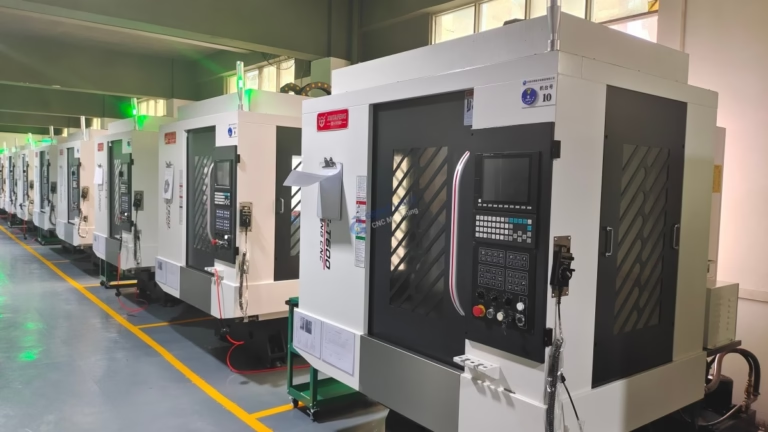
Start with the machine list. Monel parts often need simultaneous 5-axis work for ported bodies and angled holes, or mill-turn for shafts with concentric features. A shop with 16 simultaneous 5-axis machining centers, 16 mill-turn centers and a maximum processing size of 4,000 mm can cover most of this work in one setup, which reduces the number of times a hard part is re-clamped.
Ask how the quote treats the first article. On Monel, the first part usually costs more than the tenth because the parameters get dialed in on the machine. A supplier who quotes a flat per-piece price for a one-off may be guessing, and the guess usually shows up as a schedule slip rather than a higher invoice.
Check the quality system against the industry. Aerospace and marine work is often served by ISO 9001:2015. Automotive and EV programs usually want IATF 16949:2016. Medical device parts sit under ISO 13485:2016, and data handling on defense or IP-sensitive drawings is covered by ISO 27001:2022. Four certificates do not make a shop better at cutting nickel, but they do tell you which paperwork will arrive with the parts.
Confirm the commercial terms in writing. No minimum order quantity matters when you need two prototypes. Quotation and free DFM analysis within 12 hours, production start within 24 hours, and parts shipping in 3–5 days are the numbers to compare against, not the ones a sales email implies. Keep the NDA route open if the drawing is sensitive.
- 1Ask for a DFM noteA supplier who flags wall thickness or radii before quoting is reading the model.
- 2Ask who runs the first partThe programmer and the operator should be the same people from first article to final inspection.
Seven checks before you release the order
Run these in order. Each one can change the price or the supplier.
- 1Confirm the grade and conditionRead the drawing and the material cert. Monel 400, K-500 annealed and K-500 aged are three different jobs with three different tool lives.
- 2Flag thin walls and deep pocketsAnything under 2 mm wall thickness or deeper than four times the tool diameter needs a fixturing plan before quoting, not after.
- 3Set tolerances per featureMark which dimensions need ±0.005 mm and which can hold ±0.05 mm. A drawing that demands tight tolerance everywhere raises cost for no benefit.
- 4Ask for the inspection planName the instrument, the datum and the report format. Bore gauges and CMM for tight features, surface roughness tester for finish calls.
- 5Check the machine matchPorted bodies want 5-axis. Shafts with concentric bores want mill-turn. Confirm the shop has the right spindle for the feature.
- 6Compare lead times on the same basisQuote and DFM within 12 hours, production start within 24 hours, parts ship in 3–5 days. Ask whether that clock starts at PO or at drawing approval.
- 7Settle confidentiality earlyIf the part is export-controlled or patent-pending, sign the NDA before sending the model, not after the first quote.
Monel machining questions buyers ask
Can Monel 400 be machined to ±0.005 mm?
Yes, on stable features such as bores, faces and pockets, provided the shop roughs, lets the part settle, and takes a separate finishing pass. Long thin sections and deep slots are limited by deflection rather than by the machine, so those areas usually need a wider tolerance or a design change.
Ask the supplier to tell you which features can hold the tight call and which cannot. A shop that promises ±0.005 mm across every dimension without looking at the model is quoting a number, not a process.
How is Monel K-500 different from Monel 400 on the shop floor?
K-500 adds aluminum and titanium and is age-hardenable, so it reaches roughly 250–320 HB against 150–180 HB for Monel 400. Tool life drops, cutting speeds drop, and the risk of chipping a cutting edge goes up.
K-500 also distorts more during aging. If the part needs both tight tolerance and full hardness, the sequence has to be rough machine, age, then finish machine, and that sequence belongs in the quote.
Is Monel worth the cost over 316L stainless?
Only when the service medium demands it. Monel resists seawater, hydrofluoric acid and many chloride environments where 316L pits or cracks. If the part runs in fresh water, mild chemicals or dry air, 316L or a duplex grade will usually cost less and machine faster.
Bring the medium, the temperature and the concentration to the conversation. Corrosion resistance is a system property, not an alloy label.
How many Monel parts can a shop run in one order?
From one prototype to 10,000+ part runs, with no minimum order quantity. Prototypes are common because engineers want to test the alloy before committing to a production batch.
Tool wear means the tenth part and the thousandth part are not priced the same way. Ask whether the quote assumes one setup or several, and whether the parameters get locked after the first article.
What surface finish should I expect on a Monel part?
A controlled finishing pass with a fresh edge typically lands between Ra 0.8 μm and Ra 1.6 μm. Ra 0.2–0.8 μm is achievable with a separate finishing operation, but it adds a setup and a tool change.
As-machined surfaces in the Ra 1.6–3.2 μm range are fine for most functional faces. Specify the finish only where it matters, such as sealing faces or sliding bores.
Which certifications should a Monel supplier hold?
ISO 9001:2015 covers general quality management and is the baseline for most industrial work. IATF 16949:2016 applies to automotive and EV programs. ISO 13485:2016 applies to medical devices, and ISO 27001:2022 covers information security for sensitive drawings.
Certificates tell you what paperwork will accompany the parts. They do not replace a DFM review or a first-article inspection on a hard alloy.
Send the Monel drawing and get a real answer
Share the model and the grade, and we will return a quote with free DFM analysis within 12 hours, covering tooling, tolerance and inspection in one document.
12-hour quote100% inspection before shipmentNDA on request
More from the shop floor
We publish setup notes, tooling trials and inspection data from the factory floor.











