
CNC Machining Services Birmingham: A Buyer's Checklist
This guide is for engineers and buyers in Birmingham, Alabama who need machined parts and want to judge a supplier before sending a PO. It covers tolerance floors, lead time claims, MOQ, certifications, and how to read a quote. By the end you will know which questions to ask and which answers are warning signs.
In this article
- 1
- 2
- 3
- 4
- 5
- 6
- 7
Key takeaways
What to compare before you pick a supplier
Use this table to score two or three shops side by side.
| Criterion | What good looks like | Warning sign |
|---|---|---|
| Tolerance | ±0.005 mm on critical features, stated per feature | One blanket tolerance for the whole drawing |
| Quote turnaround | Quote plus DFM feedback within 12 hours | One week of silence, then a price only |
| Minimum order | No MOQ, prototype to 10,000+ parts | 500-piece minimum before quoting |
| Certifications | ISO 9001, plus IATF 16949 or ISO 13485 as needed | Certificates requested but never shown |
| Inspection | 100% inspection before shipment with reports on request | Sample check only, no records |
| Lead time | Production start within 24 hours, parts ship in 3–5 days | Vague 'a few weeks' answer |
| Data handling | Secure uploads and NDA on request | CAD files sent over personal email |
| Finishing | Anodizing, plating, powder coating in house or vetted | Finishing subcontracted with no traceability |
Tolerance, geometry, and what the drawing really asks for
Tolerance is the number buyers fixate on, and it is also the one most often misread. A drawing that says ±0.005 mm in the title block does not mean every face holds that. It means the designer wants that floor where it matters. Before you compare quotes, mark which features are truly critical and which are clearance holes. A shop quoting ±0.005 mm everywhere will either pad the price or quietly relax it later.
Geometry drives the machine choice more than size does. A part with undercuts on five faces, deep pockets at an angle, or a contoured surface needs simultaneous 5-axis work. A shaft with a cross-hole and a thread needs mill-turn, not a 3-axis mill with two setups. If your RFQ goes out without stating these features, you will get quotes for different processes and the prices will not be comparable.
Surface finish is a separate cost line. As-machined finishes land around Ra 1.6–3.2 μm. A sealing face or a bearing bore may need Ra 0.8–1.6 μm, and optical or medical sealing surfaces can go to Ra 0.2–0.8 μm. Each step down usually adds a finishing pass, sometimes a secondary operation. Put the finish callout on the face that needs it, not on the whole part.
Material choice interacts with all three. Aluminum 6061-T6 machines fast and holds tight tolerance well. 17-4PH stainless and Inconel move more under cutting heat, so thin walls and long bores need slower passes and more in-process checks. Titanium TC4 is workable but tool wear is real. If your part is thin-walled in a hard alloy, say so up front. It changes the quote in a way you want to see before, not after.
Capacity checks: machine mix, part size, and volume
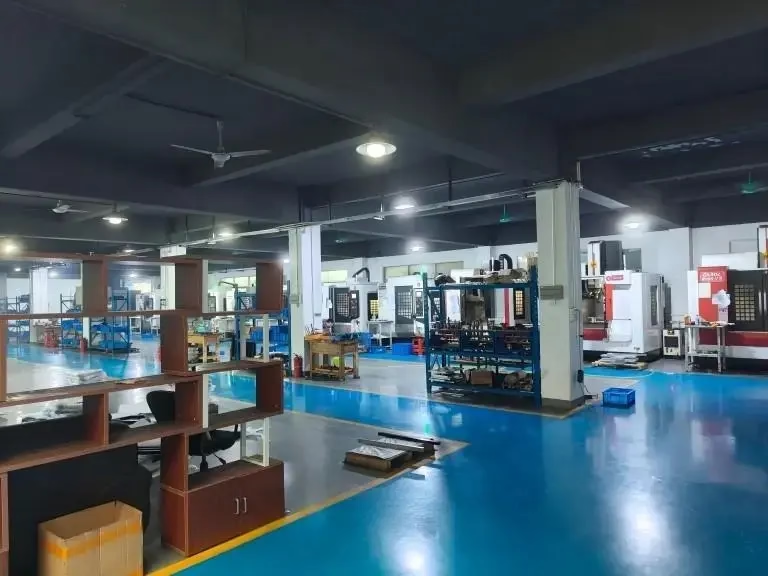
Machine count alone tells you little. What matters is the mix. A shop with 127 high-precision CNC machines might have 16 simultaneous 5-axis centers, 12 four-axis mills, 27 three-axis machines, and 16 mill-turn centers. That spread matters because your part should land on the right machine, not the only one available. Ask which machine will run your job and what the work envelope is.
Size limits are hard boundaries. A 4,000 mm maximum processing size with travels of 4,000 × 400 × 150 mm covers long, slim parts like rails and structural extrusions. Medium travels of 750 × 1,150 × 550 mm and 600 × 600 × 600 mm handle most enclosures and housings. Compact travels of 500 × 500 × 450 mm and 500 × 310 × 200 mm suit small precision parts. A Ø400 mm rotary table adds 4-axis positioning on round work.
Volume is the other axis. A supplier set up for one-off prototypes runs differently from one pushing 10,000-piece batches. You want a shop that does both without changing the process plan. No minimum order quantity means a single prototype and a 10,000-part run go through the same first-article and inspection flow. That consistency is what keeps the tenth batch matching the first.
Fixturing is where low-volume and high-volume quotes diverge. A one-off part may use soft jaws and a vise. A 5,000-piece run justifies a dedicated fixture that cuts cycle time but adds tooling cost. Ask how the fixture is handled in the quote. If the price is the same for one piece and one thousand, someone is not being specific.
Lead time, quoting, and how to read the fine print
Lead time has three parts: quote turnaround, production start, and shipping. These are separate promises and should be quoted separately. A workable benchmark is a quotation and free DFM analysis within 12 hours, production start within 24 hours of PO and material release, and parts shipping in 3–5 days. If a supplier quotes one lump number, ask them to break it apart.
DFM feedback is the most useful thing in a quote and the easiest to skip. Good feedback points at a wall that is too thin for the alloy, a corner radius that forces a smaller tool and longer cycle, or a tolerance that can be relaxed without affecting function. That last one is money back in your pocket. A quote with no engineering notes is a price, not advice.
Read the exclusions. Does the price include material certification, first-article inspection, finishing, and packing? Are tolerances listed per feature or as a blanket? Is the quote valid for 30 days or 90? Material prices move, so a short validity window is normal. What is not normal is a quote that hides finishing or inspection as later add-ons.
Track record matters more than a promised date. Ask what share of past orders shipped late. A supplier that measures this and reports a figure below 2% is managing the schedule, not hoping. If nobody has ever measured it, the date on the quote is a guess.
Certifications, inspection, and data security
Certifications are a filter, not a ranking. ISO 9001:2015 is the baseline quality system. For automotive and EV parts, IATF 16949:2016 is what your customer's quality team will look for. For medical devices, ISO 13485:2016. For handling sensitive drawings and customer data, ISO 27001:2022 covers the information side. Ask to see the certificate scope, not just the logo.
Inspection should be built into the process, not bolted on at the end. A sound flow is raw material check on arrival, in-process monitoring at defined intervals, and final inspection before shipment. 100% inspection before shipment is a reasonable bar for machined parts. Ask what is measured, with what instrument, and whether reports come with the shipment or only on request.
A qualification rate is only meaningful if the defect definition is clear. A 99.99% figure needs to state whether it counts cosmetic rejects, dimensional rejects, or both. Ask for the definition. If the supplier cannot define a reject, the number is decoration.
Confidentiality is a practical concern, not a legal formality. Your CAD files carry your product. Secure uploads and an NDA on request should be standard. If a shop asks you to email STEP files to a personal address or share a drive link with no access control, walk away. That is not about trust. It is about process.
How to run the supplier evaluation, step by step
Work through these in order. Each step produces something you can compare.
- 1Mark critical features on the drawingFlag every feature that needs ±0.005 mm, a specific surface finish, or a tight datum. Send the marked drawing, not just the STEP file. This is what makes quotes comparable.
- 2State the process you expectSay whether the part needs 5-axis, mill-turn, or 3-axis work, and why. If you are unsure, ask the supplier to propose a process and explain the setup count.
- 3Request a quote with DFM notesAsk for price, lead time, and engineering feedback in one response. A 12-hour turnaround on all three tells you the shop has an estimating process.
- 4Check the machine and envelopeConfirm which machine will run the job and that your part fits the travels. For long parts, verify the 4,000 mm capacity and the Ø400 mm rotary table if 4-axis positioning is needed.
- 5Confirm inspection and reportsAgree on what gets measured, the instrument, and the report format before the first run. Ask for raw material certs and a first-article report if the part is critical.
- 6Verify certifications and NDARequest certificate scope for ISO 9001 and any industry-specific standard. Sign an NDA before sending production drawings if the design is sensitive.
- 7Run a small first orderStart with one to five pieces to check tolerance, finish, and paperwork. No MOQ means this is normal. Inspect against the marked drawing, not a general impression.
- 8Scale only after the first article passesOnce the first article is approved, move to the larger batch. Keep the same process plan and fixture so the tenth piece matches the first.
Questions buyers ask before the first PO
What tolerance can I actually expect on a machined part?
For well-supported features in aluminum or stainless, ±0.005 mm is achievable on critical dimensions when the setup and tooling are right. That figure applies per feature, not to every surface on the drawing.
Thin walls, deep bores, and hard alloys like Inconel or Ti-6Al-4V will widen the practical band unless you accept slower passes and more in-process checks. Tell the supplier which features are critical so the process plan spends its accuracy where it counts.
Is there a minimum order quantity for a prototype?
A shop set up for both prototyping and production should not impose one. Running from a single prototype to a 10,000+ part run through the same first-article and inspection flow is the practical test.
If a supplier insists on a high minimum before quoting, they are optimized for volume and your prototype will be treated as an exception.
How fast can parts ship after I place an order?
A realistic sequence is quotation and free DFM analysis within 12 hours, production start within 24 hours of PO and material release, and parts shipping in 3–5 days.
This assumes material is in stock and the drawing is final. Any change to the design after production starts resets the clock, so freeze the revision before the PO goes out.
Which certifications should I ask to see?
ISO 9001:2015 is the baseline for any machining supplier. Automotive and EV work usually calls for IATF 16949:2016. Medical device parts need ISO 13485:2016.
If your drawings or customer data are sensitive, ISO 27001:2022 covers information security. Ask for the certificate scope, not just the certificate number.
How do I compare two quotes when the prices differ?
Put both quotes against the same marked drawing and check what is included: material certs, first-article inspection, finishing, packing, and freight. A lower price often excludes finishing or inspection.
Also compare lead time breakdown, quote validity, and whether DFM feedback was provided. The cheaper quote may be cheaper because it assumed a looser tolerance than you need.
What should I check on the first article?
Measure the critical features you marked, not just the overall dimensions. Check surface finish on the faces that have a callout, and confirm the material grade against the cert.
Review the inspection report format at the same time. If it does not match what you agreed, fix it now rather than at batch 5,000.
Send your drawing and get a quote with DFM notes
Upload your CAD files and we will return a price, lead time, and engineering feedback. No minimum order quantity, from one prototype to 10,000+ parts.
12-hour quoteNo MOQ100% inspectionNDA on request
More from the shop floor
We publish setup notes, tooling trials and inspection data from the factory floor.











