
CNC Machining Service Wholesale in China
This guide is for engineers and sourcing managers who buy machined parts in volume from China. It covers the checks that decide whether a supplier can hold a drawng on 5,000 parts, not just on the first sample.
In this article
- 1
- 2
- 3
- 4
- 5
- 6
- 7
- 8
What matters before you place a volume order
Judging a wholesale CNC supplier: what good looks like
Use these columns as a checklist when comparing two or three quotes side by side.
| Criterion | Weak signal | Strong signal |
|---|---|---|
| Tolerance capability | Quote says ±0.05 mm as standard | States ±0.005 mm with the machine class that holds it |
| Order size | MOQ of several hundred pieces | No MOQ, from 1 prototype to 10,000+ parts |
| Certifications | ISO 9001 mentioned only in sales text | ISO 9001, IATF 16949, ISO 13485, ISO 27001 on file |
| Quote turnaround | A price with no drawing feedback | Price plus DFM notes within 12 hours |
| Lead time | Vague 'depends on quantity' answer | Parts ship in 3–5 days after drawing release |
| Inspection | Final check only | Raw material, in-process and final inspection |
| Finishing | Outsourced and unmanaged | Anodizing, plating, coating and marking coordinated in house |
| Confidentiality | No NDA process | NDA on request, secure uploads, ISO 27001 controls |
Pick the supplier that can prove the second shipment
Use tolerance, certification, inspection plan and repeatability data as your filters. Price is the last column, not the first.
What CNC machining service wholesale in China actually covers
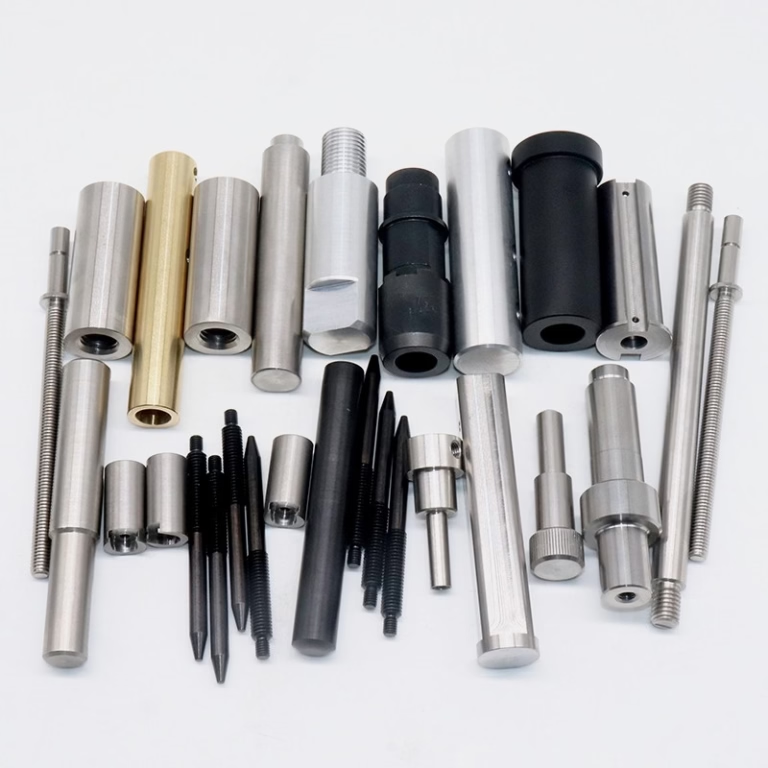
Wholesale CNC machining is a production arrangement, not a product category. You send one set of drawings, the shop machines a batch, and the unit price drops because setup, programming and fixturing are spread across the whole order. The parts themselves are the same whether you buy one or ten thousand.
In China this model grew around export manufacturing. A Dongguan shop can mill, turn, drill and finish under one roof, then ship to an OEM in Europe or North America. That reduces the number of suppliers you manage and removes the finger-pointing that happens when three vendors each blame the others for a dimensional failure.
Volume is what separates wholesale from job-shop work. A shop that runs the same aluminum housing 500 times learns where the tool wears, which fixture holds best, and how the material moves after heat treatment. That knowledge shows up as a tighter distribution of measured sizes, not as a lower headline tolerance on a website.
- 1One drawing, many processesMilling, turning, EDM and surface finishing can stay inside one quality system.
- 2Unit cost falls with setup sharingProgramming and fixturing are paid once, then divided across the run.
- 3Repeatability is the deliverableThe part you receive in month six should measure like the part from month one.
Matching part geometry to machine class
Not every part needs a 5-axis center, and paying for one on a simple bracket wastes money. The useful question is how many setups the part needs and how tightly the features relate to each other. A part with bores on four faces and a true position callout of ±0.02 mm is a 5-axis job. A flat plate with through holes is a 3-axis job.
GreatLight runs 127 high-precision CNC machines: 16 simultaneous 5-axis machining centers, 12 four-axis mills, 27 three-axis machines and 16 mill-turn centers. Maximum processing size reaches 4,000 mm, with travels of 4,000 × 400 × 150 mm on the large frame and 750 × 1,150 × 550 mm or 600 × 600 × 600 mm on the medium frames. Compact work runs on 500 × 500 × 450 mm and 500 × 310 × 200 mm machines.
Turning parts with milled flats are a common trap. If you split them between a lathe and a mill, the second setup introduces a new datum and the concentricity drifts. A mill-turn center cuts both in one cycle, which removes that error source entirely. With a Ø400 mm rotary table, larger round parts can also be indexed without re-chucking.
Choose the machine class by feature relationship, not by part size alone. A small part with angled ports can be harder than a large plate.
- 13-axisPrismatic parts, one face, holes and pockets in a single plane.
- 24-axisRound or indexed parts needing features on multiple sides, still with one main axis.
- 35-axisComplex contours, deep cavities, angled faces and tight true position between faces.
- 4Mill-turnShafts and housings that need turning and milling with no re-chuck.
Reading tolerance and surface finish claims correctly
A tolerance on a website is a capability statement, not a promise for your part. ±0.005 mm is achievable on a well-fixtured aluminum part in a temperature-stable shop. It is not achievable on a thin-wall titanium bracket that deflects under clamping pressure. Ask which features the shop expects to hold and which it would relax.
Surface finish works the same way. Ra 0.2–0.8 μm usually means a finishing pass or a secondary operation. Ra 0.8–1.6 μm is a normal machined finish on most metals. Ra 1.6–3.2 μm is as-machined and fine for brackets, covers and internal parts. Specifying a finer finish than the function needs adds cost and cycle time with no benefit.
Bore tolerance and surface finish interact. A reamed hole can hold a tight diameter but leaves a different finish than a bored hole. If a seal or bearing sits in that bore, state both the diameter range and the Ra value, and say which one is critical. That single note prevents a lot of back-and-forth.
GreatLight inspects 100% of parts before shipment, with raw material checks, in-process monitoring and final inspection. Reports are available on request. A qualification rate of 99.99% is only meaningful when the inspection plan behind it is defined, so ask to see the plan.
When certifications change the supplier shortlist
Certification matters most when your customer audits your supply chain. If you build automotive parts, IATF 16949:2016 is usually a hard requirement, not a preference. For medical devices, ISO 13485:2016 governs how the supplier controls processes and records. ISO 9001:2015 is the baseline for general industrial work.
ISO 27001:2022 is different from the others. It covers information security, not part quality. It matters when your drawings, CAD models and revision history are commercially sensitive. A supplier with these controls in place can sign an NDA and show how files are stored, accessed and deleted.
GreatLight holds ISO 9001:2015, IATF 16949:2016, ISO 13485:2016 and ISO 27001:2022. Uploads are treated as secure and confidential, and an NDA is available on request. For regulated programs, ask for the certificate scope and expiry date, not just the certificate number.
Certification does not replace process control. A certified shop with a worn fixture still ships bad parts.
MOQ, lead time and how quotes are built
MOQ is the first commercial filter. Some shops refuse runs under 500 pieces because setup dominates the cost. GreatLight has no minimum order quantity, so a single prototype and a 10,000+ part run sit in the same workflow. That matters when you need a pre-production sample before committing to tooling.
Lead time should be broken into stages. At GreatLight, quotation and free DFM analysis come back within 12 hours, production can start within 24 hours, and parts ship in 3–5 days. The historical late-delivery probability is below 2%. Ask any supplier to separate quote time, material lead time and machining time, because a single number hides where the delay will happen.
Quote structure tells you what the shop thinks about your part. A price with no comments is a price. A price with DFM notes on wall thickness, tool access or tolerance stack-up is engineering input. The second is worth more on a volume order, where a small design change can remove a secondary operation.
Material choice drives both. Aluminum 6061-T6 machines fast and takes anodizing well. 7075 is stronger but costs more and can be harder to finish. Stainless 316L and 17-4PH are common in medical and marine work. Titanium TC4 (Ti-6Al-4V) and Inconel cut slowly, so budget more cycle time per part.
Step by step: qualifying a wholesale supplier
Run these steps in order. Skipping step 3 is the most common reason a volume order goes wrong.
- 1Send a complete drawing packageInclude 2D drawings with GD&T, 3D STEP files, material spec, finish spec and annual volume. Missing datum callouts force the shop to guess.
- 2Ask for a DFM review with the quoteLook for comments on thin walls, tool reach, tolerance stack-up and any feature that would need a special cutter. Free DFM analysis within 12 hours is the benchmark.
- 3Order a pre-production sampleMeasure the sample against the drawing and check the surface finish. Confirm the fixture and process will carry over to the production run.
- 4Agree on the inspection planDefine which dimensions are checked, at what frequency, and what report format you receive. Raw material, in-process and final inspection should all be named.
- 5Confirm the finishing chainAnodizing, plating, powder coating and laser marking should be scheduled, not left open. Marking has a minimum character height of 1.5 mm.
- 6Set up confidentiality and revision controlSign an NDA if drawings are sensitive. Agree how engineering changes are numbered and who approves them before a new batch starts.
- 7Run a first article and review dataCompare measured values with the drawing, not with the CAD model. Approve the process only after the data matches.
- 8Track the first repeat orderThe second shipment is the real test. Compare key dimensions and finish against the approved first article.
Questions buyers ask before ordering
Is there a minimum order quantity for wholesale CNC machining?
At GreatLight there is no minimum order quantity. The same process handles one prototype and a 10,000+ part run.
That does not make small orders free. Setup, programming and fixturing are still paid once per part number, so unit cost falls as quantity rises.
How tight a tolerance can a Chinese CNC shop hold on a production run?
GreatLight machines to ±0.005 mm (±0.0002 in) on suitable parts. The limit depends on geometry, material and fixturing, not on the shop alone.
Thin walls, long unsupported features and hard alloys reduce what any shop can hold. Send the drawing and the shop should tell you which features are realistic.
Which certifications should I require?
ISO 9001:2015 is the baseline for industrial work. Automotive programs usually require IATF 16949:2016. Medical work requires ISO 13485:2016.
ISO 27001:2022 covers information security and is relevant when your drawings must stay confidential.
What materials are available for volume production?
Aluminum grades include 6061, 6061-T6, 2024, 5052, 5083, 6063, 6082, 7075 and ADC12. Stainless options include 303, 304, 316, 316L, 420, 430, 431, 440C and 17-4PH.
Steel, copper and brass, titanium TA1, TA2 and TC4, Inconel, magnesium and engineering plastics such as POM, PEEK and PC are also machined regularly.
How long does a wholesale order take?
Quotation and free DFM analysis are returned within 12 hours. Production can start within 24 hours, and parts ship in 3–5 days.
The historical late-delivery probability is below 2%. For large runs, confirm the schedule in stages rather than as a single date.
How are surface finishes and marking handled?
Anodizing, electroless nickel, zinc, silver and gold plating, powder coating, black oxide, bead blasting, tumbling, brushing and polishing are all available.
Laser marking and engraving are supported with a minimum character height of 1.5 mm. Specify the finish and marking on the drawing to avoid rework.
Send your drawings and get a quote with DFM notes
Quotation and free DFM analysis within 12 hours. No minimum order quantity, from one prototype to 10,000+ parts.
12-hour quoteNo MOQ100% inspectionNDA on request
More from GreatLight
We publish setup notes, tooling trials and inspection data from the factory floor.











