
CNC Machining Service Ohio: How to Vet a Supplier
Ohio shops quote fast, but engineers still get burned on late parts, vague tolerances, and surprise rework bills. This guide gives you the checks that separate a real partner from a broker with a website. Read it before you send that RFQ for EV brackets, aerospace housings, or surgical instruments.
In this article
- 1
- 2
- 3
- 4
- 5
- 6
- 7
- 8
Key takeaways
What to check before you award a PO
Use the left column as your RFQ checklist. The middle and right columns show what a weak answer looks like versus what a shop that runs the parts can actually put in writing.
| Check | Weak answer | What to look for |
|---|---|---|
| Tolerance | "We hold tight tolerances" | A number: ±0.005 mm (±0.0002 in) on the drawing |
| Lead time | "Depends on the schedule" | Quote in 12 hours, ship in 3–5 days |
| MOQ | "Tooling minimum applies" | No MOQ, from one prototype to 10,000+ parts |
| Certifications | "We are ISO compliant" | ISO 9001, IATF 16949, ISO 13485, ISO 27001 |
| Inspection | "We check the parts" | 100% inspection before shipment, reports on request |
| Finishing | "We can do finishing" | Anodizing, plating, powder coat, laser marking in house |
| Confidentiality | "Your files are safe" | Secure uploads, NDA available on request |
| Quote detail | One number, no notes | Material, finish, DFM notes, and tolerance callouts |
The short version
If your part needs ±0.005 mm, a real inspection report, and a ship window measured in days, put the seven checks above into your RFQ. The answers will separate a supplier who machines parts from one who forwards them.
Tolerance and the geometry behind it
Tolerance is where most Ohio sourcing decisions go wrong. A supplier who says "precision machining" without a number is telling you nothing. Ask what they hold on a 100 mm aluminum bracket with a bored bore and a flat mounting face. The answer should come back as a figure with a measurement method attached. GreatLight works to ±0.005 mm (±0.0002 in) on qualified features, with 100% inspection before shipment.
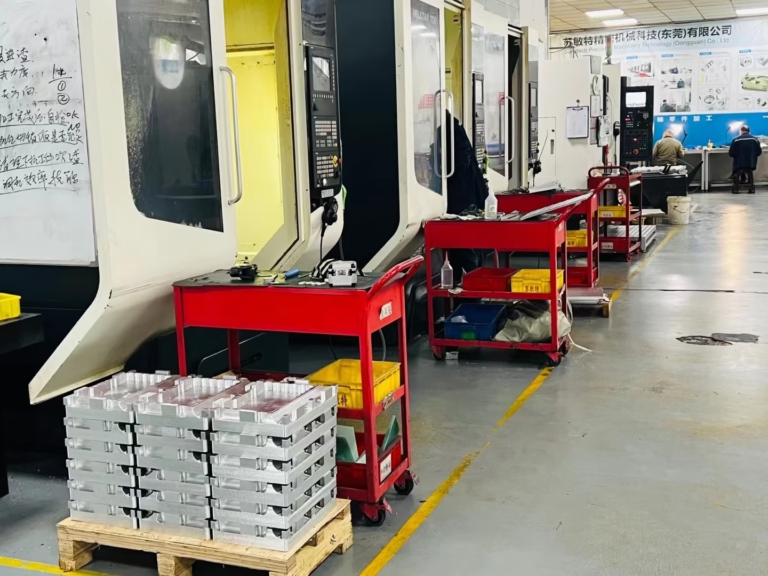
Geometry matters as much as the number. A part with deep pockets, thin walls, or five angled faces needs simultaneous 5-axis work to avoid multiple setups. Every extra setup adds stack-up error and hours. GreatLight runs 16 simultaneous 5-axis machining centers, 12 four-axis mills, 27 three-axis machines, and 16 mill-turn centers. That mix lets us pick the machine by feature, not by what happens to be free.
Size decides which machine you land on. The largest travel is 4,000 × 400 × 150 mm for long parts like rails and frames. Medium work sits in the 750 × 1,150 × 550 mm and 600 × 600 × 600 mm envelopes. Compact parts run on 500 × 500 × 450 mm and 500 × 310 × 200 mm tables, with a Ø400 mm rotary table for round work. If your part does not fit any of those, you need a different conversation.
Surface finish is the second half of the tolerance story. As-machined faces land at Ra 1.6–3.2 μm. A high-finish callout gets you Ra 0.8–1.6 μm. Sealing faces and bearing bores often need Ra 0.2–0.8 μm, which usually means a finishing pass or a secondary operation. Put the Ra value on the drawing. Vague finish notes come back vague.
- 1Put a number on it±0.005 mm with a stated inspection method.
- 2Count the setupsMore setups means more stack-up error.
- 3Match machine to feature5-axis for angled faces, mill-turn for round parts.
- 4Specify RaRa 0.8–1.6 μm for most sealing surfaces.
Lead time, capacity, and what actually ships
Ohio buyers often assume a local shop is faster. Sometimes it is. But a shop with a full schedule and four machines will quote you a six-week window and mean it. Capacity is the real variable. GreatLight runs 127 high-precision CNC machines across 3 wholly-owned plants covering 7,600 m², with 150 technicians. That footprint is what makes a 12-hour quotation and free DFM analysis realistic instead of aspirational.
The timeline to ask about has three parts. First, how fast does a quote come back, and does it include DFM feedback? Second, how soon can chips fly after you approve? Third, what is the ship window for the finished lot? GreatLight quotes within 12 hours, can start production within 24 hours of approval, and ships parts in 3–5 days. Historical late-delivery probability sits below 2%.
Do not confuse shipping speed with production speed. A supplier can ship overnight from a warehouse and still be three weeks late on the machining. Ask when the first article comes off the machine, not when the box leaves the dock. For a new part, the first article is the moment you learn whether the process is under control.
Rush work has a cost. Adding a hot job to a loaded schedule means someone else's parts move back, or the shop runs overtime. Both are fine if the shop tells you upfront. What you want to avoid is a supplier who accepts every rush job and then misses all of them. Ask how they schedule hot work and what happens to normal jobs when one lands.
- 1Ask for three datesQuote date, production start, ship window.
- 2First article timingWhen does the first good part come off the machine?
- 3Rush policyWho moves back when a hot job lands?
MOQ, materials, and the prototype-to-production gap
Minimum order quantity is a quiet filter. Shops that only run production will not touch a one-off prototype, or they will price it so high you walk away. Shops that only do prototypes struggle when you scale. A partner who runs both is worth more than a lower unit price. GreatLight has no minimum order quantity and runs from one prototype to 10,000+ part runs on the same floor.
Material availability decides whether your quote is real. Aluminum covers 6061, 6061-T6, 2024, 5052, 5083, 6063, 6082, 7075, and ADC12. Stainless includes 303, 304, 316, 316L, 420, 430, 431, 440C, and 17-4PH (SUS630). Steel runs 1018, 1045, 4130, 4140, 4340, A36, and tool steel. Copper and brass cover C101, C103, C110, beryllium copper, C27400, C28000, and C36000.
Titanium and special alloys are where supplier lists get short. TA1, TA2, TC4 (Ti-6Al-4V), Inconel, and magnesium AZ31B or AZ91D are all machinable, but each one changes speeds, feeds, and tooling. If a supplier quotes titanium at aluminum prices, they have not quoted it. Plastics run ABS, PC, PMMA, POM, PA, PEEK, PP, HDPE, and carbon fibre, each with its own chip behavior and clamping limits.
The prototype-to-production gap is where costs hide. A process that works for one part may not repeat at 500. Ask what changes between the two: fixture design, in-process gauging, cycle time, and whether the shop keeps the same machine and setup. Switching machines between prototype and production resets every tolerance you validated.
- 1One-off to 10,000+Same floor, same process, no re-qualification.
- 2Match alloy to drawingConfirm the exact grade, not just the family.
- 3Titanium changes everythingSpeeds, feeds, and tooling are not aluminum.
- 4Repeatability checkWhat changes between prototype and 500 parts?
Certifications, inspection, and paperwork you can hand to a customer
Certifications are not decoration. Each one answers a different question. ISO 9001:2015 covers a working quality management system. IATF 16949:2016 covers automotive and EV supply chains and is what a Tier 1 will ask for. ISO 13485:2016 covers medical device manufacturing. ISO 27001:2022 covers information security, which matters when you send CAD files that contain a product nobody has seen yet.
Inspection is the part of the process you never see unless something goes wrong. GreatLight inspects 100% of parts before shipment, with raw material checks, in-process monitoring, and final inspection. Reports are available on request. Ask what happens when a dimension drifts mid-run: does the operator stop, does a programmer adjust the offset, and who signs off on the rework plan?
Qualification rate is the honest metric for a shop that runs complex parts. GreatLight reports a 99.99% qualification rate. That number is only meaningful if you know what counts as a failure and how rework is handled. Ask whether the rate covers first-article approval, in-process scrap, or final inspection only. The definition changes the number.
For Ohio buyers in aerospace, medical, and EV, the paperwork trail often matters more than the part itself. Your customer wants a certificate of conformance, material certs, and inspection data. Ask to see a sample report before you place the order. If the shop cannot show you one, they will not produce one on time when you need it.
- 1ISO 9001:2015Baseline quality system.
- 2IATF 16949:2016Automotive and EV supply chain.
- 3ISO 13485:2016Medical device manufacturing.
- 4ISO 27001:2022Information security for your files.
Finishing, secondary operations, and freight
Finishing is the most common source of schedule slip. A machined part that needs anodizing, plating, or powder coating leaves the machine shop and enters another queue. If your supplier outsources finishing, you have no visibility into that queue. GreatLight handles anodizing (clear, colour, hardcoat, conductive), electroless nickel, zinc, silver and gold plating, powder coating, black oxide, bead blasting, tumbling, brushing, and polishing in the same process chain.
Laser marking and engraving are worth a separate callout. Part numbers, lot codes, and traceability marks often need a minimum character height of 1.5 mm to stay legible after finishing. If your drawing calls for a 0.8 mm code on a bead-blasted surface, expect bleed and rejects. Tell the supplier where the mark lands and whether it is applied before or after coating.
Freight from Asia to Ohio is a planning item, not a surprise. Air freight moves fast and costs more. Ocean freight takes longer and suits larger, heavier lots. A supplier who can quote both and tell you the trade-off is easier to work with than one who only offers one option. Ask what Incoterms they quote and who handles customs.
Packaging matters for machined surfaces. A finished part with a Ra 0.2 μm sealing face will arrive scratched if it is bulk-packed. Specify individual wrapping, compartment boxes, or foam for critical faces. The cost is small. The cost of a damaged shipment is a full re-machining cycle and a missed build date.
- 1In-house finishingFewer handoffs, fewer schedule surprises.
- 2Laser mark placementMinimum character height 1.5 mm.
- 3Freight optionsAsk for both air and ocean trade-offs.
- 4Packaging specProtect finished faces in transit.
How to run the supplier check in 7 steps
Work through these in order. Each step either removes a supplier or gives you a document you can compare against the next quote.
- 1Send a drawing with real calloutsInclude material grade, tolerance, Ra values, finish type, and mark location. A STEP file alone does not define the part. Redline what is critical and what is cosmetic.
- 2Ask for a tolerance statementRequire a number and a measurement method. ±0.005 mm is a working figure; "tight" is not. Ask which features they consider standard versus requiring a finishing pass.
- 3Request DFM feedback with the quoteA 12-hour quote with DFM notes tells you an engineer read the file. Look for suggestions on wall thickness, tool reach, and tolerances that cost more than they are worth.
- 4Confirm MOQ and the prototype pathAsk whether the first article is produced on the same machine and fixture as the production run. If not, ask what re-qualification is required before full release.
- 5Check certifications against your industryISO 9001 for general work. IATF 16949 for automotive and EV. ISO 13485 for medical. ISO 27001 when the files are sensitive. Request the certificate scope, not just the logo.
- 6Agree on the inspection report formatAsk for a sample report before the order. Confirm which dimensions are measured, at what frequency, and what data ships with the lot.
- 7Lock the finishing and freight planName the finish, the mark height, the packaging method, and the Incoterms. Confirm who handles customs and what happens if a shipment is held.
Questions Ohio buyers ask before the first order
How do we send CAD files safely to a supplier in Asia?
Uploads are handled through a secure channel, and an NDA is available on request before you send anything. GreatLight holds ISO 27001:2022 for information security, which covers how design data is stored and accessed.
If your program has stricter rules, send a simplified model first for quoting, then release the full definition after the NDA is signed. That keeps your geometry protected through the pricing stage.
What is the smallest and largest part you can machine?
The largest travel is 4,000 × 400 × 150 mm, which covers long rails and frame sections. Medium parts run in the 750 × 1,150 × 550 mm and 600 × 600 × 600 mm envelopes. Compact parts use 500 × 500 × 450 mm and 500 × 310 × 200 mm tables, with a Ø400 mm rotary table for round features.
If your part sits outside those envelopes, tell us the dimensions in the RFQ and we will say whether it fits before you spend time on a full quote.
Do you charge for DFM analysis or prototypes?
Quotation and DFM analysis come back within 12 hours at no charge. There is no minimum order quantity, so a single prototype is quoted on the same basis as a production run.
Prototype pricing reflects the setup and programming time that a 10,000-part run spreads across each unit. That is normal. What you want to confirm is whether the prototype and production parts come off the same machine and fixture.
Which materials are hard to source on short notice?
Titanium grades such as TA1, TA2, and TC4 (Ti-6Al-4V), Inconel, and magnesium AZ31B or AZ91D take longer to source than aluminum or stainless. They also machine differently, so the quote should reflect the actual cutting parameters rather than a standard rate.
Aluminum and stainless grades such as 6061, 7075, 303, 304, 316L, and 17-4PH are routinely available. Put the exact grade on the drawing. Substituting a similar alloy changes strength and corrosion behavior.
How is a late shipment handled?
Historical late-delivery probability is below 2%. When a delay risk appears, the useful thing is an early call with a revised date, not silence. Ask any supplier how they notify you and who owns the escalation.
For critical builds, split the order into two shipments so the first articles reach your line while the balance is still in production. That protects your assembly schedule without paying for a full air freight shipment.
Can you handle finishing and assembly, or just machining?
The process chain covers anodizing, electroless nickel, zinc, silver and gold plating, powder coating, black oxide, bead blasting, tumbling, brushing, polishing, and laser marking with a minimum character height of 1.5 mm. Related services include 5-axis, 4-axis, and 3-axis machining, CNC milling and turning, rapid prototyping, sheet metal fabrication, 3D printing, die casting, and vacuum casting.
Keeping finishing in the same chain removes the handoff where most schedule slips happen. Ask for the finish callout in writing on the quote so there is no ambiguity at inspection.
Send a drawing, get a quote in 12 hours
Upload your STEP file and drawing. We return pricing, DFM notes, and a lead time you can plan around.
12-hour quoteNo MOQ100% inspectionNDA on request
More from the shop floor
We publish setup notes, tooling trials and inspection data from the factory floor.











